


|
Obteniendo su trinidad de audio jugador listo...
|
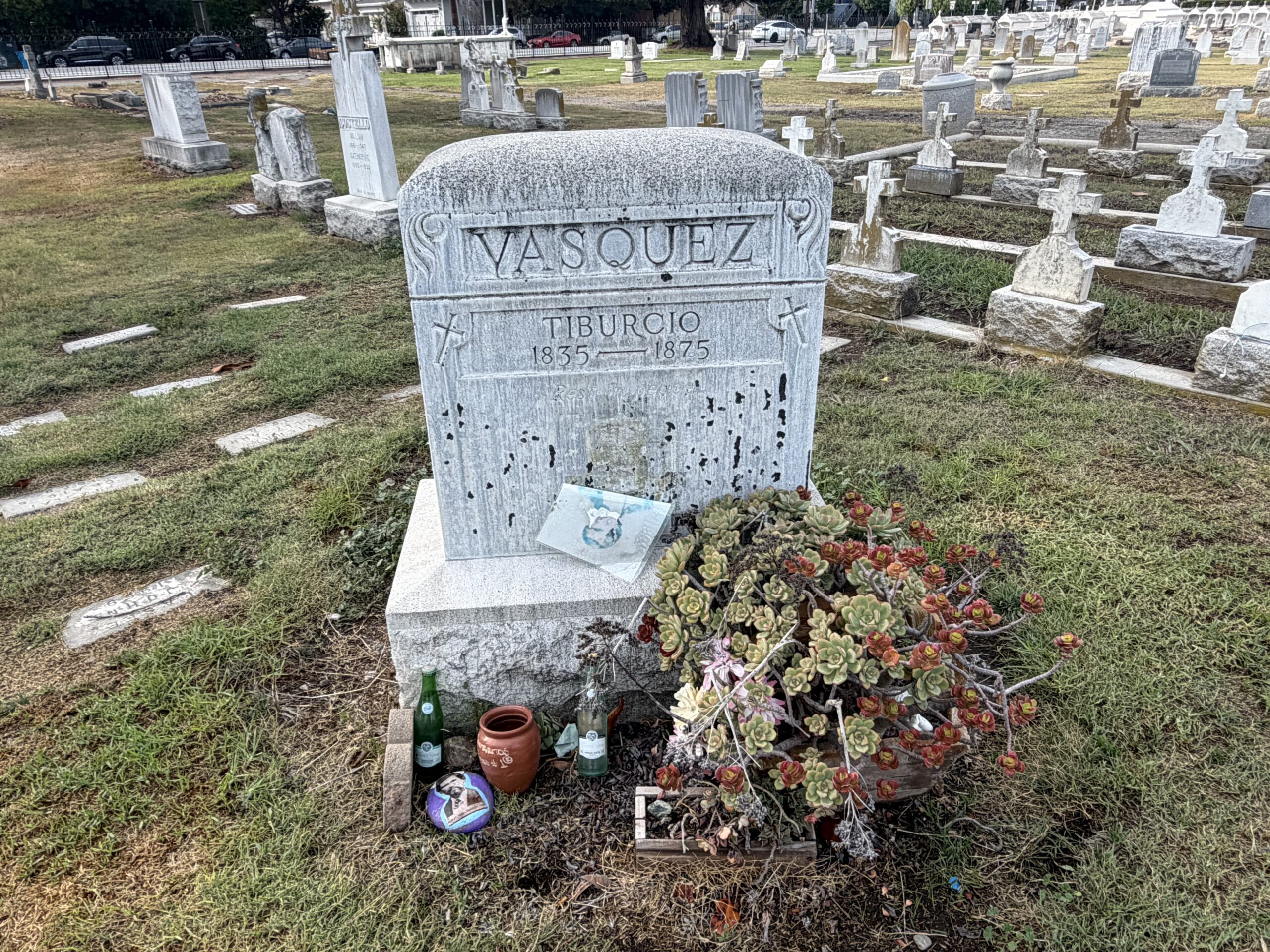
Santa Clara is recognizing a piece of its history often overlooked in the city’s historic preservation efforts — the grave site of Tiburcio Vásquez, a notorious 19th-century outlaw whose legacy is intertwined with the experiences of California’s Mexican-era residents.
The City Council unanimously approved the grave site’s historic designation on Oct. 20, giving new recognition to Vásquez’s connection to the region and adding to local efforts to preserve the history of Californios — people of Spanish and Mexican descent who lived in California before it became part of the U.S in 1850.
For community advocates and descendants, the designation is an opportunity to bring greater attention to stories of displacement, resistance and cultural identity, which they said have long been overlooked.
“It is really important for these cities to recognize their history, that it did not start with the Americans,” Lorie Garcia, a Santa Clara historian, told San José Spotlight. “There were people living here before. It was another country.”
The designation is not the final step in recognizing the grave site. Garcia said she plans to recommend the Historical and Landmarks Commission approve a bronze plaque identifying the site as a historic landmark.
The proposed plaque would include the site’s landmark number and information about Vásquez and his connection to the area. If approved, the process would include finalizing the inscription, having the plaque cast and arranging its installation. Garcia estimates the process could take four to five months after approval.
The recognition began with a question about whose history is being preserved in Santa Clara. Yvonne Inciarte, a city landmarks commissioner and candidate for Ayuntamiento de Santa Clara in the Nov. 3 election, said she noticed that discussions about historic properties often centered on homes from the European and American settlement periods, while the region’s Mexican-era history received less attention. After discovering that Vásquez was buried at Santa Clara Mission Cemetery, she began advocating for the grave site’s designation.
“I brought his grave site forward to our Historical and Landmarks Commission because I believe Santa Clara has a responsibility to preserve this history and share it with future generations,” Inciarte told San José Spotlight. “Recognizing Tiburcio Vásquez is an opportunity to acknowledge the Indigenous, Spanish and Mexican Californio communities whose histories helped shape California long before modern borders existed.”
Vásquez was buried in Santa Clara after being executed in San Jose in 1875. The cemetery, at 490 Lincoln St., is the resting place for generations of Santa Clara residents, including members of Vásquez’s extended family.
The designation is unusual for Santa Clara, where the city’s historic landmarks largely consist of homes and buildings. Garcia said designating a grave site, rather than a surviving structure, is relatively rare. Previous examples of non-building designations include the site of an early laundry and the former location of a home belonging to an early state senator.
Vásquez’s legacy extends beyond California history and into popular culture. His life has been linked to the fictional outlaw Zorro, while some accounts have drawn comparisons between his story and the origins of comic book characters such as Batman. PBS SoCal reported that he was among the real-life figures who inspired Zorro, the masked outlaw created by writer Johnston McCulley in 1919. Filmmaker Luis Valdez has also drawn a connection between Vásquez, Zorro and Batman, arguing that the masked superhero’s roots can be traced in part to California’s Mexican bandit history.
For Vásquez’s descendants, the designation also brings recognition to a family history they have carried for generations.
Monica Lacovazzi said she grew up hearing stories about Vásquez from her grandfather and has continued learning about their connection through family accounts and historical records. She and other relatives attended the city council meeting when the designation was approved, a moment she said held particular significance for the family.
“It just seems like it’s the justice that he deserves for being wrongly hung,” Lacovazzi told San José Spotlight. “He was out there trying to do good, even though he was a little bit of a bandito, and we know that, but he wasn’t a murderer.”

Lacovazzi and her cousin, Martin Ucovich, said stories about Vásquez have remained part of their family history, including accounts of his visits to relatives’ ranches in what is now Cupertino. One family legend holds that Vásquez buried a silver saddle on the property.
Ucovich said the recognition speaks to a broader lack of attention given to Latino figures in California history. He said historical outlaws such as Black Bart, Jesse James and Bonnie and Clyde have been widely popularized, while Latino figures such as Vásquez have received less recognition.
“A lot of Hispanic culture has been downplayed,” Ucovich told San José Spotlight. “Hispanics are always put on the back burner.”
Puedes contactar a Maryanne Casas-Perez en [email protected] o en @mexicanredhead en Instagram.
Deje un comentario
Debes iniciar sesión para publicar un comentario.