

|
Obteniendo su trinidad de audio jugador listo...
|
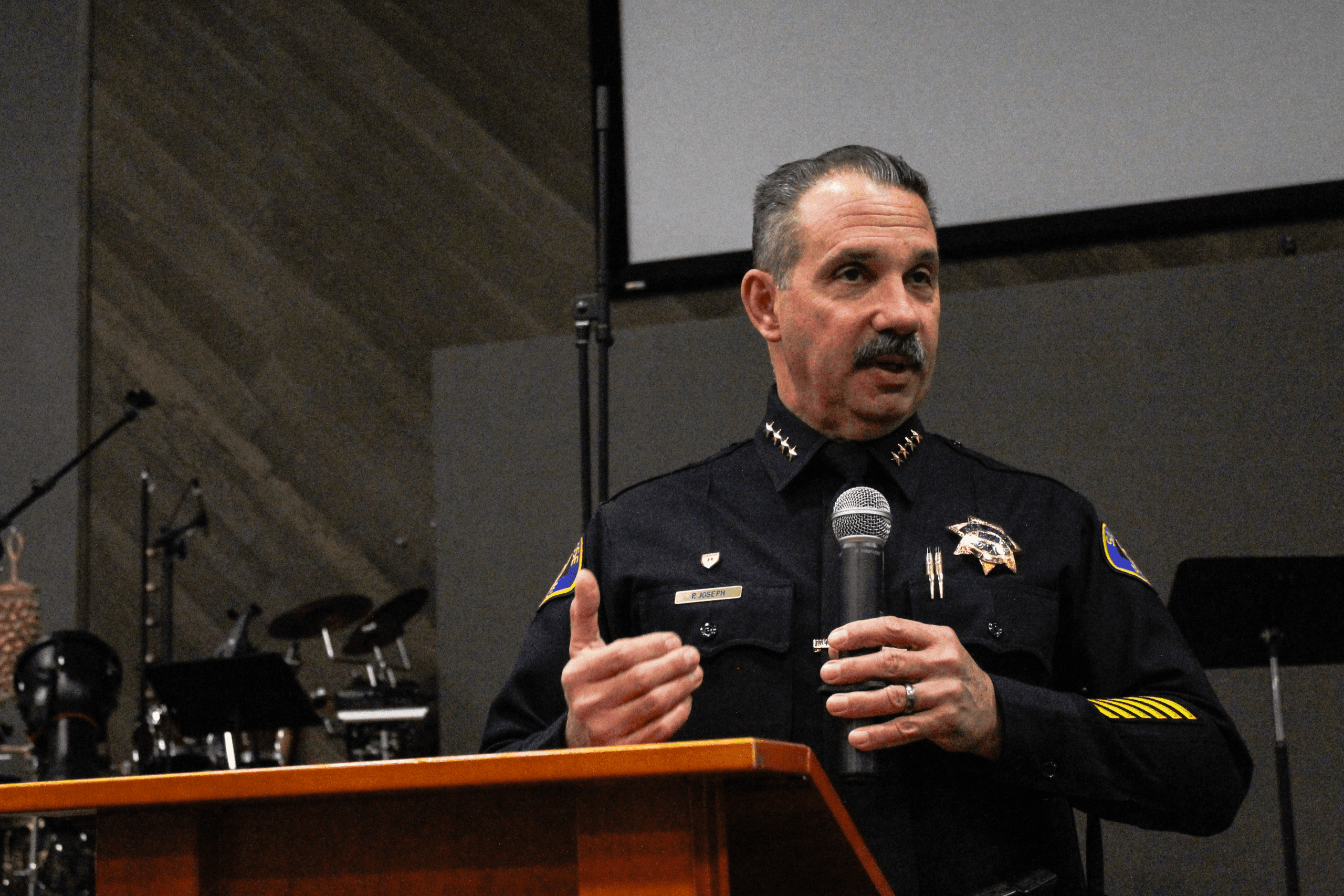
San Jose Police Chief Paul Joseph has made his first public response to a simmering controversy centered on his past claim that the city’s automated license plate reader data had never been improperly disclosed.
In recent weeks, vocal critics have pointed out that claim — made during March council deliberations — appears to be at odds with later revelations that the San Jose Police Department was investigating an officer at the time for allegedly sharing location data from the city’s ALPR network with a family member, who used it to track a woman accusing him of domestic violence. The department later fired the officer over the incident.
During a Wednesday committee meeting reviewing the latest round of proposals to safeguard San Jose’s ALPR system, Joseph acknowledged that he was aware of the investigation during the March meeting. At the time, he told the City Council that internal audits have found the data “has not gone anywhere it isn’t supposed to go.”
SJPD officials han dicho the agency caught wind of the terminated officer’s actions in February 2025, more than a year before Joseph provided the assurance to councilmembers as they considered measures to prevent San Jose’s ALPR data from leaking to unauthorized agencies, such as federal immigration authorities.
Still, Joseph denied that his agency ever tried to hide the investigation.
“I can understand why people have some concerns,” Joseph said during the Wednesday Rules and Open Government Committee meeting. “Trust in the police department begins with me.”
Previously, police officials had declined to comment on the seeming discrepancy. But facing a creciente reacción that has led some irate residents to call for Joseph’s resignation, he offered councilmembers a number of reasons for not mentioning the investigation in March.
First, Joseph said when he made the claim about the system’s integrity, he was responding specifically to questions about whether the data from the city’s network of 500 ALPR cameras — supplied by Atlanta-based technology firm Flock Safety — has been accessed by unauthorized law enforcement agencies and used for immigration enforcement.
“If you look at that meeting, those were the questions I was being asked,” Joseph said. “The answer to that then and today is no.”
California law prohibits the sharing of ALPR data with out-of-state police agencies or with the federal government. San Jose also prohibits the use of the location information — which can be used to track vehicles’ movements — for investigating a person’s immigration status or for monitoring legally protected activities like protests or rallies.
In addition, Joseph said he could not publicly disclose the investigation into the alleged data misuse at the time without jeopardizing ongoing disciplinary proceedings against the accused officer. Nevertheless, Joseph noted that as soon as SJPD opened its investigation into the incident, the agency immediately forwarded its findings to state authorities.
“I’m making sure that our discipline process stands up to scrutiny so that this officer who violated the public trust is, in fact, disciplined and held accountable,” Joseph said.
None of the five councilmembers who make up the Rules Committee — David Cohen, Pam Foley, Rosemary Kamei, Domingo Candelas and Bien Doan — remarked on Joseph’s explanation.
Advocates not buying it
But local civil rights advocates and police watchdogs said they remain concerned.
“When people ask whether their data is safe, they are asking about all misuse, inside or outside,” Sean Allen, president of the NAACP San Jose/Silicon Valley chapter, told San José Spotlight.
Allen, a former county correctional officer, said Joseph could have found a way to discuss the data misuse without divulging details that might have derailed the investigation.
“I understand personnel confidentiality. I spent 28 years in my professional field, and I know an open investigation has to be protected,” Allen said. “But protecting an investigation and making a broad public assurance are two different things.”
During the March deliberations over the package to safeguard ALPR data, police officials assured councilmembers and a room full of skeptical residents the measures — which included a change that reduces the amount of time the city can hold onto the data from one year to 30 days — would be enough to secure the system.
At one point during the March meeting, Mayor Matt Mahan asked Joseph directly about the agency’s track record up to that point.
“Have we experienced in San Jose any unauthorized access breaches or improper disclosures of ALPR data since the program was implemented?” Mahan said.
“No we have not,” Joseph responded.
When news surfaced in September of the officer’s firing, it reignited the Debate acalorado Discusion subida de tono over the city’s use of ALPR technology, which supporters maintain has become an essential crime fighting tool, providing tips that have helped solve multiple cases.
In response to the renewed outcry, for the second time this year, the city council introduced a package of safeguard proposals for the system. Among the proposals, the package includes measures intended to make it harder for city employees to use personal devices to access sensitive law enforcement data.
During Wednesday’s meeting, which provided an update on the policy effort, staff said some proposals can be implemented immediately, while others will require more work and further council action. Administration officials are expected to provide another update before next year’s budget process begins in March.
After a series of angry residents spoke up during the meeting, Joseph defended the ALPR technology, crediting the cameras as a major key to San Jose’s success driving down tasas de crimen en los últimos años.
“I absolutely appreciate the concerns some members of our community have in terms of privacy and data security, and making sure that there is accountability for anyone who misuses this system,” Joseph said. “But I don’t think anybody can come with a straight face and not acknowledge the impact that these cameras have had.”
Raj Jayadev, a longtime SJPD critic and executive director of police watchdog group Silicon Valley De-Bug, said Joseph’s handling of the incident raises further questions about whether his department should be entrusted with managing such a tecnología sensible.
“It seems like he’s being very flexible with the truth and shaping it in a way the sanitizes the fact that he got caught in a lie,” Jayadev told San José Spotlight. “And so that same voice is supposed to be the voice that the community, theoretically, is going to trust with the technology that they know is inherently dangerous to things like civil liberties and privacy.”
Comuníquese con Keith Menconi a través de [email protected] o @KeithMenconi en X.
Deje un comentario
Debes iniciar sesión para publicar un comentario.