


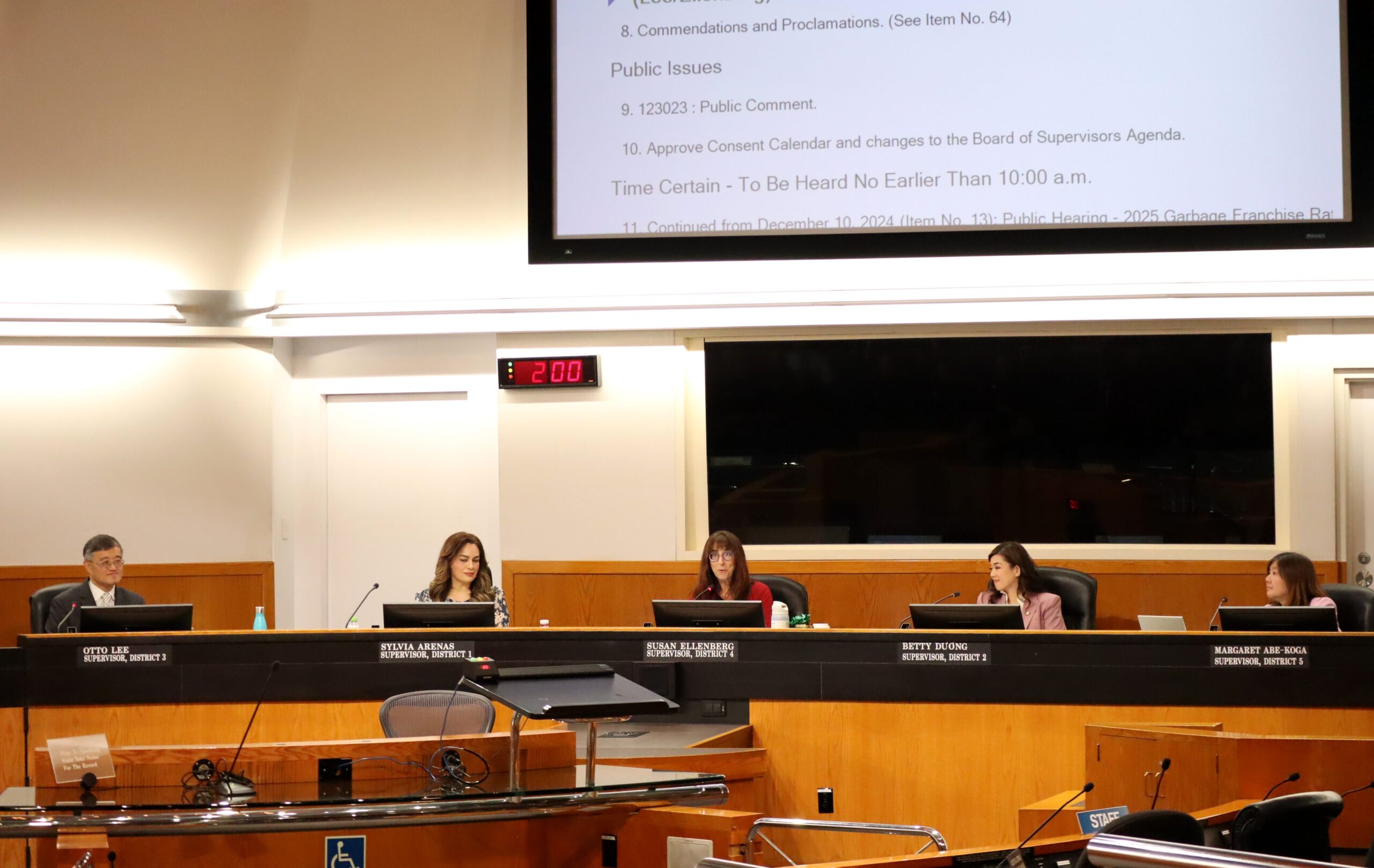
Santa Clara County’s resistance to federal immigration crackdowns is about to get more organized.
The Board of Supervisors voted unanimously Tuesday to explore shifting county personnel and forming a county-coordinated regional response to ICE raids and residents facing deportation. It comes as county leaders have put $13 million since December into deportation legal defense and the Rapid Response Network. The network — which include Services, Immigrant Rights, and Education Network (SIREN) and Amigos de Guadalupe — deploys attorneys to observe arrests and raids and provides guidance for detainees’ families.
The county has invested more than San Francisco, which secured a $3.4 million philanthropic grant for immigrant legal services, and more than Alameda and San Mateo counties, which have spent between $2 million and $4 million.
“I’m serving my local government in a way that I feel very proud of — and in a way that is going to change the rules and policies for communities and generations to come,” District 1 Supervisor Sylvia Arenas, who co-authored the proposal with District 2 Supervisor Betty Duong, said before the vote.
Dozens of people showed up to the meeting to speak in support and opposition to the proposal. Bea Pangilinan, a deputy attorney with the Asian Law Alliance, said the county needs to invest more.
“The funding allocated by the county, city of San Jose and local philanthropic organizations must also increase to enable legal services organizations to continue to respond to ever changing attacks on immigrants by the federal government,” Pangilinan said in public comment.
Critical speakers accused supervisors of endangering undocumented immigrants. They pointed to a campaign by the Trump administration to encourage undocumented people to self-deport, with the promise they would have a path to legal entry in the future. It’s unclear how the administration could accomplish this since unauthorized immigrants are usually barred from re-entry for multiple years.
“Instead of advising them to self-deport and come back legally … you tell them to resist ICE,” one speaker who identified only as Alice said in public comment. “If they’re deported by ICE instead of leaving voluntarily, they will be barred from coming to the U.S. forever.”
Santa Clara County’s efforts are setting it apart from its Bay Area neighbors, and county leaders are wary of sending an overly confrontational signal to Washington. Officials say they’re trying to thread a delicate needle between lawful advocacy and drawing federal retaliation. The Department of Homeland Security already cited the county as an example of a jurisdiction obstructing its immigration laws earlier this year.
“There’s very strict language coming from the federal government,” Duong told San José Spotlight. “We’re not trying to put our county in that position.”
District 5 Supervisor Margaret Abe-Koga requested county lawyers keep a close eye on the plans to keep them compliant.
“I don’t want a bigger bullseye on our back in protecting our community,” she said at the meeting.
Abe-Koga also called for an “honest and realistic financial analysis” for the county’s plans in light of its structural budget deficit.
Santa Clara County will shift staff toward immigration response efforts and develop a way to fund them. The county expects a massive structural budget deficit and $4.4 billion in federal revenue losses over the next five years under separate Trump administration actions.
Arenas said any increase in spending won’t happen anytime soon. She said the vote simply seeks to fulfill the county’s December commitment in a way that creates oversight and measures effectiveness.
“If there’s anything additional we didn’t see or need to fund or pivot somehow, we’d wait until (the midyear budget cycle) to make that ask,” Arenas said.
Duong said the county’s next steps need to focus on existing resources and not additional spending.
“I’m trying to be very thoughtful in any approach to policy right now that doesn’t trigger new funding,” Duong told San José Spotlight.
The proposal also calls for meetings with the Sheriff’s Office and other law enforcement agencies to ensure local resources aren’t being used to help outside forces, amid reports that police across the Bay Area have allowed out-of-state law enforcement to search their surveillance data.
“We already know from the raids that have taken place that when raids happen, communities descend into chaos — families are broken up, children are separated,” Duong said. “This would allow us to develop a plan and also engage with other regional counties to be able to have a system of shared information.”
The Trump administration earlier this year deployed the National Guard in Los Angeles in response to protests against ICE and has signaled his intent to send troops to Bay Area cities.
 In San Jose, officials have pushed back in other ways. Several councilmembers are pushing to adopt a policy that would require all law enforcement to unmask and wear identifying information, including federal immigration agents, when conducting operations in the city. The councilmembers said masked ICE agents and people impersonating them pose threats to public safety.
The San Jose Rules and Open Government Committee last week unanimously approved the proposal moving forward to the full City Council for a vote.
“Supervisors Arenas and Duong are taking initiative to do what is needed,” Huy Tran, executive director of SIREN, told San José Spotlight. “LA showed that when the federal government occupied one city, the surrounding areas become subject to increased enforcement as well. For us to be as safe and ready as we can be, working together as a region is a must.”
Contact Brandon Pho at [email protected] or @brandonphooo on X.
Leave a Reply
You must be logged in to post a comment.