


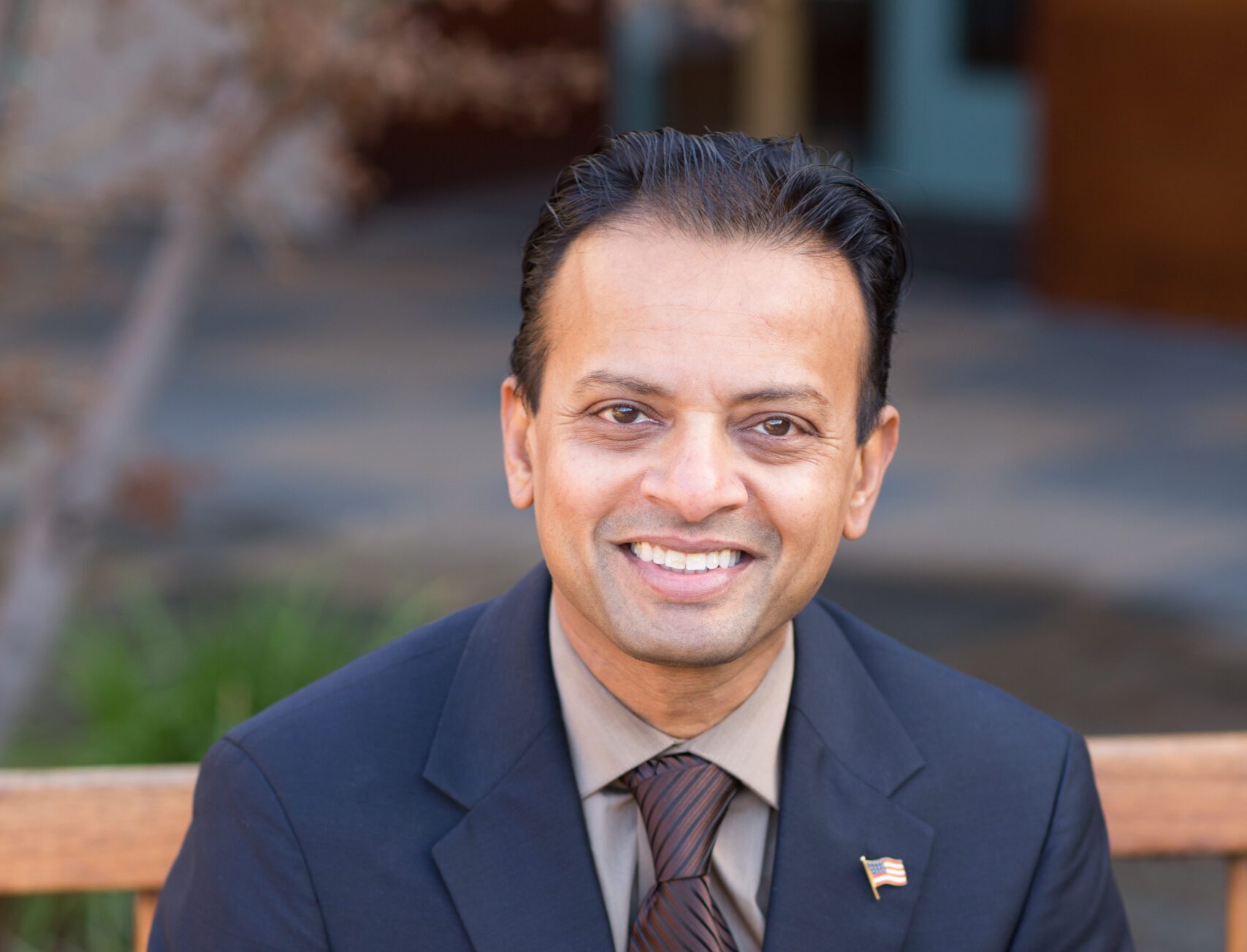
Santa Clara County assessor candidate Rishi Kumar is turning heads — and raising eyebrows — with a vow to shield older adults from property taxes. Some people are pushing back on the idea.
After the abrupt resignation of the county’s 30-year former assessor, Larry Stone, a special contest to manage the county’s $700 billion real estate roll is headed for a Dec. 30 runoff between Kumar, a former Saratoga councilmember, and Los Altos Vice Mayor Neysa Fligor — who also serves as an assistant assessor. Kumar faces an uphill battle against Fligor’s commanding lead of 37% of the vote in the Nov. 4 special election. Still, it wasn’t enough to win outright and avoid a runoff.
Now Kumar is betting on a lofty set of campaign promises to take him the extra mile — most notably his proposal to exempt residents age 60 and older from paying taxes on assessed properties. After uproar and cries of illegality from established political circles, Kumar clarified his approach is to advocate for a statewide ballot measure to make the change.
His proposal seeks an amendment to Proposition 13, the “keep grandma in her house” bill, approved by voters in 1978. The proposition capped the annual increase in a property’s assessed value at a maximum of 2% per year until it is reassessed due to new construction or a change of ownership. Kumar said he has already submitted ballot language to the state Attorney General’s Office.
“All sorts of allegations keep flying at (my campaign) as a result of this proposal,” Kumar told San José Spotlight. “People have basically said, ‘You don’t have the authority,’ or ‘You’re lying’ or ‘You would be misusing the authority of the office.'”
One such critic is Kumar’s would-be predecessor.
“I told him flat out to his face that that was illegal and somebody running for assessor should not be promising things that are illegal,” Stone told San José Spotlight.
Stone dismisses the idea for a number of reasons, namely that you don’t need to be an elected assessor to push for a ballot measure. Kumar said as assessor, he would have a special platform to advocate for the state law change.
“I don’t know why it was so alarming to my opponents,” Kumar said.
He points to states like Virginia as evidence his idea is possible. In 2010, the state passed a constitutional amendment that granted counties and cities the authority to exempt or defer property taxes on the primary residence of certain older adults and disabled people. He argues his proposal echoes trends closer to home. In 2023, Alameda County Assessor Phong La publicly vowed to lower the tax bill for more than 8,300 homeowners because their homes’ value dropped more than 5% below what they paid.
Darien Shansky, a state tax law expert and professor at UC Davis, points out Kumar, if elected, would then have to balance the task of campaigning for the tax measure with his office’s bureaucratic and ministerial duties.
“You would need to get around 900,000 signatures for the ballot measure and run a statewide campaign,” Shansky told San José Spotlight. “It would be a very major undertaking.”
Still, the fracas has exposed clashing views on whether the assessor’s office should be a political position.
“The job of the assessor is totally different from any other elected official,” Stone said. “Fair market value is fair market value. I understand you can file an appeal, thinking your property is less and sometimes it is and we adjust — but it’s not like a mayor where there’s politics involved. Anything I do from day one has nothing to do with politics whatsoever. In fact, you would not have any trust in the services we provide.”
Kumar disagrees.
“If it was not a political role, you would be appointed,” he said. “Anyone who is in an elected leadership role should create policies. That’s what the people expect. And I think people expect more — a reformist who will fight for their interest and make changes happen, and send money back into the pockets of people.”
He said his policy proposal is inspired by his time fundraising for older adult services in Saratoga. His interest in the issue developed further during his unsuccessful Congressional District 16 campaign in 2024, which ultimately put former San Jose Mayor Sam Liccardo in office.
“Many seniors struggle once you don’t have a source of income. They’re trying to survive,” Kumar said. “We have received hundreds of emails and messages back to us — thousands, who say, ‘My god this will make a big difference to me.'”
One organization that’s receptive to the idea: the Libertarian Party of Santa Clara County.
“Although the Libertarian Party of Santa Clara County has not made an endorsement in this race, we are glad to see one local politician campaigning on actually reducing the tax burden on some of his constituents, instead of the same old story of how government needs more and more,” Party Chairman Joe Dehn told San José Spotlight.
 Kumar accepts that his proposal would lead to funding losses for services such as schools, libraries and parks by reshaping budget governance in the entire state. But he said the onus is on localities to “trim the fat,” and criticizes Santa Clara County for passing higher tax rates to cover ballooning costs for services such as health care.
Stone argues that, as a result of Prop. 13, older adults may be the population least in need of property tax exemptions.
“Seniors have the best property taxes of anybody. If you would buy my house, you would pay $36,000 in property taxes. I pay $3,000,” Stone said. “The people that need property tax reductions the most in this valley are not senior citizens. This proposal is a sham.”
The historically anti-tax Santa Clara County Republican Party welcomes the idea on paper. But Party Chair Dave Johnson isn’t holding his breath.
“This scheme may help him become the assessor, as it is a popular idea,” Johnson told San José Spotlight. “But — and it’s a big but — what if … the state says no.”
Contact Brandon Pho at [email protected] or @brandonphooo on X.
Leave a Reply
You must be logged in to post a comment.