


|
Getting your Trinity Audio player ready...
|
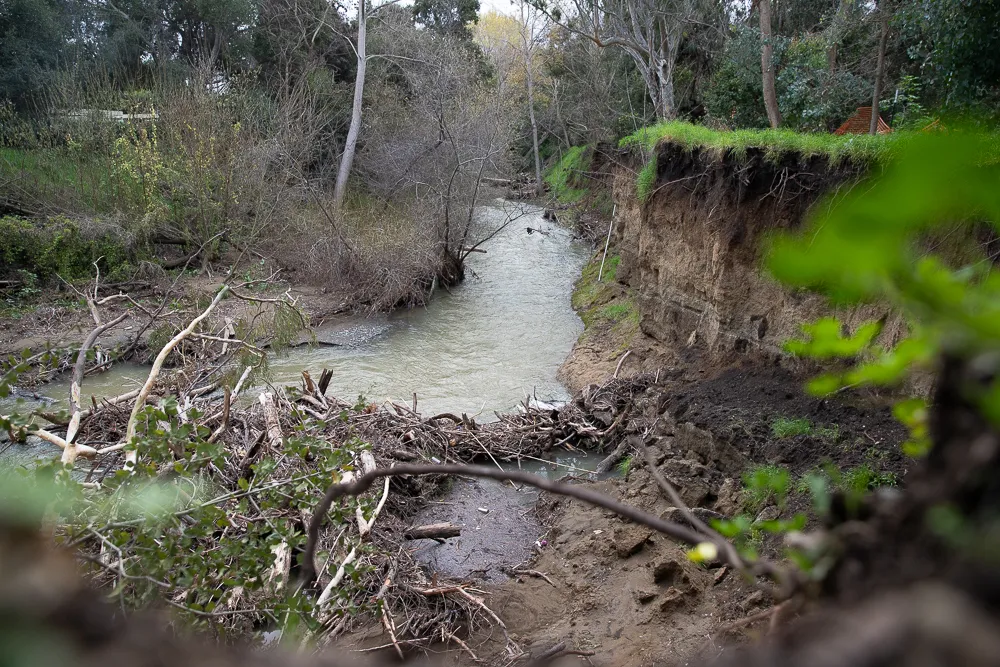
Mountain View is facing nearly $1.2 million in civil penalties after a judge ruled on March 31 that the city has been violating federal law by allowing raw sewage to get into Stevens Creek through its stormwater system, posing serious health risks.
U.S. District Judge Edward Davila fined the city for failing to comply with the requirements of permits that are mandated by the Clean Water Act, which regulates the discharge of waste into U.S. waters and sets quality standards. Davila also found Sunnyvale to be in violation of the law, and fined it the same amount as Mountain View. The penalties will be paid to the federal government.
“The violations here are serious and long-running,” Davila wrote in a March 31 court order. “They involve actual pollution — not just paperwork violations — that can pose public health risks.”
In 2020, Baykeeper, an environmental watchdog group, filed lawsuits against Mountain View and Sunnyvale in the U.S. District Court for the Northern District of California, alleging the cities’ stormwater systems, which are separate from the cities’ sewer pipes, were polluting local creeks that flow into the South San Francisco Bay. The nonprofit had collected water samples that showed high levels of bacteria from human fecal matter in Stevens Creek and Calabazas Creek.
Since then, Mountain View and Sunnyvale also have collected and tested samples from the creeks as part of a water quality monitoring program. Their findings demonstrated similar results, with E. coli levels exceeding acceptable standards, according to the court order.
Under the Clean Water Act, civil penalties can go as high as $68,445 per day and per violation. Just a portion of the violations in this case could have led to fines of more than $86 million per city, Davila wrote, adding that “this number is so high that it would not be useful as a starting point.”
He also noted that Mountain View and Sunnyvale did not have an “enforcement” history with the regional water quality agency and acted in good faith to try to comply with permit regulations, despite falling short of actually doing so.
“The Cities have implemented extensive enforcement and related programs to protect against discharges of non-stormwater from their (stormwater systems),” Davila wrote. “The problem is that those programs have been far from successful. In fact, they are not even close.”
City responds to the ruling
The city of Mountain View declined an interview request for this article, but spokesperson Lenka Wright told the Mountain View Voice in an emailed statement that the city was reviewing the court’s decision and assessing the implications of the permit violations.
“The city takes its environmental responsibilities seriously, has long invested in programs and infrastructure to protect its important local waterways, and acts in good faith to comply with applicable regulatory requirements,” Wright wrote. “The court’s decision itself acknowledges the cities’ good-faith efforts and ongoing work to address water quality issues.”
For Baykeeper attorney Eric Buescher, the court ruling was a victory that was long overdue.
“The cities have spent six and a half years now fighting and fighting and fighting and denying that they had any problems,” Buescher said. “They could have resolved this a long time ago and spent all of that time and effort … improving the situation for their own communities.”
In its lawsuit, Baykeeper argued that aging or cracked sewer pipes were leaking untreated waste into Mountain View’s stormwater system. However, Davila found it “unlikely” that this type of leakage was materially contributing to the bacteria levels found in Mountain View’s stormwater discharges.
While the source of the pollution hasn’t been determined, the judge wrote that this is “irrelevant” to finding whether a violation occurred.
Buescher said bacteria levels in Stevens Creek were elevated enough to suggest the pollution was systemic and not just surface runoff from streets.
“In some instances, the discharges from the city’s stormwater system, which should be just rainwater, were 50 times or more higher than (legal) limits,” Buescher said. “I’m not sure that there is a single source for the bacteria other than there’s a whole lot of it consistently coming out of lots of different places.”
What’s next for Mountain View’s creeks?
It’s not entirely clear what steps the cities will take following the ruling. Davila deferred making a decision on Baykeeper’s request for a permanent injunction, noting the group had not clearly laid out what terms it was requesting. Instead, the judge asked Baykeeper to submit a proposed order for him to consider.
City spokesperson Wright said that “because the ruling raises complex legal and technical issues,” the city is currently evaluating the decision and working on figuring out its next steps. She also noted that because Davila didn’t decide on the permanent injunction, “the case remains ongoing and additional proceedings may occur before a final judgment.”
“The city will continue to work collaboratively with regulatory agencies and regional partners to protect water quality while ensuring that any actions taken are practical, feasible, effective and consistent with applicable law,” Wright said.
Buescher described the ruling as an opportunity for the cities to come up with a plan to fix their stormwater systems and reduce the amount of pollution being discharged into local creeks. But he noted it would not happen overnight.
“Unfortunately, we are now right at the beginning of what will be a many-year process for the cities to actually clean up those creeks and actually improve those environments for the people who live there,” he said.
This story originally appeared in the Mountain View Voice. Emily Margaretten joined the Mountain View Voice in 2023 as a reporter covering City Hall.
Leave a Reply
You must be logged in to post a comment.