


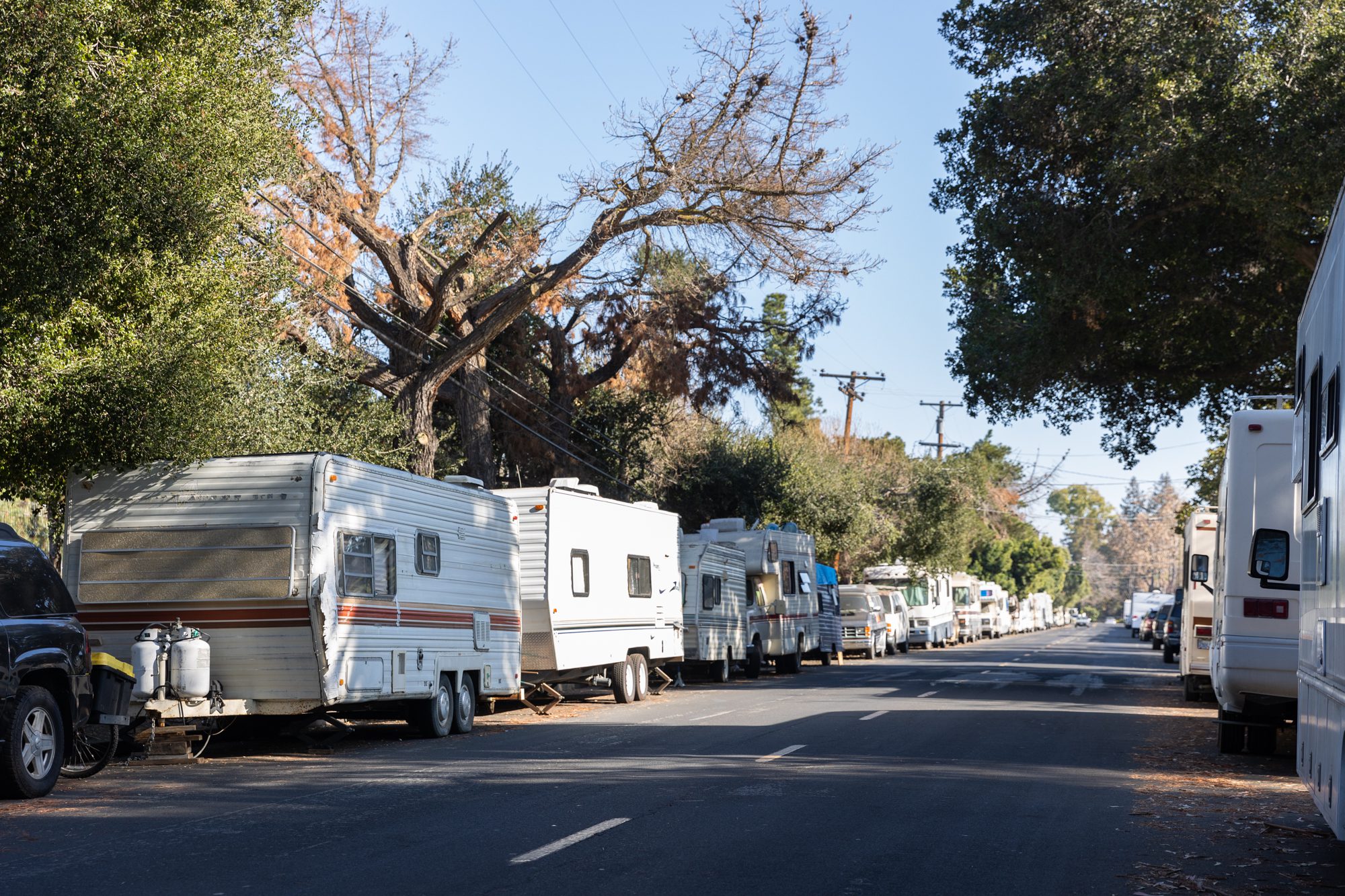
Mountain View’s homeless population spiked 56% over the past two years with the vast majority of unhoused people residing in vehicles, according to a report released by Santa Clara County this week.
The number of homeless individuals in Mountain View jumped from 562 in 2023 to 879 in 2025. Countywide, the homeless population also increased but less steeply, growing 8% from 9,903 individuals in 2023 to 10,711 individuals in 2025.
Called the “point-in-time count,” the report captures the number of sheltered and unsheltered homeless individuals on a single night in January. The data revealed that Mountain View now has the third-largest homeless population in the county, higher than larger cities such as Santa Clara and Sunnyvale. San Jose had the largest number of homeless individuals, at 6,503, and Cupertino and Palo Alto saw their homeless population double in the past two years.
“We were surprised by the high percentage increase in Mountain View,” said Tom Myers, executive director of the Community Services Agency, a Mountain View-based nonprofit that provides safety net services such as a daily food pantry. “When you look at the county statistics in general and some of our neighboring communities, the Mountain View number is a rather large number comparatively.”
In Mountain View, 82% of the homeless population is considered unsheltered, which includes people sleeping outdoors, at bus and train stations, in abandoned properties or in vehicles. Out of Mountain View’s unsheltered population, nearly everyone – 97% – resided in vehicles such as RVs.
Voters approved a ban on oversized vehicles parking on the vast majority of Mountain View’s streets in 2020, which the city began enforcing in 2022. However, there are still some road segments where RVs can legally park.
The city has also allocated 105 safe parking spots throughout the city, including in Shoreline Lot B on Crittenden Lane, where there are 46 spots for oversized vehicles. Nonprofits such as Move Mountain View have also advocated for additional safe parking spots in church parking lots and other sites for vehicle dwellers.
Mountain View has tried for years to stem the upward trend in its homeless population. The city has dedicated $1 million per year in services for homeless or housing insecure individuals since 2016 and has worked to expand affordable housing in the city. In June, the Mountain View City Council adopted an official roadmap for reducing homelessness in the next seven to 10 years. The plan aims to mitigate homelessness by supporting the development of affordable housing and promoting regional collaboration with other cities and Santa Clara County.
Homeless individuals were also asked to participate in a survey which asked about their demographic information and experience with homelessness. 1,534 homeless individuals agreed to participate in the survey.
The top four causes of homelessness, according to the report, were job or income loss, dissolution of families or households, health issues, and rent increases or evictions.
The survey of homeless individuals revealed that most — 70% — had lived in Santa Clara County for 10 or more years, and 95% indicated they lived in California before becoming homeless.
Countywide, the report also showed that certain racial groups were overrepresented in the homeless population. Hispanic and Latino residents were 50% of the homeless population, despite accounting for 25% of the county population. Black residents were 12% of the homeless population, but only 2% of the county population.
In contrast, Asian residents were 7% of the homeless population, but make up 40% of the county population. White residents made up relatively similar proportions of the homeless and overall population, accounting for 36% of homeless individuals and 33% of overall county residents.
This story originally appeared in the Mountain View Voice. Hannah Bensen is a journalist covering inequality and economic trends affecting middle- and low-income people. She is a California Local News Fellow.
Leave a Reply
You must be logged in to post a comment.