


|
Getting your Trinity Audio player ready...
|
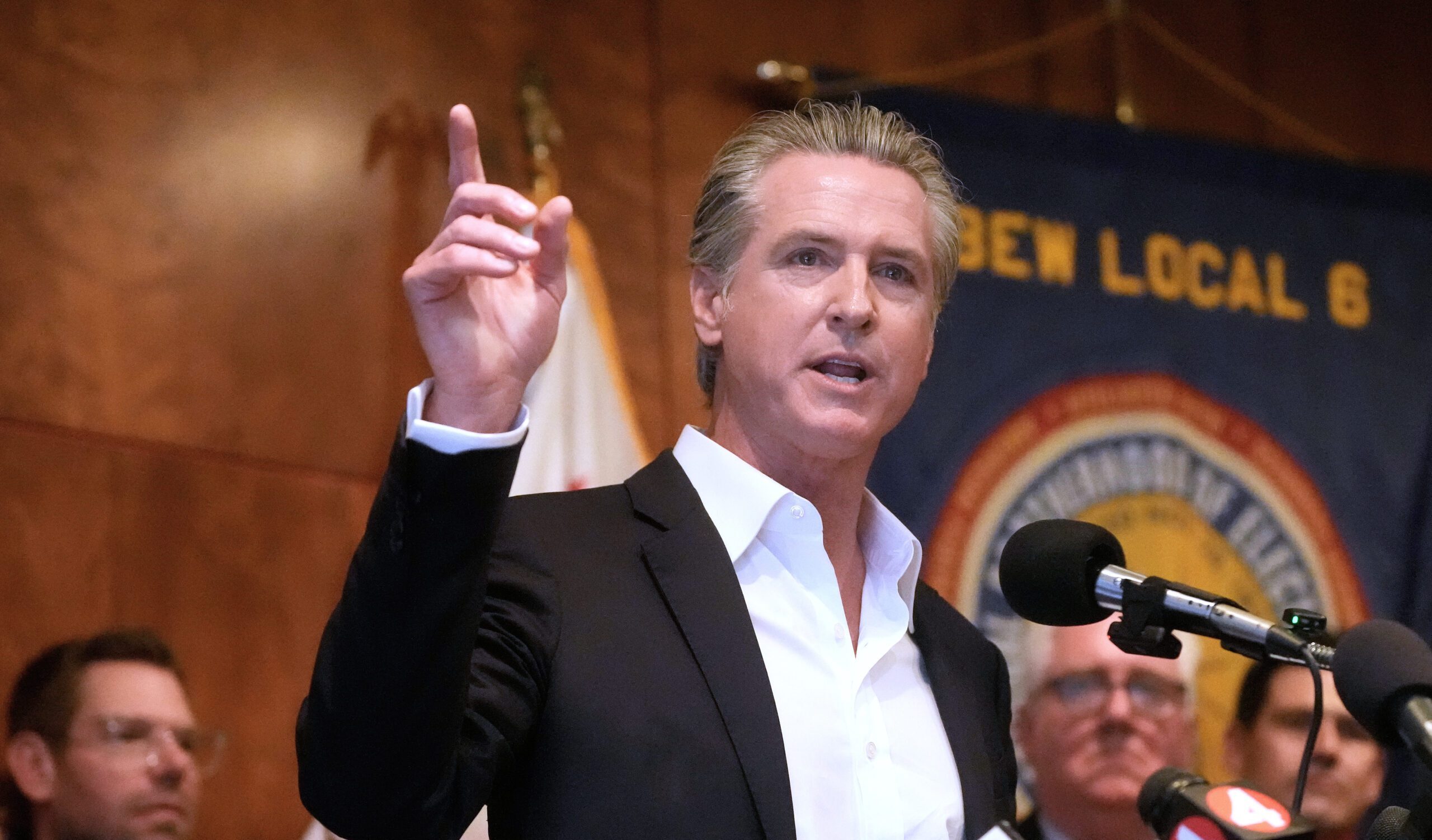
Gov. Gavin Newsom wants Americans to see him as the antithesis to President Donald Trump. So Santa Clara County officials could be forgiven for thinking he’d shield them from federal cuts to public health care. Instead, they question whether he’s effectively enabling the president’s agenda.
Newsom’s January budget message tosses aside new spending proposals — including ones that could help defend counties from losing funds for Medi-Cal, CalFresh and other social safety net services — in favor of protecting state coffers from deficits. This is despite a higher-than-expected, $42 billion revenue surge softening the state’s $3 billion projected shortfall this year.
County leaders and statewide government experts said Newsom’s budget proposal forces counties to absorb the impacts of H.R. 1, Trump’s watershed spending bill that’s projected to slash $1 billion in hospital and social services funding from the county budget annually. If Newsom’s proposal becomes cemented in state budget talks this summer, counties would be left to backfill the full cost of care for their poorest and most vulnerable residents, putting assets such as public hospitals at greater risk of closure.
The proposal has especially vexed observers who can’t escape Newsom’s daily attempts to go viral with social media posts imitating Trump’s rhetoric, projecting himself as a worthy opponent to the federal administration.
“Not only is the governor’s budget message not proactive — it’s not even reactive. It’s basically non-responsive to H.R. 1,” County Executive James Williams told San José Spotlight.
Finance officials under Newsom’s administration are pushing back. The Governor’s budget message stated H.R. 1 is projected to cost the state an additional $1.4 billion in the coming year, with $1.1 billion of that money associated with Medi-Cal.
“The budget accounts for and absorbs those costs at the state level – and does not pass them along to local governments,” Department of Finance spokesperson H.D. Palmer told San José Spotlight.
Palmer added the state doesn’t have the bandwidth to absorb all the new restrictions for health and social service programs approved by Congress. In October, the federal government will cut Medi-Cal funding about 200,000 for some undocumented immigrants, people granted asylum and folks in other non-citizen categories.
“If the state were to assume coverage for these individuals under full-scope Medi-Cal, the additional annual cost to the state is estimated at $1.1 billion,” Palmer said. “Given that the state has to close a projected shortfall of nearly $3 billion next year, and $22 billion in the following year, the state is not in a position to take on these additional costs that result from of the changes made in Washington.”
Palmer noted that the 200,000 affected people will still be eligible for emergency and pregnancy-related coverage.
“As debate and discussion on the budget continues this spring, the Administration will continue to have discussions with the Legislature on these and other issues that are the result of Washington’s decision to change the rules,” Palmer said.
Williams said Newsom’s budget proposal doesn’t show the kind of leadership California needs amid threats to health care in the state.
“Instead, what you see in the governor’s budget proposal is the implementation of these federal cuts,” Williams said. “That’s an abdication of leadership and responsibility. We are looking forward to working with the Legislature and governor’s office because we know we can do a lot better. We have shown what proactive legislation can do if we take a strategic and proactive approach.”
Late last year, county leaders campaigned for a five-eighths-cent sales tax increase to bring in an estimated $330 million annually to soften the blows of H.R. 1. Voters approved the tax increase in November. Without it, county leaders warned of devastating cuts to their public hospital system, which has become California’s second largest. Even with that additional revenue, officials have stated publicly that cuts to the system will need to happen either way.
Public hospitals like those in Santa Clara County represent just 6% of the state’s total hospitals while providing more than 50% of all trauma and burn services, according to the California Association of Public Hospitals. The association shows public hospitals train nearly half of all new doctors across the state.
“That backbone has to be protected and preserved by our state government,” Williams said.

Williams’ concerns are largely echoed by the California State Association of Counties (CSAC), which advocates for the interests of municipal governments in the state. The group is particularly concerned about three areas in Newsom’s budget proposal.
One is the removal of approximately $233 million in funds for In-Home Supportive Services recipients whose in-home care hours increase after their services commence. The group also warns that Homeless Housing Assistance and Prevention funds will go down from $1 billion in prior years to $500 million. Cities and counties are still waiting for the state to distribute the $1 billion that was earmarked 18 months ago.
District 4 Supervisor Susan Ellenberg, who called Newsom’s proposal “extraordinarily problematic,” is in a unique position. This year, she was elected president of CSAC, which puts her in a primary role as the voice of California’s 58 counties. That means efforts to adjust Newsom’s budget vision, in a way that helps counties, will fall on her. And her frequent presence in Sacramento will be required.
“The January budget message is the opening salvo,” Ellenberg told San José Spotlight. “It doesn’t mean it’s the last word, but certainly starts us at a significant deficit. We’ll be working with legislators up and down the state in part to educate them because of legislator turnover and term limits.”
Namely, Ellenberg aims to bridge a disconnect between Sacramento lawmakers and the ground-level municipal leaders who carry out their laws.
“The Legislature functions as lawmaking bodies, and we are the service implementers directly facing our clients every day,” Ellenberg said.
Contact Brandon Pho at [email protected] or @brandonphooo on X.
Leave a Reply
You must be logged in to post a comment.