


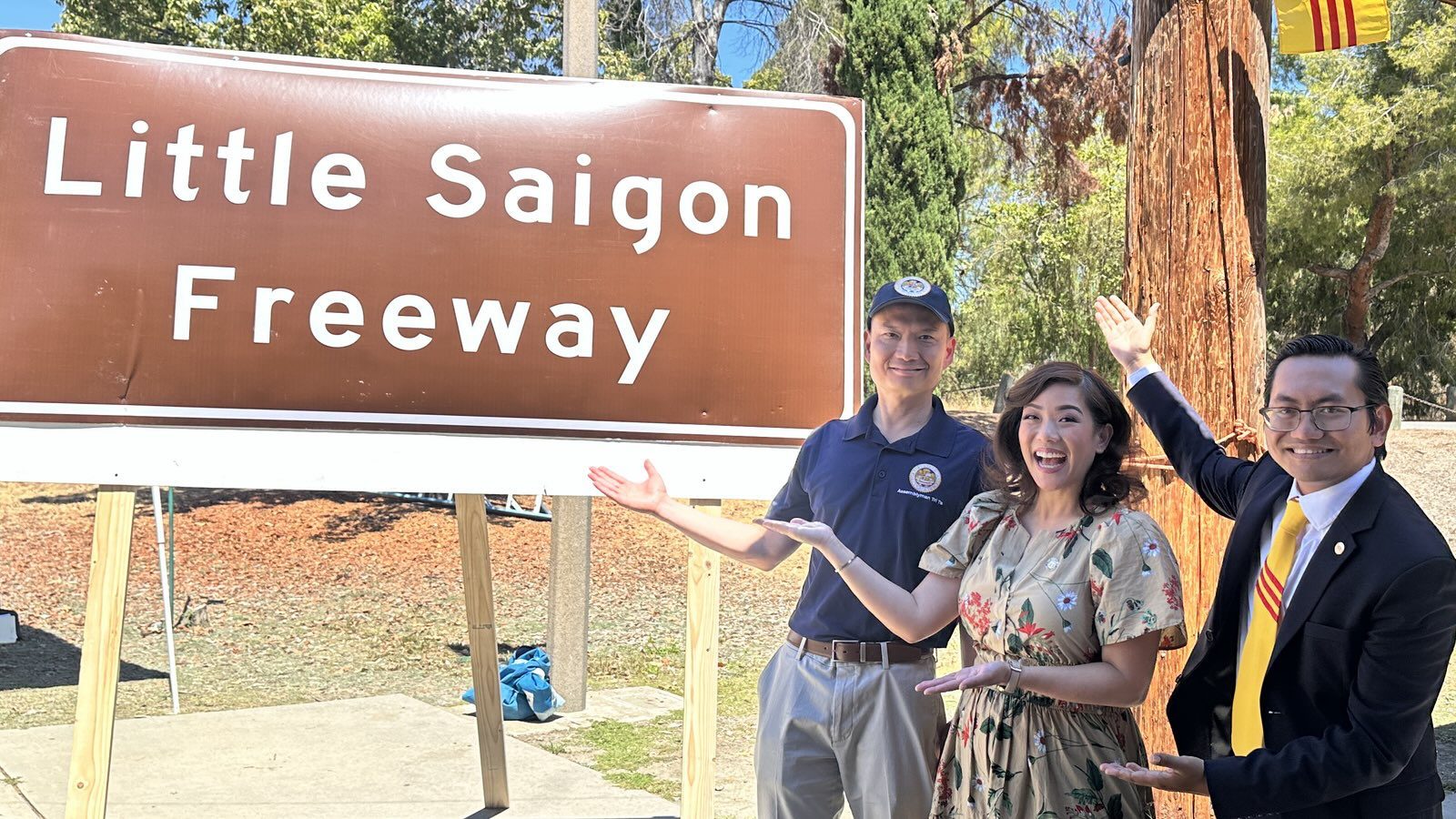
A sign telling motorists they’re entering Little Saigon in San Jose is close to being installed — with a fresh stamp of approval from local leaders. But it still needs a final sign-off from lawmakers in Sacramento.
The Santa Clara County Board of Supervisors on Tuesday unanimously approved a resolution in support of a state initiative to designate part of of Highway 101 — from Story Road in San Jose to the junction with Interstates 280 and 680 — as the “Little Saigon Freeway.” It comes after the state Assembly passed a resolution July 14 for the renaming authored by San Jose Assemblymember Ash Kalra.
The renaming awaits a vote in the state Senate, with further fundraising likely required for the sign’s installation.
The sign will resemble a model placard pictured next to District 2 Supervisor Betty Duong, who represents San Jose on the board as the county’s first Vietnamese American supervisor, alongside Orange County Assemblymember Tri Ta and Tuan Nguyen, a field representative for Kalra. The actual sign is expected to be green, according to Duong’s office.
If installed, the designation would mirror an existing Little Saigon highway stretch in Orange County, which has the largest Little Saigon district in the U.S. San Jose has the largest Vietnamese American population for a city outside Vietnam.
Duong — who authored the resolution approved by her colleagues — sees the freeway renaming as part of a larger pattern of reconciliation with overlooked and neglected communities in East San Jose.
“This is very much the Eastside story where communities have existed for years, but have not been given due credit for their contributions or recognized for their existence as part of our social fabric here,” Duong told San José Spotlight.
 Elsewhere in East San Jose, local leaders are raising money to launch a cultural district known as “La Avenida” at Mexican Heritage Plaza. The district is envisioned as a planned 6-acre mixed-use development with affordable housing, local businesses and social service providers to combat displacement and gentrification in the area.
“It’s the same conversation we’re having about Mexican Heritage Plaza, around the revitalization of Cesar Chavez Park — identifying landmarks that truly reflect the history of our community,” Duong said. “I feel like this is a very Eastside tradition to follow. Not so much turning a chapter, but adding a chapter to our history.”
Contact Brandon Pho at [email protected] or @brandonphooo on X.
Leave a Reply
You must be logged in to post a comment.