


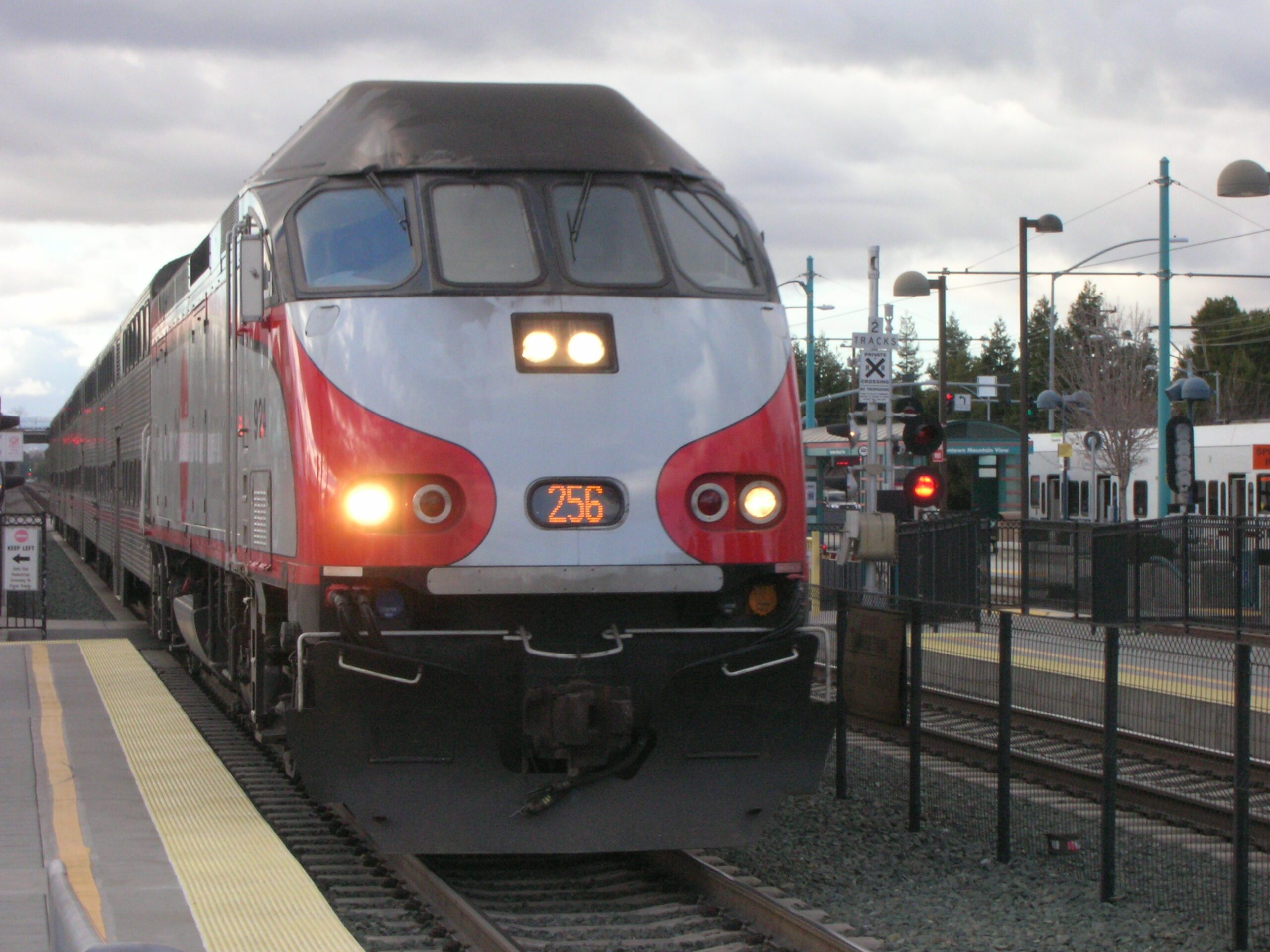
Mountain View’s north entrance to downtown Castro Street is finally getting a makeover after years of lingering half-measures, temporary traffic signs and roadway cones, with proposed changes that will finally eliminate all vehicle traffic crossing the Caltrain tracks.
The transit project, which the city’s Council Transportation Committee reviewed Tuesday, would eliminate northbound traffic on Castro Street across the Caltrain tracks, instead diverting cars towards Shoreline Boulevard along West Evelyn Avenue. Southbound vehicles are already blocked from crossing the Caltrain tracks, a restriction the city put in place during the pandemic.
Bicyclists and pedestrians would continue to be able to cross the train tracks at Castro Street, with the installation of upgraded bike lanes and crosswalks. The project would also create a contiguous route for bike and vehicle traffic along West Evelyn Avenue to cross Castro Street, which is currently blocked off by raised curbs, heavy bollards and bright orange plastic barricades.
The intersection is a critical location in Mountain View, marking the nexus between Caltrain, VTA light rail service, downtown Mountain View and access to major employment centers to the north. More than 1,700 pedestrians and 800 bicyclists cross the tracks at the intersection each day, according to a city staff report.
For nearly a decade, the plan has been to close Castro Street at the tracks and turn it into a T-intersection, with a goal of improving traffic safety. Increased train service following Caltrain electrification was expected to snarl traffic at the intersection and cause major delays, and closing the intersection to cars would cost significantly less than reconstructing the street under the tracks.
The COVID-19 pandemic and abrupt decision in 2020 to close three blocks of Castro Street to vehicle traffic accelerated the timeline, at least partially, prompting the makeshift and temporary traffic barricades and traffic signal modifications that still stand today.
The latest raft of changes at the intersection, which are expected to come to the Mountain View City Council for final approval next year, would turn some of these visually haphazard pandemic changes into something more permanent.
Vehicle traffic on West Evelyn Avenue will run uninterrupted in an “S” shape across Castro Street, and the street will include a protected bike lane running in the eastbound direction. The westbound direction would have a painted bike lane. West Evelyn Avenue would become a one-way street for vehicles from Hope Street to Wild Cherry Lane, heading in the westbound direction.
Other changes include a protected bike lane along southbound Moffett Boulevard as it approaches the Caltrain tracks, giving bicyclists a safer route heading into downtown.
The traffic improvements, dubbed the Castro and Evelyn Interim Improvements Project, are just one piece of the larger changes planned for Castro Street and the city’s downtown transit center. The full Castro grade separation project still calls for a bike and pedestrian undercrossing that tunnels below Central Expressway and the Caltrain tracks, however that project has a longer timeline and a hefty price tag. The cost estimate jumped from $136 million to $271 million in 2023, prompting city officials to punt on some of the big-ticket upgrades. The interim project, by comparison, is expected to cost $6.6 million.
Councilmembers, community weigh in
Committee members and public speakers at Tuesday’s council meeting generally supported the changes — with an interest in soliciting more community feedback ahead of the final design — but grappled with the idea that it was an “interim” project with temporary changes. With no set timeline and no committed funding to pay for the full grade separation project and all of its big-budget features, these smaller-scale changes could very well be here to stay, said Adrian Brandt, a member of the Caltrain Citizens Advisory Committee.
“I have seen a lot of projects in my lifetime of this nature, and there’s a good chance this may be the permanent solution,” he said.
Councilmember and committee Chair John McAlister took a different approach, calling for better data to justify the placement of bike lanes and “No Right Turn on Red” restrictions, an idea that public speakers suggested for southbound traffic on Moffett turning onto Central Expressway. He was particularly skeptical of the changes on West Evelyn Avenue, which call for constructing bike lanes in both directions.
The design would remove a total of 12 parking spaces, which he flagged as an issue for downtown businesses and pressed city staff to consider opportunities for preserving the valuable parking spots.
“We have to keep an open mind, especially for our small businesses,” McAlister said.
The project provides little in the way of bike and pedestrian upgrades on Moffett Boulevard, between Central Expressway and Jackson Street. The city is currently working on a comprehensive plan for the Moffett corridor that will provide the roadmap for transportation improvements north of the tracks, which would be created at a later date.
The deferral approach didn’t sit well with the city’s Bicycle and Pedestrian Advisory Committee, which recommended last month to improve the northbound bike lane along Moffett. They also sought protected bike lanes along both directions of West Evelyn Avenue, not just in the eastbound direction.
Another aspect of the project that raised eyebrows was the decision to funnel all bike and pedestrian traffic across the tracks on the east side of Castro Street. According to the city staff report, Caltrain sought to maintain only one at-grade bicycle and pedestrian rail crossing at the location, leading to the elimination of the crossing on the west side of Castro Street.
At the Nov. 17 bicycle and pedestrian committee meeting, committee member John Stone said the change didn’t seem to have a strong justification and would inconvenience those crossing the tracks.
“The answer to why we’re getting rid of it seems to be mostly that Caltrain doesn’t want to maintain it, which is their problem, not our problem,” Stone said. “Diverting everyone around is very pedestrian-hostile, and that’s kind of par for the course for Caltrain, they have a lot of pedestrian-hostile designs.”

Leave a Reply
You must be logged in to post a comment.