


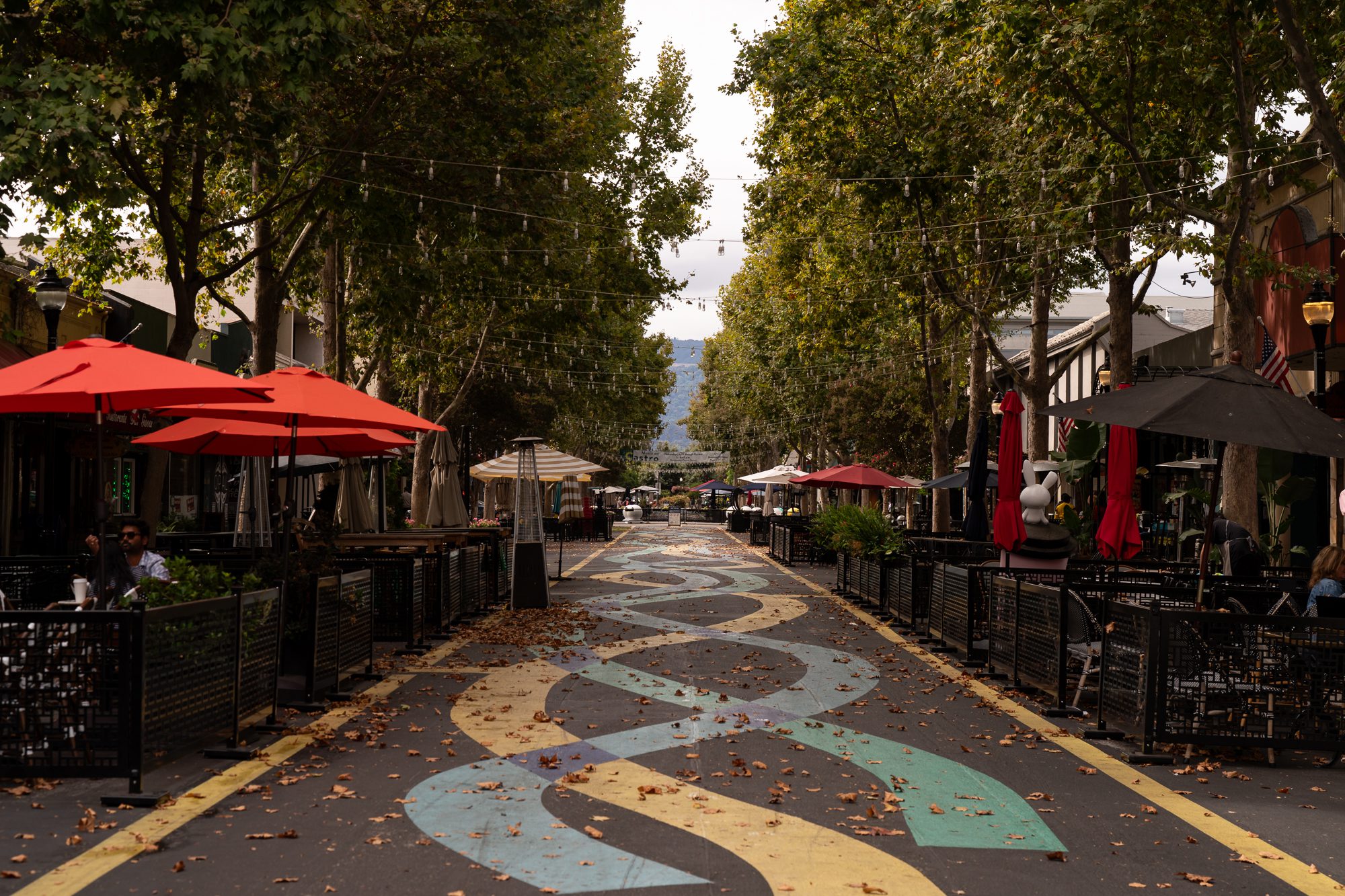
Five years after Mountain View closed off three blocks of downtown Castro Street to vehicle traffic, the city is looking to add large, central crosswalks at two main intersections to create a continuous route for pedestrians walking down the center of the blocked off street.
The first phase of the project, which city staff presented to the Council Transportation Committee on Tuesday, Dec. 2, would add 21-foot-wide crosswalks to the Villa and Dana street intersections, as well as new traffic signals and pedestrian push buttons.
Currently, people walking along the middle of Castro Street need to move over to a sidewalk in order to cross the street at each intersection. Principal Civil Engineer Robert Gonzales told the transportation committee this week that the present configuration breaks the continuity of the downtown pedestrian mall.
Installing the central crosswalks would allow community members to cross Villa and Dana from the center of Castro. The city also plans to retain the crossings that line up with the sidewalks on each side of the street.
Mountain View closed the 100, 200 and 300 blocks of Castro Street to cars during the pandemic to create space for outdoor dining. While originally intended to be a temporary closure, the city has since taken steps to make it permanent, including adding decorative fencing around the seating areas and striping along the middle of the street.
Creating a centralized path through the intersections is intended to provide a more consistent “look and feel” to the pedestrian mall as people move through it, Gonzales said.
If approved by City Council, staff anticipates that designs for the Dana and Villa street intersections will be finished by the end of summer 2026 and construction will commence shortly thereafter, finishing about six months later. The changes to these two intersections are expected to cost about $1.7 million, according to Senior Civil Engineer Joseph Cervantes.
Due to funding constraints, the City Council decided in October 2024 to delay changes to the California Street intersection until a second phase, the city staff report said. Currently, that intersection features a signalized roundabout for car traffic, and designs for its improvements aren’t expected to start until 2026. A date for construction of this phase has not yet been set.
At Tuesday’s meeting, City Council member John McAlister said that he wants staff to look at how they might reduce “clutter” in the designs for the Villa and Data street crossings, noting that the current plans include adding eight pedestrian push buttons at each intersection.
City Council member Alison Hicks emphasized that while she strongly supports the initiative to create a centralized pathway for pedestrians, she is also worried about some of the design elements. The proposed changes include the addition of removable standard bollards and the reuse of the existing decorative fencing that surrounds Castro Street’s outdoor dining.
“I support a lot of the configuration, but I feel like there’s a design element that is lacking,” Hicks said. “I feel like some of the furnishings or trim are not appropriate for a downtown.”
The current fencing isn’t the best fit for the area, Hicks said, adding that she feels the project is being rushed.
Despite the concerns, the members still recommended that the City Council approve the current plans, on the condition that staff continue working with the design team to refine specific elements.
This story originally appeared in the Mountain View Voice. Emma Montalbano is an education reporter for the Mountain View Voice.
Leave a Reply
You must be logged in to post a comment.