



|
Getting your Trinity Audio player ready...
|
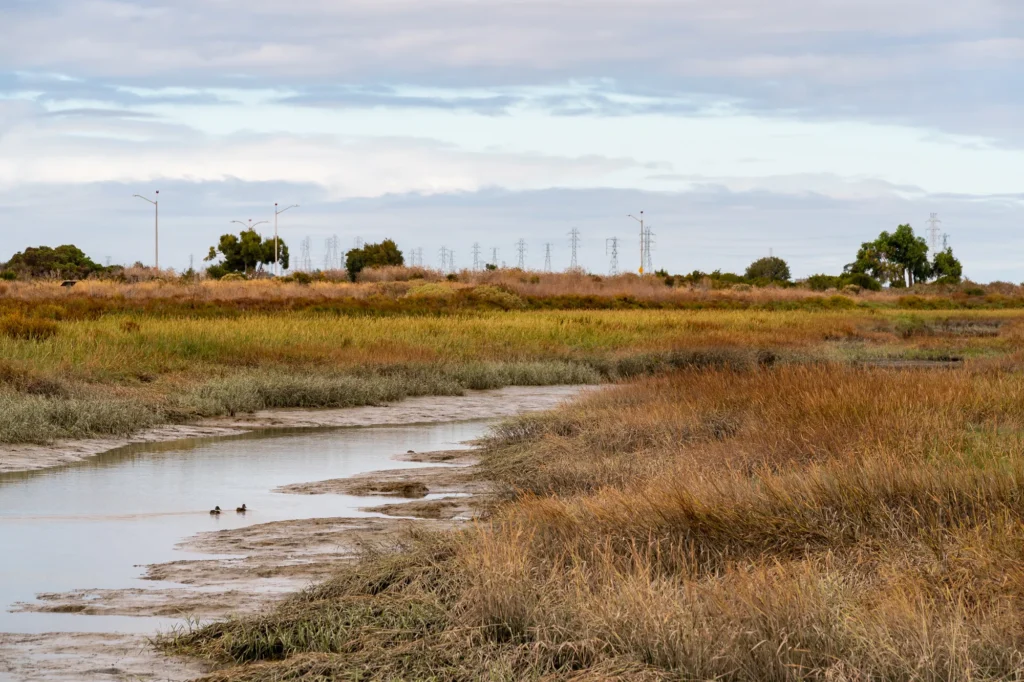
The ribbon of land stretching along the southeast edge of Palo Alto’s wastewater plant has little to offer at first glance, but plenty on the second or third.
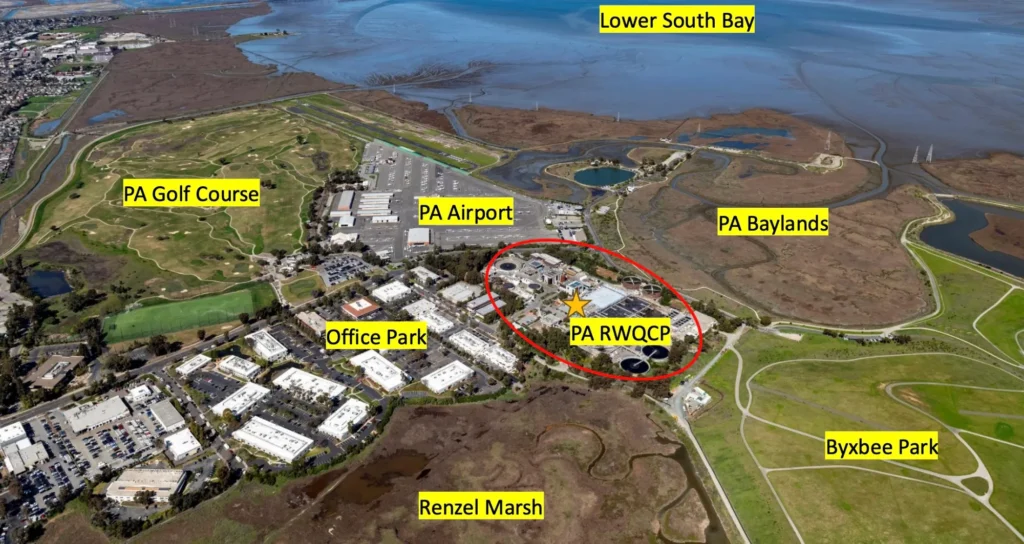
It stretches between two critical environmental habitats, the Baylands Harbor Marsh on its northern end and the Emly Renzel Wetlands to the south. When Palo Alto voters agreed to remove “parkland” status from a 10-acre area around this corridor 15 years ago, proponents noted that the flat strip of land currently doesn’t have any attractive features or amenities.
“Many times, it was presented as if there’s nothing there, it just stinks, nobody uses it, we don’t need it,” Palo Alto Parks and Recreation Commissioner Shani Kleinhaus recalled during a Tuesday discussion of the site’s future.
But a newly commissioned study challenges the notion that the corridor is a blank slate, or that it is perfectly suitable for a new industrial operation. A consulting team from Rincon studied the site and considered the viability of transforming it into a wildland corridor between the two marshy expanses. The team found the land is used by a variety of species, including the northwestern pond turtle, burrowing owl, salt-marsh common yellowthroat, California ridgeway rail and Crotch’s bumble bee.
Another area resident is the white-tailed kite, a little hawk that feasts on voles, the study found.
“It’s one of the few birds that mates for life, reuses their nest and has a large family group,” Travis Belt, natural resources director for Rincon, said. “So, a disturbance in that area could be … disturbing.”
It’s not just the white-tailed kite that sees a long-term future in the site. So do the engineers in the city’s Public Works Department, who see this land as a suitable location for a future industrial operation. While nothing is currently planned, staff requested the 2.4-acre piece of land next to the plant be reserved for a wastewater operation, even as the remaining 7.7 acres of the Measure E site get reverted to parkland.
Tina Pham, senior public works engineer, said staff want to be prepared for possible changes in state regulations or rising hauling charges, factors that may force the city to reconsider its local operations. Wastewater treatment equipment takes a long time to plan, design and build, she noted.
“We are much more likely to meet these regulations and deliver costs-effective projects if we’re able to reserve this 2.4 acres, rather than having to go through a process of undedicating the amount of land needed in order to build the same facilities,” Pham said. “We’re hoping to save time and money in order to move quickly in that case.”
That proposal proved to be a tough sell, however, with the Parks and Recreation Commission voting 3-2 to recommend restoring the parkland status to the entire 10-acre site. If the City Council accepts the commission’s recommendation, it would effectively reverse the results of the 2011 vote in which 63% of voters supported building a waste-to-energy operation on the Measure E site. The measure allows the city to restore the parkland status if the city doesn’t advance with the wastewater plant over the coming decade.
The proposed plant, which would have converted local biosolid waste into electricity, was never constructed, with city leaders deeming it too expensive and technically complex. Instead, the city continues to treat and dewater its biosolid waste, turning it into “sludgecakes” that are trucked to the Central Valley and Solano County and ultimately converted into an agricultural soil amendment.
The question of what to do with local biosolid waste proved divisive in 2011, when two camps of environmentalists clashed over whether it’s more critical for Palo Alto to treat its own waste or to protect a sensitive nature habitat. But while proponents of Measure E won that battle, the conservationists that oppose it may win the war.
Kleinhaus, who had opposed Measure E in 2011 and who now serves on the ad hoc committee that reviewed the staff proposal, retained her opposition to repurposing the Baylands site for industrial use. The Rincon report, she noted, confirms the value of the site.
“Why is nature so expendable? That’s always been my question,” Kleinhaus said.
Emily Renzel, the former vice mayor whose name adorns the marshland next to the Measure E site, also argued against removing the parkland protection. The charter amendment that the voters approved in 2011 made a provision for restoring the parkland status precisely to “prevent capricious use of park land whenever the city wanted new facilities and didn’t want to pay for the required land,” Renzel wrote.
Attempts by city staff to hold onto a portion of the Measure E parkland is “precisely a case in point,” Renzel wrote.
Her view ultimately prevailed, with Chair Nellis Freeman and Commissioner Roger Smith joining Kleinhaus in the 3-2 vote. Commissioners Vadim Axelrod and Yudy Deng dissented.
Former Mayor Peter Drekmeier, who was one of the leaders of the Measure E campaign, reprised his former advocacy role at the meeting. He argued that Kleinhaus’ historical opposition to the undedication of the 10-acre site should have disqualified her from serving on the ad hoc committee evaluating the issue. He also questioned the need to turn the land next to the wastewater plant into a park.
“There’s no community interest in putting park benches and picnic tables next to the wastewater treatment plant, with planes flying over,” he said.
Drekmeier also criticized the city for failing to do sufficient public outreach. He didn’t learn that the item is returning to the commission until last Thursday, he said.
“A lot of people would show up if they knew that the Measure E site was at risk,” Drekmeier said.
Stephen Rosenbloom, who supported Measure E, also urged the commission not to hasten to restore the parkland status. He supported the staff recommendation to restore the parkland status to 7.7 acres of land while preserving 2.4 acres for biosolids treatment.
“Voters agreed that we should take more responsibility for treating our waste and not (export) it for other people to deal with,” Rosenbloom said.
This story originally appeared in Palo Alto Weekly. Gennady Sheyner is the editor of Palo Alto Weekly and Palo Alto Online. As a former staff writer, he has won awards for his coverage of elections, land use, business, technology and breaking news.

Leave a Reply
You must be logged in to post a comment.