


|
Getting your Trinity Audio player ready...
|
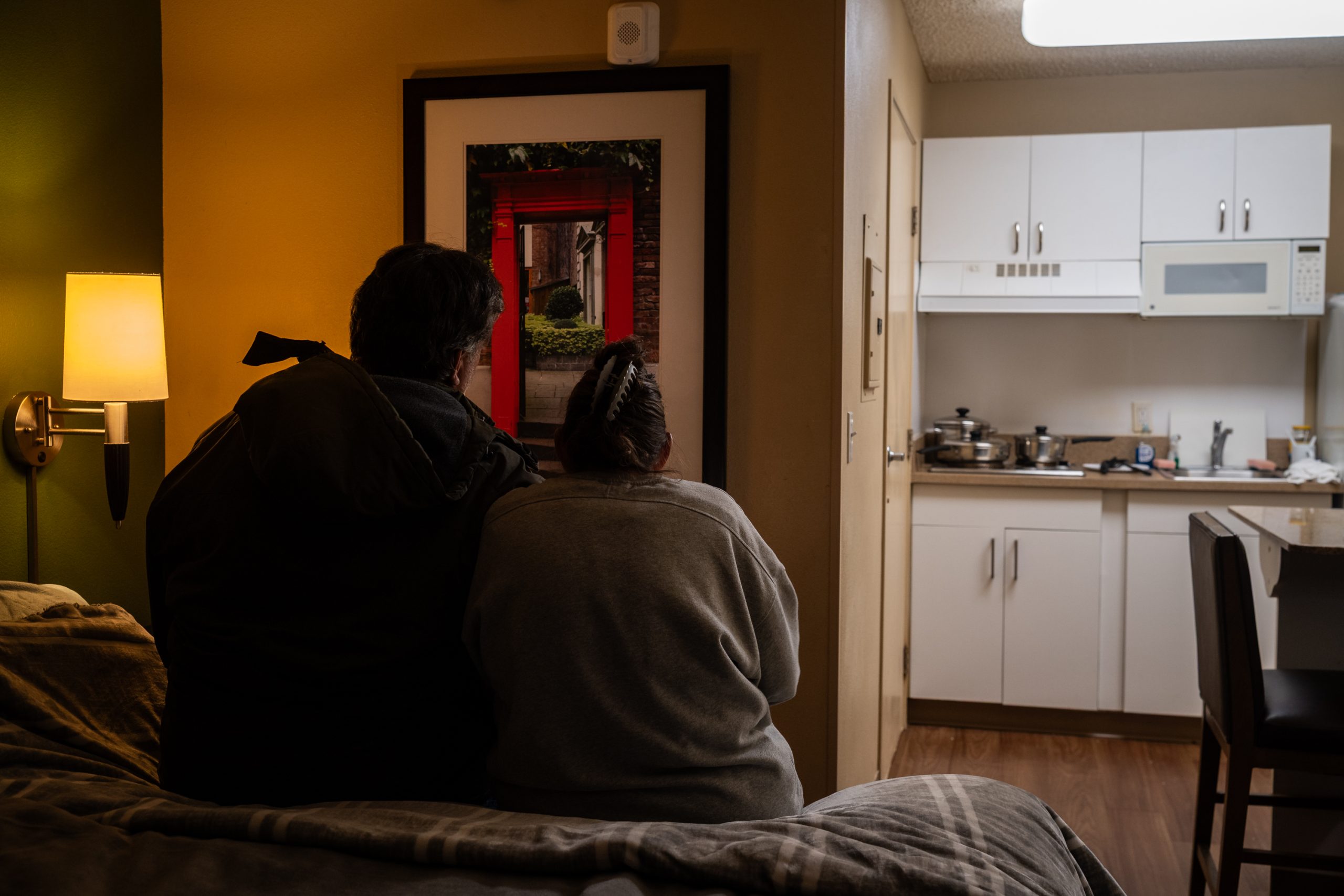
It’s a simple hotel room: a bed and night stands, a small kitchenette and a bathroom tucked in the far corner.
For Paul and Sheryl, it’s the difference between a good night’s sleep and a restless eight hours in a crowded shelter — or worse, on the street.
“Out there, you have one eye open all the time when you’re sleeping, and during the day, you’re so tired,” Sheryl said. “The best thing for our mental health has been not being in with anybody else.”
Paul and Sheryl, who asked to be identified only by their first names for safety reasons, are just two of dozens of homeless Palo Alto residents who have been moved into interim housing at a hotel in Sunnyvale. The program is operated by homeless services nonprofit LifeMoves — with support from Palo Alto and Santa Clara County — and aims to house people until the Homekey site with 88 units of interim housing opens in late spring of this year.
LifeMoves and Palo Alto requested that the exact location of the hotel remain unpublished in order to protect the families and individuals who are staying there through the bridge program. The Sunnyvale hotel was chosen due to its capacity and the contiguous layout of available rooms, according to LifeMoves. Only a few of the hotel’s buildings are being used for interim housing, and the rest remain available for other visitors.
During the cold months between mid-December and the Homekey opening, the Sunnyvale hotel acts like a bridge to keep people sheltered and ready to transition into more permanent housing, LifeMoves spokesperson Maria Prato said.
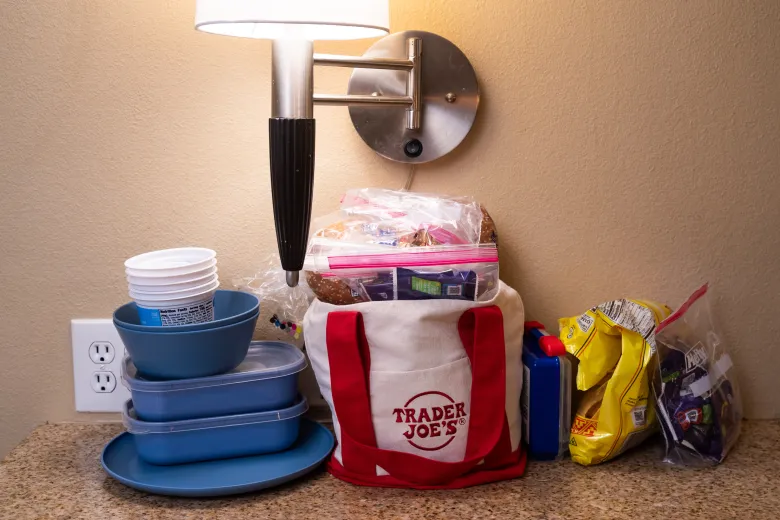
The biggest perk for Sheryl is the fact that their hotel room has a kitchen — she said her cooking beats shelter food. For Paul, access to a private shower and bathroom is a “godsend.”
The couple has been together for nearly two decades. Paul used to work in sales, sometimes for nonprofits, while Sheryl was a special education teacher in San Jose. But during much of their time in and around Silicon Valley, the two have struggled to find permanent housing. Sheryl’s disability makes it difficult to keep a steady job, while Paul was unable to afford housing even when he was working consistently.
Paul used to describe himself as a bit of a lone wolf. But in recent years, he said he has “been humbled to realize that sometimes, you need people.”
The program launched in mid-December, and barring any major community guideline violations, everyone being housed at the Sunnyvale hotel can expect a room at Homekey Palo Alto.
The Homekey project will supply 88 units of interim housing near the Baylands and has been long-anticipated by the city and the county to relieve pressure from the shelter and transitional housing system. The three-story development at 1237 San Antonio Road will include 64 apartments for single residents and 24 for families. The City Council approved it in June 2023, and construction launched in October of that year.
“The city was involved early on in this effort, with LifeMoves in the lead, and we’ve been very supportive of the opportunity to benefit both the unhoused community regionally and in Palo Alto,” Melissa McDonough, assistant to the city manager, said.
Palo Alto’s homeless population, for the most part, lives in vehicles or RVs, according to city documents. Based on the homeless point-in-time count from January 2025, there were roughly 400 unsheltered homeless people living in Palo Alto, of which 76% were in vehicles. Only 19 individuals were living in a shelter.
As of last week, the Sunnyvale program was housing 22 families and 58 single adults, about 90% of the capacity of the Homekey site. Clients can be referred through the county’s coordinated entry program, which matches unhoused residents to appropriate temporary or permanent housing based on an assessment of their needs. Prato with LifeMoves said participants also have the opportunity to work with a case manager while staying in Sunnyvale, but it’s not mandatory.
The program is geared specifically toward longtime Palo Alto residents who have had difficulty finding temporary or permanent housing, Prato said. For example, outreach workers with the county may ask homeless residents if they work in Palo Alto or have children attending school there to determine their compatibility with this particular program.
Some participants also have to attend appointments, school or job interviews in Palo Alto while staying in Sunnyvale, so Palo Alto is paying for ride-shares to and from those obligations. Unlike many other shelter options in the area, residents can bring their pets, and if they have a car, they can park it on-site. RVs are not allowed, however.
Paul and Sheryl did not previously live in an RV before finding themselves in Sunnyvale, but the couple said they are eager to be on the path to a more permanent living place soon.
“We’re part of your community,” Paul said. “It can be you.”
KJ Kaminski, who leads the county’s Office of Supportive Housing, said Santa Clara County does not keep track of where program participants are living before they move into the Sunnyvale hotel. Whether it’s a car, an RV or a tent, their living situation is not suitable for human habitation, Kaminski said.
“We would communicate the limitations of the shelter that they’re being referred to if they had an RV,” Kaminski said. “It would be up to that household to determine what they wanted to do with their RV, or if they would rather get on a waitlist for a safe parking program that can accommodate RVs.”
Prato was clear to say the Sunnyvale bridge program will not be able to completely address Palo Alto’s influx of people living in RVs. The issue is also a regional one: neighboring cities like Menlo Park and Mountain View had placed restrictions on where and for how long people could park RVs on public streets, long before Palo Alto followed suit with its own phased policy approach.
Palo Alto’s only city-sponsored safe parking site, which gives people living in their vehicle a designated place to stay, has been at capacity nearly every day since opening in 2020. The city also has a program that allows local congregations to host up to four vehicles, though these typically are not RVs. While the city recently expanded its Geng Road safe parking site, raising its capacity from 12 to 22 RVs, it falls well short of what’s needed to accommodate the recent influx in oversized vehicles on city streets. Last year’s point-in-time count showed the city’s population of unsheltered individuals doubled from 2023 to 2025.
The city council has been inundated the past several months with complaints from residents and business owners about RV parking in their neighborhoods. People cite the lack of proper sewage disposal and other potential health hazards, as well as the fact that parked RVs on residential streets can limit visibility for cyclists and pedestrians.
The city formed a council ad hoc committee to further study the issue, and in the meantime, passed the first phase of a policy in October that attempts to balance the health and safety concerns without displacing homeless residents who say they have nowhere else to go. In practice, that looks like greater enforcement of the 72-hour parking limit, a ban on parking detached trailers and an exploration of alternative housing options like safe parking sites — or even a hotel two towns south.
The Sunnyvale bridge program will close after its residents are fully transitioned into the Homekey site later this year, Prato added.
Leave a Reply
You must be logged in to post a comment.