


|
Getting your Trinity Audio player ready...
|
After more than a decade of debating and designing, Palo Alto is approaching a critical juncture in its plan to redesign the rail corridor, a critical and complex project with a price tag that now hovers above $1.5 billion, according to new projections from the city and Caltrain.
The City Council is getting ready to advance in September a set of recently refined designs for three rail crossings: Churchill Avenue, East Meadow Drive and Charleston Road. Each would achieve grade separation, allowing trains to travel on a different plane than drivers, bicyclists and pedestrians.
The city has been pursuing grade separation for more than 15 years as a way to improve east-west connectivity, reduce traffic backups that occur near rail crossings when the gate is lowered and eliminate the city’s most prevalent method of youth deaths by suicide. Just last week, The JED Foundation released a report on youth suicide that recommends pursuing grade separation at all railway crossings to support youth mental health.
“Although restricting access along railway systems can be operationally challenging and costly in the short term (grade separation), such interventions may prove cost-effective over time,” the report states.
Any construction would be, at best, years away. The city’s next milestone is approval of 15% design for each grade separation alternative, an incremental but critical step that will allow councilmembers to seek project grants, Palo Alto’s Chief Transportation Official Ria Hutabarat Lo said at a Tuesday community meeting on the project.
After that, city staff and Caltrain consultants would proceed to 35% design, at which point the city could perform environmental analysis and refine project costs and construction schedules. If things go as planned, the city will hit that target in late 2027.
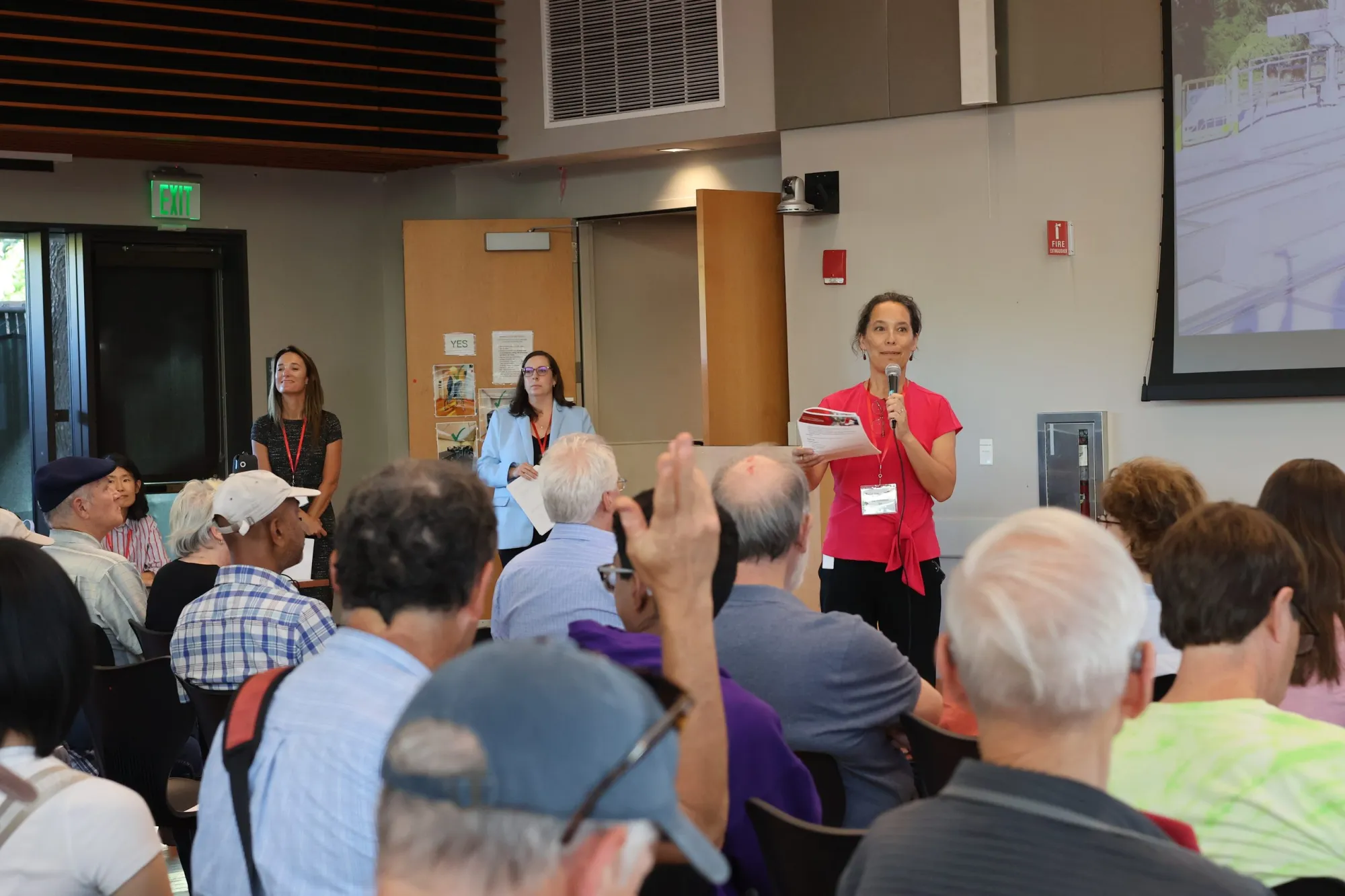
While city leaders see grade separation as a key transportation improvement, not everyone is thrilled about the evolving plans. More than 50 people attended the meeting at Mitchell Park Community Center, where consultants shared the latest renderings and residents sounded off on their biggest concerns: property impacts, bicycle access and the need for temporary “shoofly tracks” that would need to be installed over the course of construction, in some cases close to area homes.
John Melnychuk, who lives near the Meadow crossing, complained about the “Berlin Wall” that the city plans to build near his house and the shoofly tracks that would run close to his front door for years. Others wondered about changes to their property values and the traffic impacts from construction.
But perhaps the biggest wildcard is money. According to figures from Caltrans, grade separations at all three crossings would cost between $1.5 billion and $1.6 billion if the East Meadow and Charleston grade separations were performed concurrently, and between $1.7 billion and $1.8 billion if they were done in sequence, first Charleston and then East Meadow.
Given the astronomical costs, some people at the meeting wondered if the project would advance at all. Even if the council ultimately makes a definitive decision about what grade separation options to pursue, will it make any difference?
“Will people say, ‘It’s too much money?’” resident Jon Foster asked at the meeting.
At the moment, the city is more than $1 billion short. Even as design work continues to advance on all three crossings, councilmembers have indicated over the past year that they will likely start with one crossing. As the busiest of the three, the southernmost crossing at Charleston is the likeliest to go first.
At the moment, the city is relying on local funds and contributions from the Federal Railway Administration and VTA to bring the project to 35% design. Funds from Measure B, VTA’s sales tax measure, are expected to also help with construction costs once the city finalizes its options. These funds would not, however, be enough to pay for the entire project.
“None of these numbers add up to $1 billion yet,” Edgar Torres, a consultant from the firm Kimley-Horn who is working on the project on behalf of Caltrain, said.
So what would the redesigned crossings look like? Under the current plan, Charleston would get an underpass that would allow cars, cyclists and pedestrians to use a direct access ramp to go beneath the tracks as they cross the corridor. Charleston would be lowered while the tracks would remain in their current alignment.
On Meadow, the city would pursue a “hybrid” model that combines raised tracks and a lowered road. Because the slope would be less steep than on Charleston, the ride would be smoother, Torres said.
“It’s more gradual, there’s better lines of sight, it allows cyclists to be able to go to bike lanes and be very visible at the intersections,” Torres said.
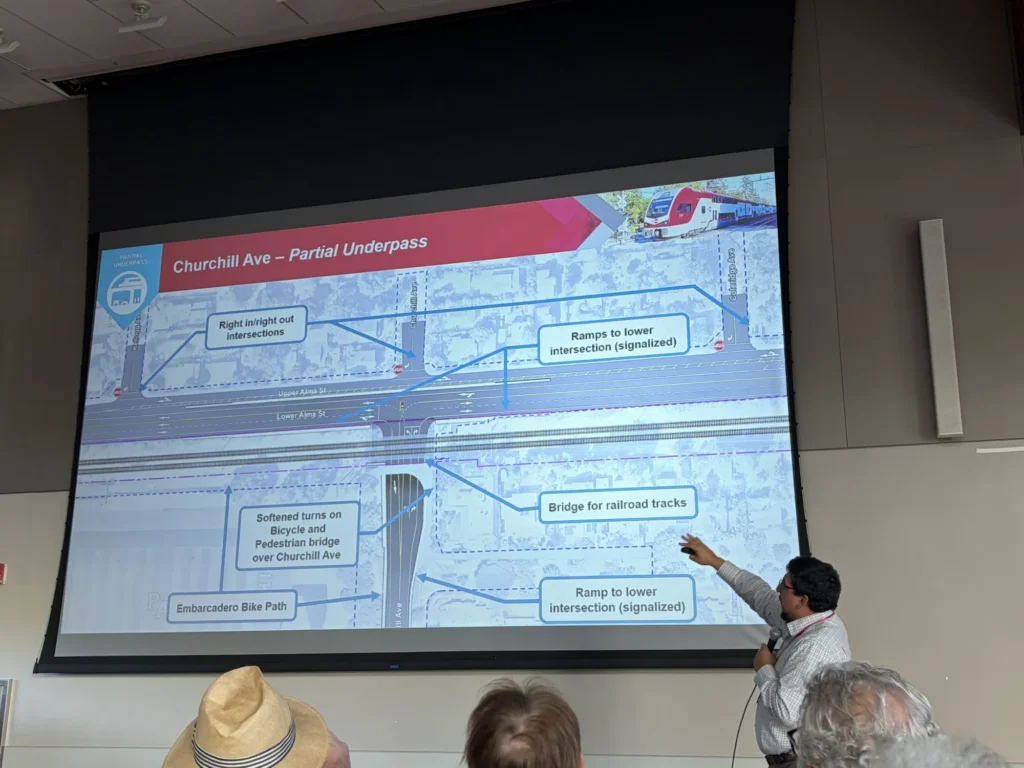
The city’s top alternative for the Churchill crossing is the “partial underpass” that would send cars under tracks and create a T-intersection on Alma Street for eastbound traffic. Concurrently, the city would create a separate crossing for cyclists and pedestrians near Seale Avenue, allowing them to go beneath the tracks.
The city and Caltrain made some refinements over the past year in response to public feedback. On Churchill, it eliminated a planned landscape strip along Alma to minimize property impacts. On Charleston, it eliminated a planned roundabout east of the tracks, near Mumford Place, in favor of direct ramp access, a change that is intended to shrink the project’s footprint.
Some residents, including council candidates Brian Hamachek and Henry Etzkowitz, have continued to call for train tunnels as a preferred grade separation option. But Torres told the crowd that because the tunnel would have to go past two creeks, that alternative would be far more complex and more expensive “by orders of magnitude” than the options presented at the meeting.
This story originally appeared in Palo Alto Weekly. Gennady Sheyner is the editor of Palo Alto Weekly and Palo Alto Online. As a former staff writer, he has won awards for his coverage of elections, land use, business, technology and breaking news.
Leave a Reply
You must be logged in to post a comment.