


|
Getting your Trinity Audio player ready...
|
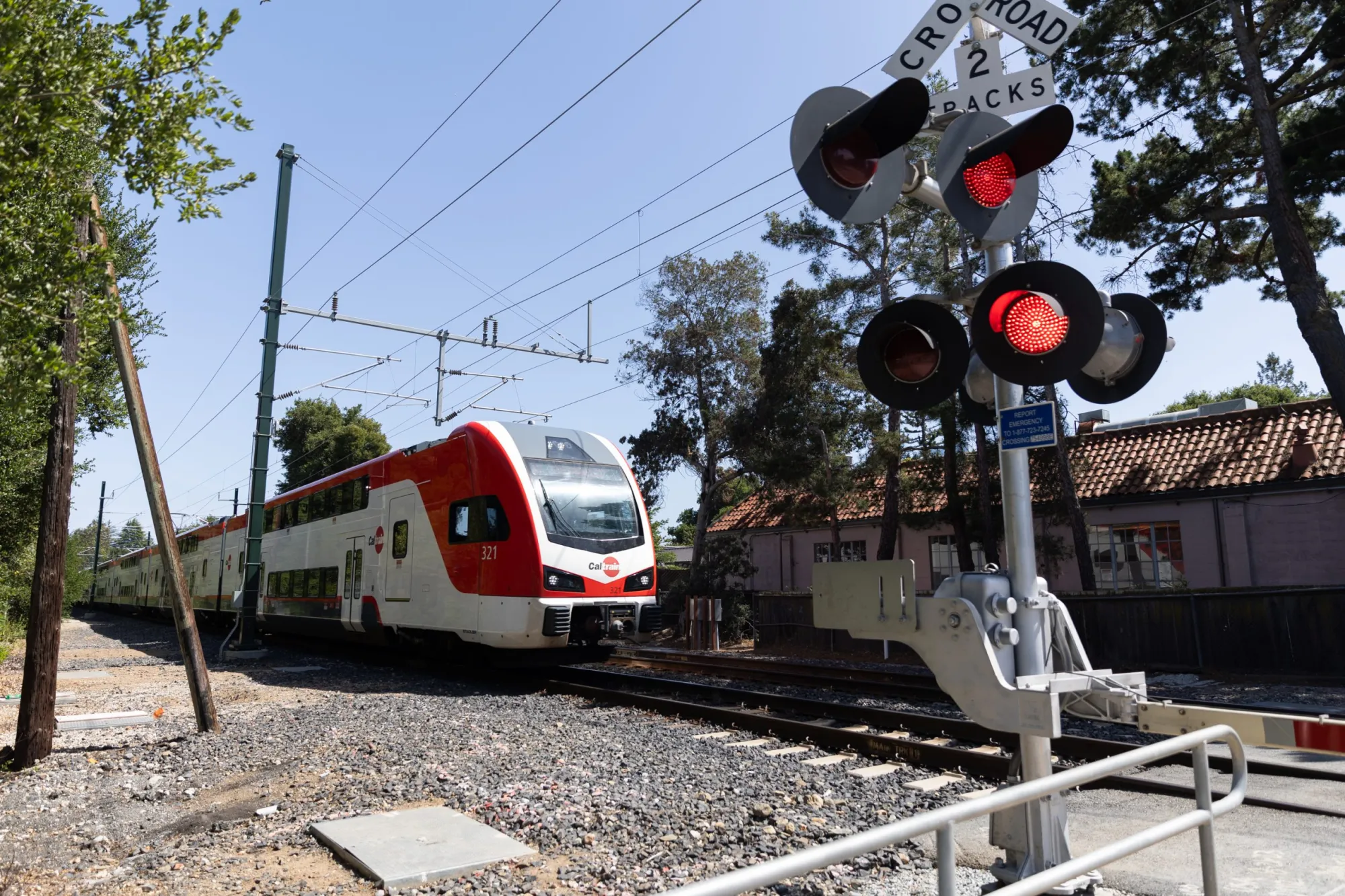
After more than a decade of designing, debating and dreaming of grade separation at three local rail crossings, Palo Alto’s elected leaders are preparing to narrow their scope and focus their energy on one location: Charleston Road.
Formally, the City Council remains committed to exploring grade separation on Charleston, East Meadow Drive and Churchill Avenue. Later this month, councilmembers are set to review the 15% design for all three crossings and advance them to 35% design, at which point the city could seek grant funding and begin conducting environmental analysis. The analysis is funded largely through state and federal grants.
But as members of the council’s Rail Committee acknowledged Tuesday, the high costs of actually constructing grade separation make it all but impossible for the city to pursue all three projects, which would collectively cost more than $1.5 billion, according to new projections.
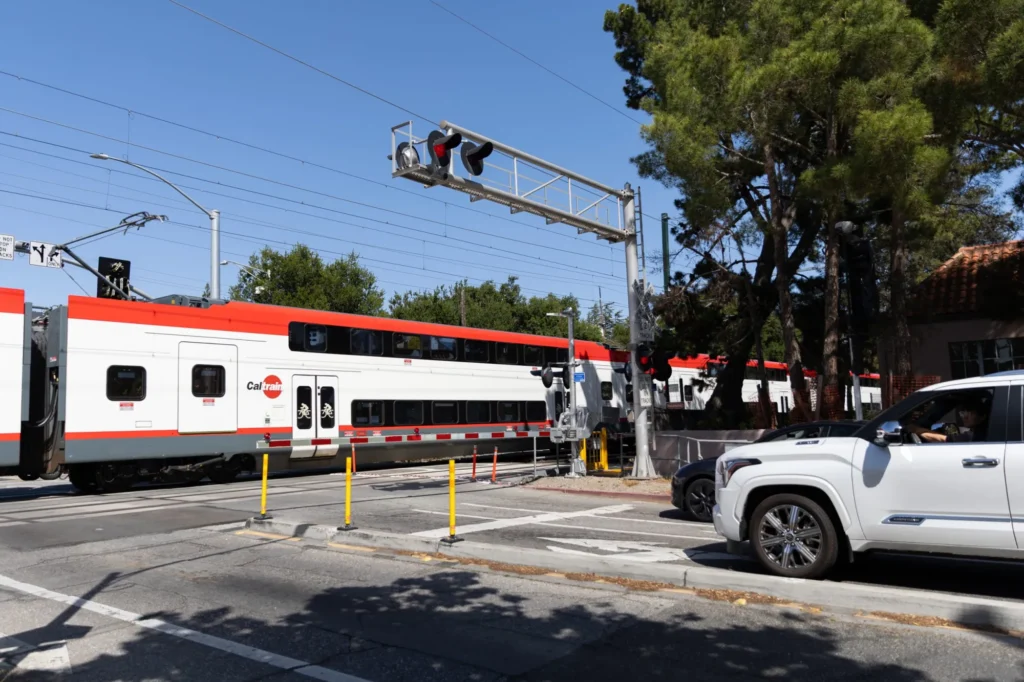
The city’s preferred alternative for Churchill, a “partial underpass” for cars, would have a price tag between $420 million and $450 million, according to Caltrain. Building a car underpass on Charleston, the city’s busiest crossing, would cost between $480 million and $530 million. Meanwhile, pairing Charleston with East Meadow, where the city is exploring a “hybrid” design that raises the tracks and lowers the road, would cost between $1 billion and $1.3 billion, depending on the work sequencing.
All three committee members — Chair Pat Burt, Julie Lythcott-Haims and Ed Lauing — highlighted funding as a major concern. Lauing called the projected costs for the three grade crossings “staggering” and suggested that pursuing all three would be “unrealistic.” He suggested it may be time to formally pause work on the other crossings.
“Should we at this point in time sort of take a little bit of a turn and say, ‘Let’s focus on Charleston?’ That solves our immediate needs,” Lauing said at the meeting.
Lythcott-Haims said even the city’s preferred alternatives have flaws, with the East Meadow and Charleston crossings requiring either partial or full property acquisitions to accommodate utilities and new road configurations. She wondered what the odds are that the city secures the needed state, federal and regional funding to pay for these projects.
“We wouldn’t be talking about it if it was completely impossible, but obviously it’s not a shoo-in,” Lythcott-Haims said. “We know it’s not entirely on the city to have bake sales to raise $1 billion.”
Burt, who serves on the Caltrain board of directors, was particularly explicit about his desire to narrow the city’s scope to one crossing. He said even if the city limits its ambitions to building an underpass for cars at the Charleston crossing in conjunction with an underpass for bikes and pedestrians near Matadero Creek, that would be a long and costly endeavor.
“That’s a lot to take on, with a lot of construction impacts, a lot of benefits. Those are two historic projects,” Burt said.
The committee’s comments represent a market shift in the city’s conversation about grade separation. Earlier this year, the city was strongly considering closing the Churchill crossing in the aftermath of a student who died by suicide. Former school Superintendent Don Austin was among those who advocated for the Churchill closure as a part of the city’s response to a suicide cluster.
After hearing from both advocates and opponents of the Churchill closure, the council abandoned that option in May.
The idea of reducing student access to the tracks resurfaced in a new report from the Jed Foundation, a nonprofit that specializes in mental health. The report recommended the city pursue grade separation at all railroad crossings in Palo Alto.
“Although restricting access along railway systems can be operationally challenging and costly in the short term (grade separation), such interventions may prove cost-effective over time,” the report states.
The report identifies grade separation as part of a package of measures that could reduce access to the railroad right-of-way, a list that also includes high-security fencing, intrusion detection systems and anti-trespass infrastructure.
“While such projects require substantial financial investment and extensive planning, they offer the greatest potential for durable risk reduction and may prove cost-effective over time when considering the human, social, and economic costs associated with repeated fatalities and traumatic incidents,” the report states.
Caltrain has already installed some safety measures, including LiDAR systems that use artificial intelligence and lasers to detect intrusions at the tracks. The council and Palo Alto Unified School District have also hired security guards to patrol the tracks at an annual cost of $1.7 million, which the two entities are splitting.
Even though the council has been discussing grade separation for more than 15 years, Burt pushed back Tuesday against the Jed Foundation’s recommendation that the city should continue to look at all at-grade rail crossings. Even if the city found a way to fund grade separations at all four existing rail crossings — Palo Alto Avenue, Churchill Avenue, East Meadow Drive and Charleston Road — the projects would likely take at least two decades to be completed, he said.
“The recommendation from Jed Foundation to do something that is $2 billion, that is very unlikely to materialize and take 20 years to do it was really a disserve to us to make that recommendation in the way that it did,” Burt said. “It’s not realistic and it has elements of the community going, ‘Why don’t you just think about grade separating it all and you’ll solve this problem?’ We’ve been thinking about it.”
This story originally appeared in Palo Alto Weekly. Gennady Sheyner is the editor of Palo Alto Weekly and Palo Alto Online. As a former staff writer, he has won awards for his coverage of elections, land use, business, technology and breaking news.
Leave a Reply
You must be logged in to post a comment.