


|
Getting your Trinity Audio player ready...
|
San Jose’s tree canopy is disappearing.
The city is working to reverse the trend, but advocates say in order to meet its goals, more investments are needed in low-income neighborhoods where coverage is sparsest. San Jose has one of the thinnest tree canopies in the Bay Area, with about 13.2% of coverage across the city as of 2020. That’s down from 15.4% in 2012. A recent Santa Clara County Civil Grand Jury report found that if the city plants 2,000 trees a year, it won’t reach its goal to have 20% of the city covered by 2051.
“I don’t think the city’s strategy is feasible, particularly for high poverty neighborhoods,” Jose Murillo, director of place-based neighborhoods for nonprofit Amigos de Guadalupe Center for Justice and Empowerment, told San José Spotlight. “I just don’t think that we will get significant tree canopy coverage in our neighborhoods such as Mayfair, unless we do something radically different. The city should be responsible for maintaining, pruning and planting trees in high poverty neighborhoods.”
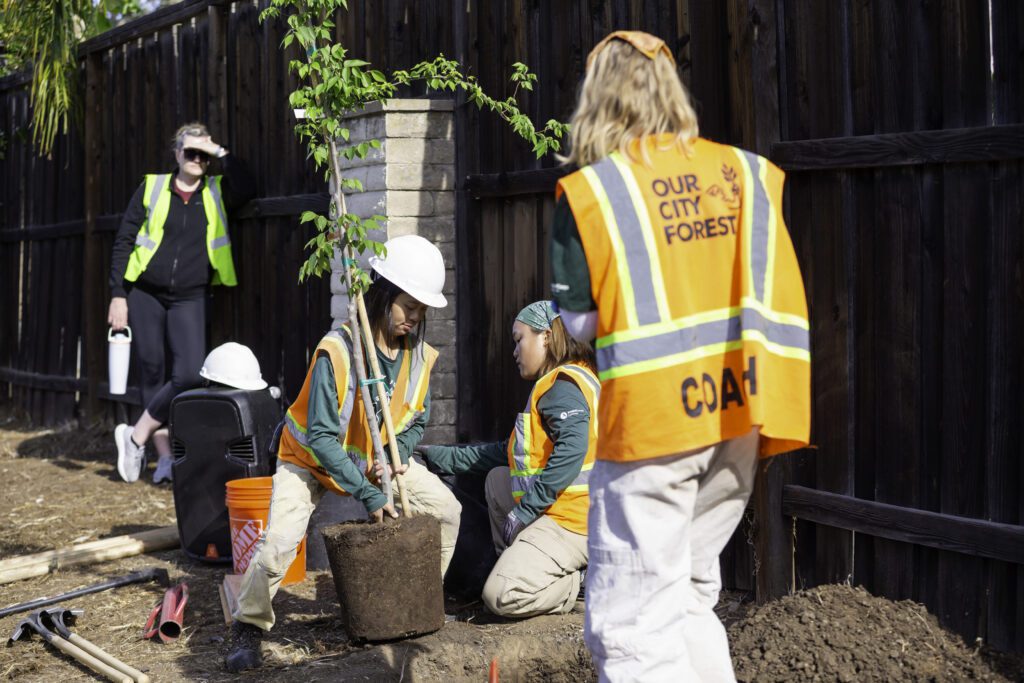
Property owners are responsible for maintaining trees on their property and on the sidewalk next to their home. More than 90% of San Jose’s 1.6 million trees fall on the responsibility of homeowners to maintain, an unrealistic burden for some households, Murillo said.
City staff disagree with the civil grand jury report’s findings. Since a 2022 audit, the city has been planting 2,073 trees a year on average — up from roughly 400 trees a year. Over the last four years, the city has planted more than 7,000 trees, representing a net gain, a Department of Transportation spokesperson said.
“To help preserve existing trees, we have reduced our pruning cycle on city-maintained trees from roughly 30 years to 11,” spokesperson Colin Heyne told San José Spotlight. “We have also updated our approach to tree preservation with respect to roadwork and development projects, seeking to keep existing trees in place if feasible and safe.”
However, the report indicated that the city would realistically need to plant between 4,500 to 22,000 trees every year to reach its goal of 20% coverage if the trees are smaller than 50 feet.
Heyne said the city does not have the sizes of the trees it’s planting readily available.
“Without deliberate strategic planning, the city seems to be headed for inevitable failure — just as in 2007 when it reached only 15-20% of its goal to plant 100,000 trees,” the report reads.
Trees not only provide needed shade during scorching summers, they help clean the air, mitigate flooding by absorbing rainwater and support wildlife. Places like East San Jose have as little as 9% tree coverage, and as a result could be several degrees hotter than well shaded areas in the city.
The lack of tree coverage in high poverty areas affects mental well-being, as well as someone’s ability to enjoy the neighborhood, Shawn Gerth, executive director of community farm Veggielution, said. Her organization is working on a plan to increase tree coverage in Mayfair by growing oak trees on the farm and then planting them in key areas in the neighborhood.
“East San Jose is 7 degrees hotter than other neighborhoods with adequate tree cover,” Gerth told San José Spotlight. “You see people walking around Mayfair in summer with umbrellas, and folks know why they’re not going outside. You can’t navigate from one part of the neighborhood to another part as comfortably as you can in other neighborhoods that have adequate tree cover.”
San Jose’s tree canopy is declining in large part because the city hasn’t invested enough in preserving its mature trees, Tara Sreekrishnan, executive director of nonprofit Our City Forest, said. Trees require regular pruning to ensure they are healthy and compatible with street infrastructure such as power lines. The city hasn’t tracked how much it invests in pruning trees it maintains.
“If folks don’t have that, you’ll see improper pruning, and that can weaken the tree or create hazards,” Sreekrishnan told San José Spotlight. “So preventative and structural pruning is really important for protecting mature canopy.”
Our City Forest, an urban forestry organization established in 1994, grows and plants trees across Silicon Valley. Its community nursery and training center incubates thousands of trees and arborists teach residents how to care for them.
In 2023, San Jose received a $ 6.6 million federal grant to provide free street trees to qualified property owners, in addition to three years of watering and pruning services. Heyne said the city plans to plant 2,800 new trees and prune 5,000 existing ones in the next two years through the program.
Sreekrishnan said the city should invest in a public dashboard so residents can see where tree plantings are happening and whether new trees are surviving, as well as have a stronger strategy for pruning trees in residential and low-income neighborhoods.
“We have a lot of infrastructure in place, and it’s worth the city’s investment to partner with us more,” Sreekrishnan said.
Contact Joyce Chu at [email protected] or @joyce_speaks on X.

Leave a Reply
You must be logged in to post a comment.