


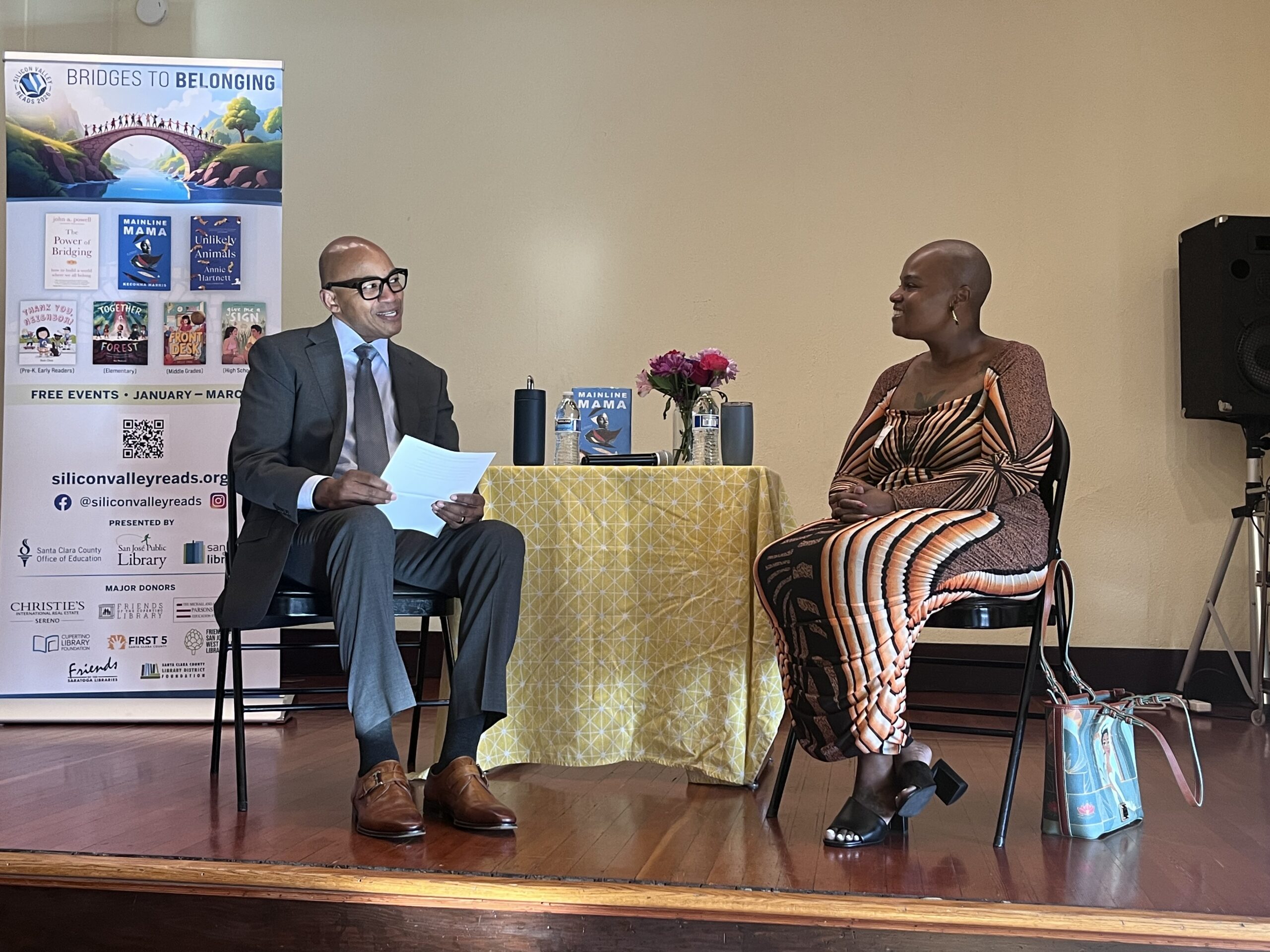
Disproportionately high levels of mass incarceration affect Black people and their families. Local criminal justice advocates are fighting for reform.
That was the focus of a recent panel discussion between “Mainline Mama” memoir author Keeonna Harris and Chuck Cantrell, creator of the “Dying to Stay Here” video and podcast series and San José Spotlight columnist. The panel, hosted by nonprofit Silicon Valley Reads, took place Jan. 17, where the pair discussed the systemic barriers facing Black communities in California.
After her partner was sentenced to 22 years in jail at age 17, Harris experienced life as a young Black mother fighting to keep her family intact while navigating the justice system.
“The first five years were the most difficult for him because he felt his life was over,” she said. “Twenty-two years … when you are a teenager sounds like a lifetime.”
Black people, who make up 2.9% of Santa Clara County’s population, were arrested 5.3 times more than white people in 2021, according to the Vera Institute of Justice. Black men and women made up 28% and 23% respectively of prisoners statewide in 2023, while representing only 6% of the state’s adults, according to the Public Policy Institute of California.
Spending weekends visiting her partner in prison, Harris became a fierce advocate. She said she wrote letters and made phone calls, which affected how her partner was treated. She formed a community with other women visiting their loved ones and advocated on their behalf. Her success buoyed her to found the Borderland Project, a mental health and support system which advocates for women and families affected by incarceration.
Harris, who has a doctorate in justice studies, desires an end to the existing penal system. She said everyone’s made mistakes, but what differs is who gets caught and arrested.
Her memoir about her experiences was chosen by Silicon Valley Reads for its 2026 Bridges to Belonging series. The nonprofit aims to use selected books and events to spark connection and empathy and encourage discussion in the community.
“My book is a love letter to Black girls and women, because I want those people who are trying to keep a connection to an incarcerated person to feel seen and heard,” Harris told San José Spotlight. “Oftentimes, our voices are left out of any conversation when it comes to mass incarceration, reform or reentry — and we are the ones that are shouldering all the weight.”
Jails and prisons are sites of human bondage disguised as rehabilitation, Cantrell said.
“Black people simply walked off the plantation and into a jail cell, a chain gang and prison work camp,” he wrote in a column on the school to prison pipeline. “For Black children in Santa Clara County, zero-tolerance school policies never fostered opportunity — they shortened the road to incarceration.”
Cantrell said in the 2023-24 school year, the suspension rate for Black students in Santa Clara County was 6.2%, while the average rate for all groups was 2.2% despite Black students comprising only 1.8% of the total enrollment.
Silicon Valley De-Bug is working toward criminal justice reform, police accountability and racial and economic justice. Founder Raj Jayadev said having an incarcerated family member creates generational devastation. He said historically, police stops, arrests and sentencing have been inherently anti-Black, and Black people are charged with resisting arrest at a rate eight times that of the general population.
“That’s what we’ve seen happen here in San Jose, in Santa Clara County for a long time,” Jayadev told San José Spotlight. “There is no collective recognition or acknowledgement of the inherent discriminatory practice of incarceration to the Black community.”
De-Bug created participatory defense, an organizing model which provides a way for families and communities to challenge and impact the outcome of court cases and transform the landscape of power in the court system.
“It had huge outcomes,” Jayadev said. “Charges started getting dropped. People didn’t feel forced to take plea deals. What would have been prison sentences became out of custody resolutions.”

Jayadev said it’s past time this country relinquished its reliance on incarceration.
“I don’t think that there’s anything redeemable or virtuous about the criminal punishment system,” he said. “It is a tool simply for controlling people, particularly controlling communities of color.”
NAACP San Jose/Silicon Valley President Sean Allen said the local Black population continues to drop because of the criminal justice system, which is racially biased due to its leadership and culture. Allen, a former correctional officer, said San Jose needs to bring in an outside police chief.
“We don’t have a significant presence in the city, but we have a significant presence in our jails,” he said.
Contact Lorraine Gabbert at [email protected].
Leave a Reply
You must be logged in to post a comment.