


|
Getting your Trinity Audio player ready...
|
A dispute between contractors has disrupted the construction of the transitional housing complex that Palo Alto and nonprofit organization LifeMoves are preparing to open on San Antonio Road, next to the Baylands Nature Preserve.
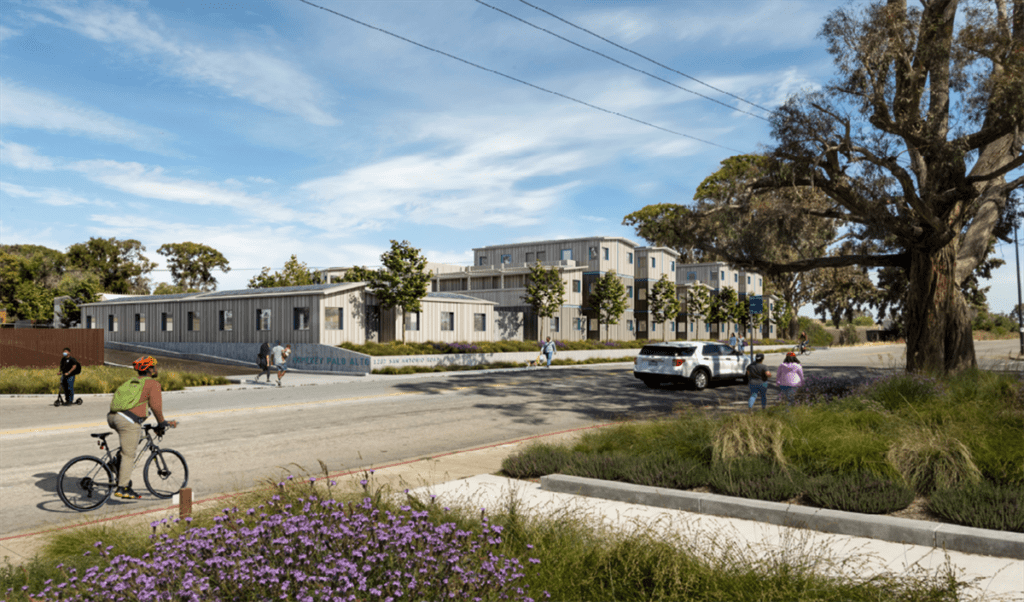
The Homekey project at 1237 San Antonio Road has been in the works since fall 2023, when city and state leaders touted its importance in addressing the local and regional housing crisis. Once completed, the 88-room complex next to the Mountain View border will focus on providing shelter to more than 200 homeless individuals and families.
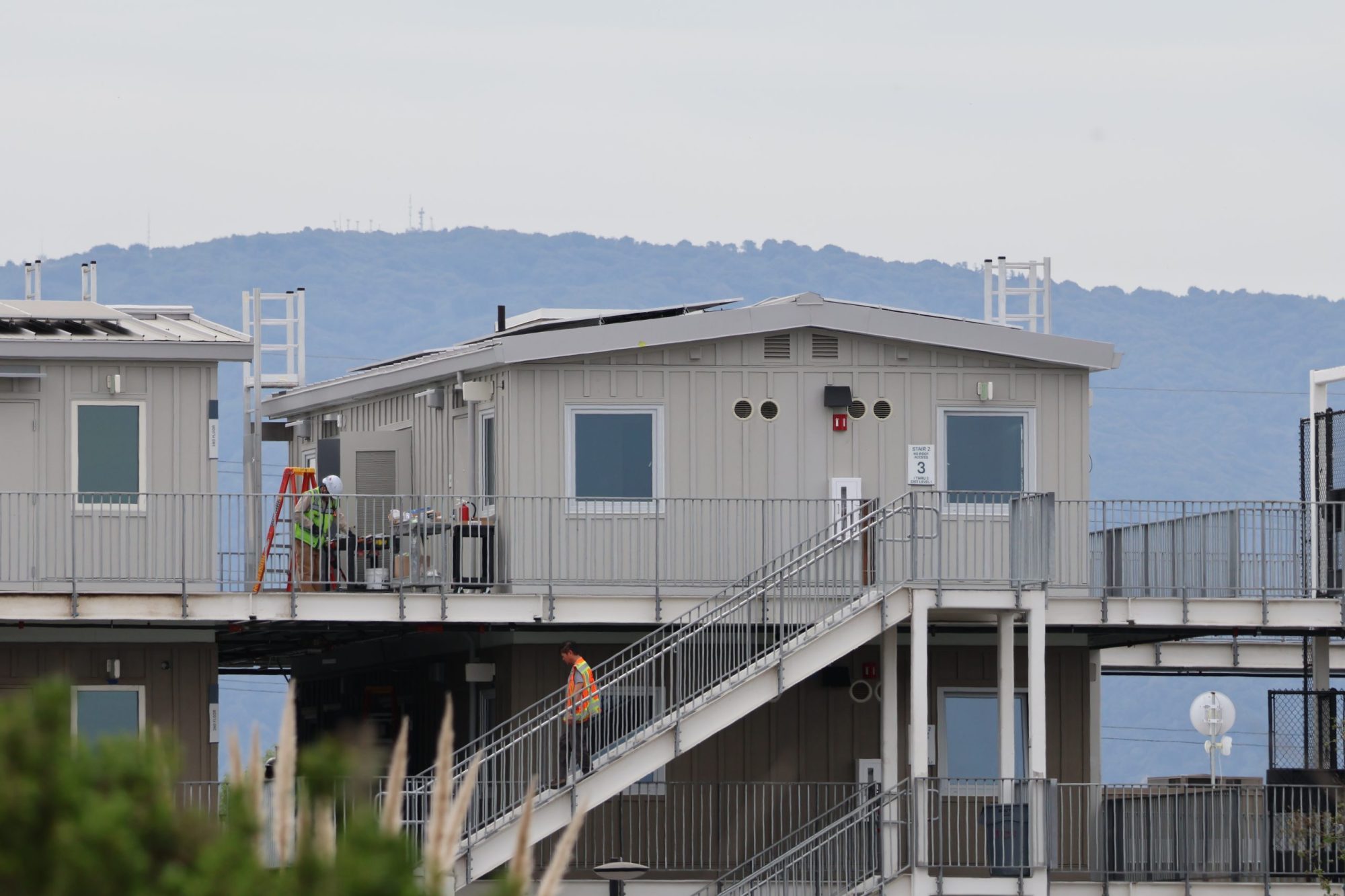
The project was scheduled to be completed earlier this year, and initially had a construction deadline of April 21, 2025 set by the state. Although it looks largely complete from the outside, it has yet to cross the finish line. While LifeMoves has not confirmed an exact opening date, spokesperson Maria Prato said it is on track to open in late spring.
That said, the delays have already caused significant complications for LifeMoves, prompting it to open up a temporary location in Sunnyvale as it scrambled to meet a state deadline to provide shelter to unhoused individuals.
Contract delays
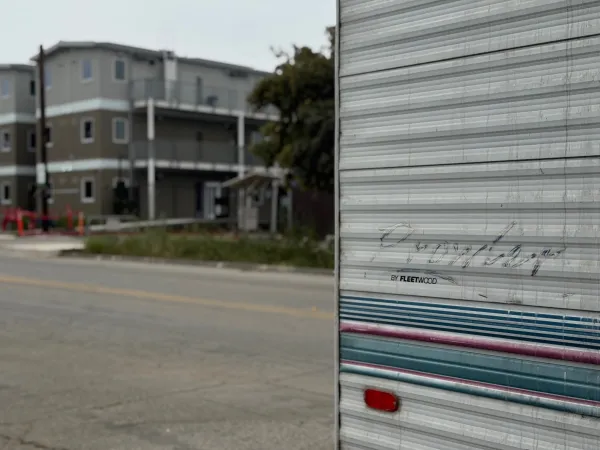
At least some of the delays behind the opening of Homekey Palo Alto can be attributed to disagreements between the project’s general contractor, Devcon Construction, Inc. (DCI), and its various subcontractors. According to public records obtained by the Palo Alto Weekly, the subcontractor ARECO Construction halted work in November 2025, citing nonpayment from another subcontractor, Volumetric Building Companies (VBC), which is responsible for the modular units on site.
City Manager Ed Shikada wrote in an email to the City Council in November that the payment disputes totaled $1.4 million.
“This is clearly a payment dispute between DCI and their subcontractors. DCI remains contractually responsible for delivering the site per at the agreed-upon Guaranteed Maximum Price,” LifeMoves CFO Paul Simpson wrote in a memo to city officials in December. “LifeMoves intends to hold Devcon wholly responsible for any delays in project completion caused by the work stoppage.”
The contract dispute is ongoing, Prato confirmed last week, but she added there is no further impact on the construction timeline and no risk to public funds.
Devcon CEO and President Gary Filizetti said the company is paying ARECO Construction directly instead of going through VBC in order to complete the project on time.
“We’ve helped those guys out by paying them and doing those kinds of things. We stepped up and are making sure that some of the subs that work for VBC are going to get paid by us, and then we’ll deal with VBC after the job is finished,” Filizetti said in an interview. “Most of their work is done, and a lot of the work that needs to be finished is going to be done by Devcon employees.”
Filizetti challenged the $1.4 million in disputed invoices as reported by the city, saying Devcon, VBC and ARECO will arrive at a dollar amount after construction is completed.
ARECO and VBC did not respond to requests for comment.
In November, the remaining work included balcony brackets, fire alarm repairs, line repairs, mechanical closet work and restroom floors. These were previously listed as “high risk” items due to the contract dispute but were moved to low risk by mid-December, Simpson wrote in the memo to council.
The balcony brackets in particular were improperly installed at first, preventing upper-floor walkways from going in on site. While the issue has since been resolved, this caused several weeks of delay, Shikada wrote to the council in November.
There remains also another punchlist of miscellaneous work items to be completed before people can move in to the Homekey site, Filizetti said. That work, which includes painting and cleanup, will take place after the site receives a temporary certificate of occupancy, he said.
In November, LifeMoves told the city it anticipated the end of construction on March 25 — a date that has since come and gone. The years of delays and mounting state pressure to open the Homekey site caused the nonprofit to begin looking for a temporary shelter option to house people in the meantime.
“As you may recall, (LifeMoves) has also been investigating the potential to establish an alternative shelter location to mitigate the delay in opening Homekey Palo Alto,” Shikada wrote to the council. “We have heard that they have not been able to identify a suitable location in Palo Alto, so have expanded their search into the Mountain View/Sunnyvale area.”
State pressure
Funding for Homekey comes largely from the state Housing and Community Development (HCD) department. Palo Alto’s project was granted $26.6 million in 2022 for the 88-room proposal that intends to house more than 200 people. Santa Clara County also chipped in an additional $4 million alongside many other local partners, bringing the grand total to $37.2 million, according to the city’s project page.
Although state funding for Homekey is contingent upon a tight 12-month construction timeline, HCD has granted numerous extensions to accommodate the unforeseen delays, such as the ongoing contractor dispute.
Emails from Brandie Stowe, the city’s assigned HCD multifamily grant management representative, reveal the latest extension request was not approved because it exceeded the maximum possible deadline.
“If the equivalent of 90% occupancy can be achieved at a temporary offsite location, the contract will be considered in compliance so long as occupancy is maintained at 90% of units filled or higher for the duration of the Homekey project construction,” Stowe wrote in an email in November.
LifeMoves found a suitable location at a hotel in Sunnyvale, which Palo Alto Weekly previously reported. The hotel is about a 15-minute drive away from the Homekey site, and clients are expected to be able to seamlessly transition to a room at Homekey once it opens, Prato with LifeMoves previously said.
One issue LifeMoves ran into was the hotel management, which wanted to “keep the ‘program rooms’ in certain wings/floors away from the other ‘paying customers,'” Michelle Covert with the Santa Clara County Office of Supportive Housing wrote in an email to city leaders and LifeMoves.
However, the nonprofit was able to work out a contract with the hotel in order to begin moving people into rooms beginning the week of Dec. 15, with a focus on Palo Alto-affiliated clients. Through a staggered entry system, LifeMoves set a goal of placing 58 single adults and 22 families, totaling around 124 individuals, into the hotel to meet the 90% occupancy requirement from HCD by the Feb. 6 deadline.
LifeMoves is funding the hotel placements through interest accrued on the capital or operating expenditure accounts at a rate of about 5%, Simpson wrote in an email to HCD.
The rollout for the hotel placement took longer than expected, though. LifeMoves and the county office of supportive housing adjusted their approach in January to be more proactive in meeting clients to address the “slower-than anticipated ramp-up,” according to an email to the city from Anat Leonard-Wookey, vice president of programs and services at LifeMoves.
In order to get placed in supportive housing in Santa Clara County, someone experiencing homelessness can call the Here4You hotline and participate in an assessment of their housing needs. They then enter the coordinated entry system, which allows a variety of nonprofit partners to engage and place them in housing based on vulnerability, need and availability.
LifeMoves eased some of the engagement requirements for coordinated entry in order to house people in Sunnyvale more quickly, according to public records.
“We’ve aligned that if a Palo Alto-connected client has previously engaged with the community hotline, that engagement will be considered sufficient from a Coordinated Entry perspective,” Leonard-Wookey wrote in January to city and county officials. “This allows outreach to support welcoming the client to the Bridge site without requiring re-engagement with the hotline or re-entry onto the waitlist.”
But faced with mounting HCD pressure to reach 90% occupancy in just eight weeks, LifeMoves pursued other avenues to fill rooms in Sunnyvale.
The nonprofit also operated Hotel de Zink in Palo Alto, a network of rotating faith-based organizations that provided a place to sleep, meals and case management to homeless individuals in the community overnight. Hotel de Zink served anywhere from 10 to 15 clients at a time before it was quietly sunsetted at the end of February, and provided services to nearly 700 people since March 2013, according to LifeMoves.
“The transition from Hotel de Zink is part of long-standing planning that began with the news of the Homekey Palo Alto award,” Prato said in an email to Palo Alto Weekly. “The intent was to shift from an overnight-only model, where resources were stretched, toward a more comprehensive and sustainable interim housing model.”
Public records suggest LifeMoves shuffled Hotel de Zink clients to Sunnyvale in part to fulfill the HCD’s occupancy requirements. Prato confirmed nine Hotel de Zink clients — all but one — transitioned to Sunnyvale. The one person who declined to do so was experiencing chronic homelessness and was not comfortable moving, she added.
Prato told Palo Alto Weekly the Hotel de Zink closure was supposed to coincide with the Homekey opening, but the timing was moved up to align with the Sunnyvale program instead. Shikada confirmed in a January update to the council that the clients of Hotel de Zink were being transferred to Sunnyvale in February.
“The priority for placement in Sunnyvale is Palo Alto affiliation, and clients will be moved to Homekey Palo Alto when it opens. Related, LifeMoves will sunset Hotel de Zink at the end of February, transferring clients into the motel program,” Shikada wrote in a weekly briefing to the council in January.
By the middle of January, dozens of residents were moved to Sunnyvale, according to city staff.
“Learned there are 42 singles & 9 families now at Sunnyvale hotel; working on getting 11 regulars from Hotel de Zink in there too,” Melissa McDonough, assistant to the city manager, wrote in a January email to Shikada.
Prato said an additional 38 individuals from the Opportunity Services Center — a drop-in location for food, showers and case management in Palo Alto that is also run by LifeMoves — similarly transitioned to Sunnyvale.
She added in an email that the Sunnyvale hotel program “was also driven by the timeline for sunsetting Hotel de Zink’s program, along with the opportunity to ensure operational readiness and respond to seasonal weather conditions.”
By Feb. 5, one day before the HCD deadline, the Sunnyvale site achieved the 90% occupancy level with 58 single adults and 22 families.
“I am deeply grateful for you all as we navigated standing up a bridge housing opportunity in what felt like a blink of the eye,” Leonard-Wookey wrote in an email to city officials on Feb. 7.
All clients at the Sunnyvale hotel receive case management services and will be transitioned to the Homekey site when it opens, according to LifeMoves.
Meanwhile, the construction on the housing complex is finally wrapping up. Filizetti, the Devcon CEO, said the Homekey project is undergoing fire inspections this week and an elevator inspection on April 13, after which it can receive a temporary certificate of occupancy and begin moving people in.
“The important thing is to get the people in the affordable housing that need to get in there. That’s our goal,” Filizetti said.
This story originally appeared in Palo Alto Weekly. Riley Cooke is a reporter at Palo Alto Weekly and Palo Alto Online focusing on city government.
Leave a Reply
You must be logged in to post a comment.