


|
Getting your Trinity Audio player ready...
|
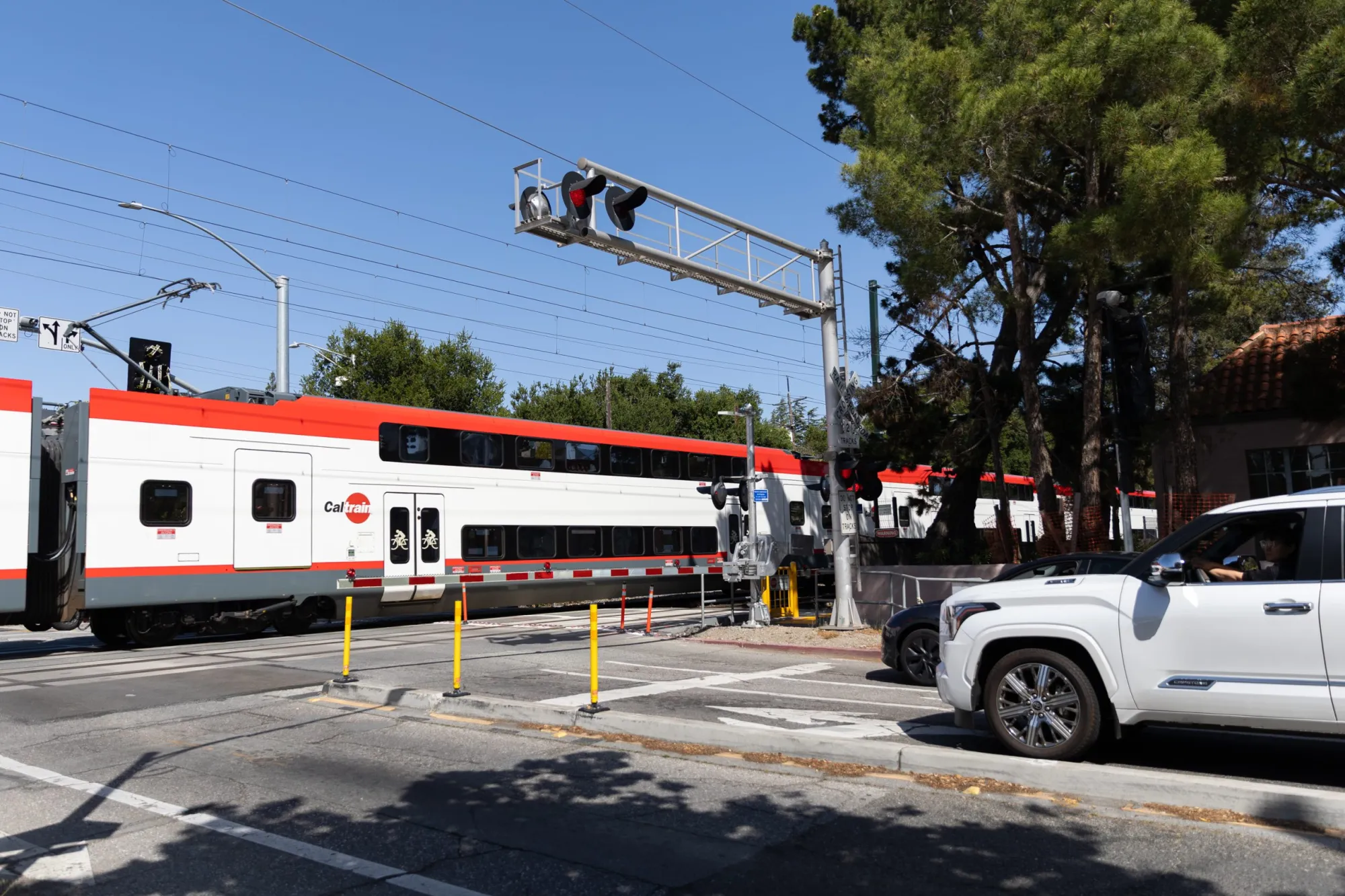
After years of debate, Palo Alto leaders on Monday advanced three alternatives for redesigning the rail corridor near the Churchill Avenue, Meadow Drive and Charleston Road crossings, even as they acknowledged it’s unlikely all three will make it to the construction phase.
The designs for all three crossings are currently at the 15% design stage, with plans calling for a car underpass design at Churchill, a hybrid design featuring raised tracks and a lowered road at Meadow and a full underpass for cars for Charleston. To comply with grant funding requirements, the city needed to advance the project to 35% design, which would build upon the existing concepts and incorporate a traffic analysis and environmental study.
The goal of the project is to separate the rail tracks from the roadway so they would no longer intersect at the same grade. Palo Alto has been discussing the grade-separation alternatives for well over a decade as part of a plan to improve traffic safety and connectivity.
“The city and Caltrain have committed to completing 35% for the three crossings, including environmental, and that will then position the city for funding for whichever project it chooses to be able to advance,” said Edgar Torres, a consultant from the firm Kimley-Horn who is working on the project on behalf of Caltrain.
Torres told the City Council that based on traffic estimates and projected vehicle congestion, any alternative at the Charleston and Meadow crossings would be better than building nothing.
According to estimates from Caltrain conducted in 2025, the amount of delay could double by 2040 if the city does nothing to the intersections. But if there is an underpass at Meadow and Charleston with a direct access ramp, the delays in 2040 could be one-third of what they are today during the morning commute and one-sixth in the evening commute.
Although the council is currently advancing a hybrid option at Meadow, several councilmembers expressed an interest in looking into an underpass for the crossing instead.
“We really should just get behind the fact that we have to move on with 35% and make some new judgments when we get to that point, but add in the review of the underpass (then),” Councilmember Ed Lauing said.
Councilmember Pat Burt, who also serves on the Caltrain board of directors, said the hybrid option was selected in large part because it involved fewer property acquisitions compared to an underpass. Torres confirmed that the right-of-way for Caltrain contains a jog at Meadow Drive that shifts, which he described as a “legacy issue from Southern Pacific” that complicates an underpass option.
Several residents, however, decried the hybrid option for Meadow, noting the construction design would create a retaining wall along the train corridor on Alma Street.
“Give us more than a red line hashtag drawing, which I could have done with a crayola,” Melinda Melnychuk said during the public comment portion of the meeting. “I’m quite angry about this situation that we find ourselves in, and I’m begging you to do the right thing, and the right thing is not to move a bad plan forward.”
Although the Churchill crossing is on the “back burner,” according to Lauing, Councilmember George Lu raised the idea of closing Churchill to vehicle traffic and only building the bicycle and pedestrian underpass. The council had considered closing Churchill earlier this year, but opted not to pursue it.
Lu’s justification is that the Churchill partial underpass for cars is unlikely to proceed to construction given cost constraints, and while closing the crossing is also unlikely, it has a slightly better chance — in other words, generating “some marginal value out of something that’s otherwise almost no value.”
Caltrain and city staff are expected to return to council at a later date to formalize the inclusion of a Churchill closure in the environmental review, which is part of the broader 35% design stage.
Councilmembers also discussed potential construction deliveries, although the decision will not be up for a vote for quite some time. Caltrain and city staff presented three primary options: building out Meadow and Charleston concurrently, constructing the two sequentially or only moving forward with Charleston.
The Charleston-only version is the cheapest and fastest and would not require shoofly tracks during construction, an element of the project that is of great concern to neighbors and other residents. Preliminary designs suggest the shoofly tracks would divert trains along Alma Street for 30 to 36 months if both Meadow and Charleston proceed to construction, regardless of whether they are completed simultaneously or sequentially.
But by doing Charleston alone, crews could use a construction method known as “jacked box” segments to avoid the shoofly altogether.
The simultaneous construction option would take approximately five years and up to $1.1 billion to complete, while the sequential version could last as long as nine years for an additional $200 million in cost.
The 35% design stage is expected to be completed by the end of 2027, according to Caltrain and city staff. The council vote was unanimous, except for Councilmember Keith Reckdahl, who recused himself due to living in close proximity to the Charleston crossing.
In response to the daunting cost estimates of the grade-separation project, Burt said the city still has a little more than $350 million from the Measure B sales tax that voters approved in 2016 — something that could mostly fund the cost of construction for one of the three crossings.
Grade separation has the dual purpose of improving traffic flow and increasing safety on the tracks, especially in light of multiple deaths by suicide on the Caltrain corridor in Palo Alto. Burt said there has not been a single death by suicide since the city implemented track guards at all four Caltrain crossings, a measure that the school district now jointly funds.
“For the cost of grade-separating four locations, we literally could pay for track guards for 1,000 years,” Burt said. “That’s the cost comparison there.”
Leave a Reply
You must be logged in to post a comment.