


|
Getting your Trinity Audio player ready...
|
The complaints from residents of Palo Alto’s Crescent Park neighborhood about the recent changes on their block began more than five years ago via letters to planning staff, phone calls to City Hall and reports filed on 3-1-1, an online portal that residents use to report everything from potholes and downed branches to zoning violations.
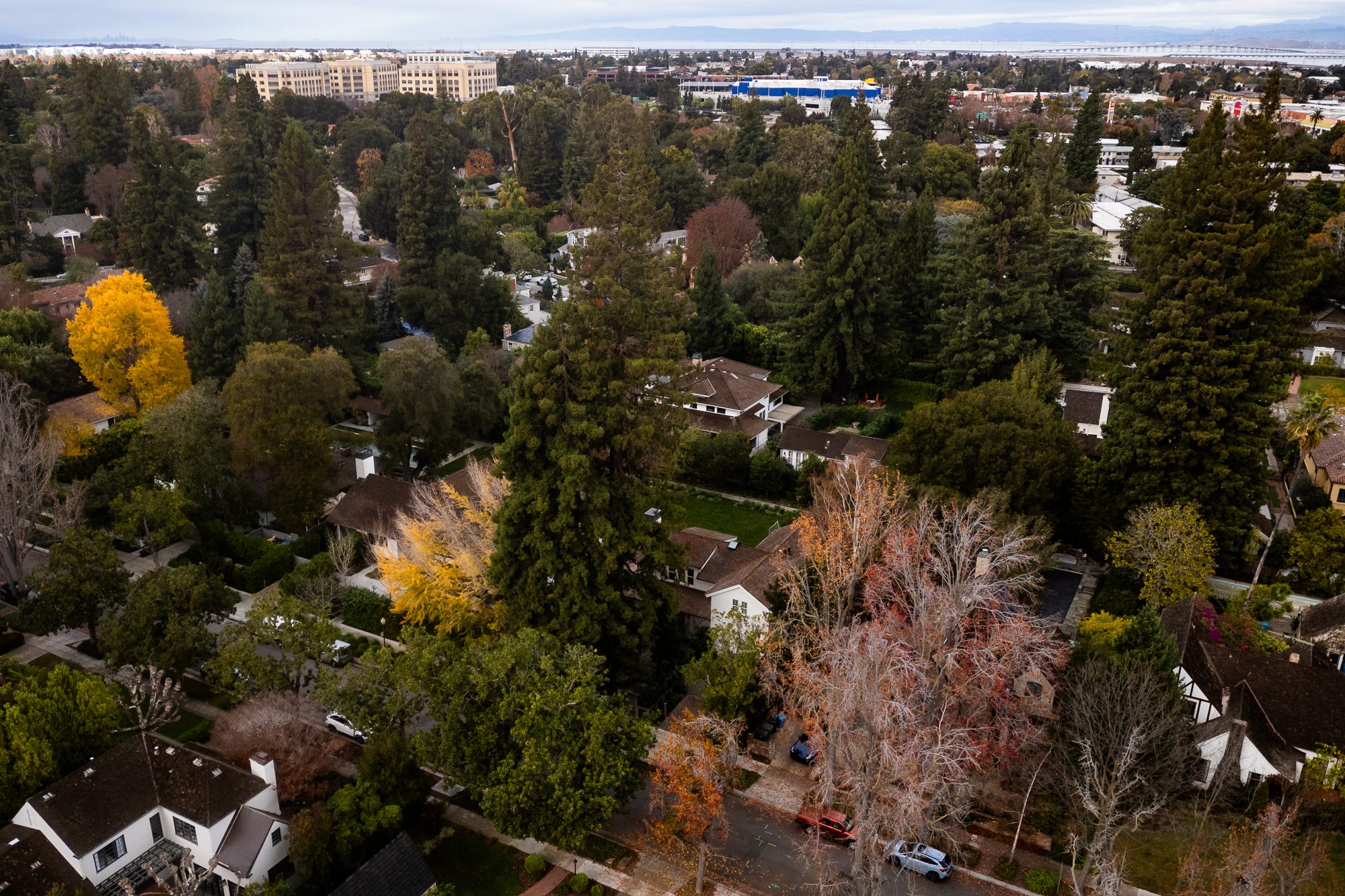
Some pertained to illegal uses; others to excessive construction. One complaint, which was filed by a neighborhood resident in January 2022, protested the recent actions by Mark Zuckerberg, the Facebook founder who had purchased a row of homes on Hamilton Avenue and combined them into what critics and city officials have described as a fortified “compound,” complete with a security headquarters and, until recently, a private school.
One of the homes, according to the complaint, had “dozens of employees coming and going 24 hours a day/ 7 days a week” who were “parking overnight without permits, parking illegally, speeding, violating traffic laws.”
The city had been hearing about the school for several years from neighbors who reported seeing teachers and students arrive and depart the property every weekday, according to the city’s permitting records and documents that this publication obtained through numerous Public Records Act requests. Every time, however, the city’s code enforcement officers opened and promptly closed their investigation after concluding that no violation had occurred.
Taken together, the complaints — and the city’s inactions — have fueled a growing belief among neighbors that Palo Alto has been unwilling or unable to enforce its rules when confronted with a billionaire homeowner.
The conflict became a national story earlier this year, with the New York Times, WIRED and the San Francisco Chronicle all reporting on the litany of concerns raised by Zuckerberg’s neighbors, most of whom asked to remain anonymous to protect their privacy or out of fear of retribution. According to the Times, Zuckerberg has purchased at least 11 homes in Crescent Park totaling more than $100 million. In addition to the school, houses in the compound have also been used for entertainment and a staging ground for outdoor parties, the Times reported in August.
Now, after years of pressure and national scrutiny, the private school has been shut down, and city officials are considering broader policy changes to curb the impacts of large property buy-ups in residential neighborhoods.
A neighborhood transformed
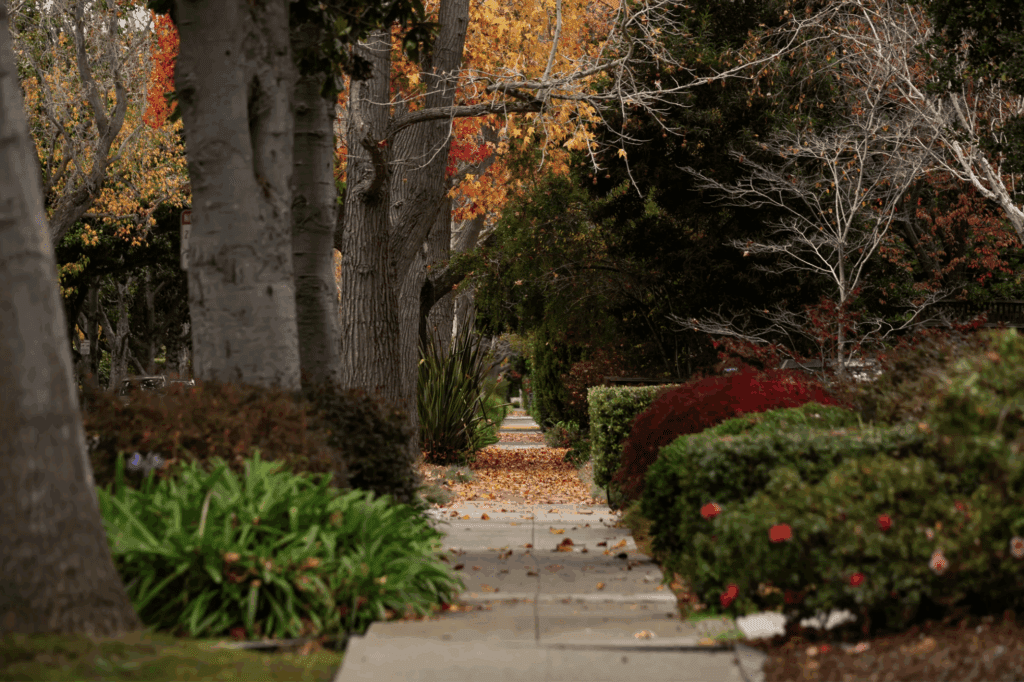
According to interviews with six of Zuckerberg’s neighbors, including one who submitted a letter that ultimately shut down the private school, the years of unrestrained construction and other activity have become a source of growing frustration in the neighborhood. Each lamented the changing nature of their neighborhood, an affluent, leafy enclave just east of downtown Palo Alto known for historic homes, quiet streets, a volatile creek and large single-family lots.
When Crescent Park debuted in 1924, the meticulously planned subdivision came with rules meant to safeguard both its character and its exclusivity. Homes were required to cost at least $10,000 — about 1.6 times the national average at the time — and lots averaged roughly half an acre. Uses were tightly controlled: Livestock and poultry were prohibited, setbacks were mandated to preserve uniformity and aesthetics, and pricing standards were designed to ensure high-end construction throughout the tract. Marketed as one of the Peninsula’s most carefully restricted residential districts, Crescent Park was engineered for luxury long before Silicon Valley wealth arrived.
A Peninsula Times Tribune advertisement published in July 1924 when the neighborhood officially opened framed those restrictions as “home protection.”
“A home built in Crescent Park has the immediate protection of restricted home-building — there is no gamble attached to the purchase of Crescent Park home-sites,” the ad read. “There is no need to worry about how the future will affect your home. … There is but one resultant feature attached to your purchase — and this is the most important — increased valuation!”
Now, residents are increasingly worried about the neighborhood’s future. Since the compound opened, families have left the 1400 block of Hamilton Avenue and security guards have arrived. Construction trucks and delivery vans have become fixtures on the block, where Zuckerberg purchased homes at a rapid clip. Some remained unoccupied for months, while others were repurposed for other uses, according to the neighbors.
One resident, who filed a code enforcement complaint against Zuckerberg in 2022, said by the time he moved out of the Hamilton Avenue block in late 2024, he could barely recognize the neighborhood that he had moved into 14 years prior. Homes that were once occupied by families were bought up, renovated and repurposed for other uses by Zuckerberg, the Meta CEO whose primary residence is on Edgewood Drive, which runs parallel to Hamilton.
“The frontage of the compound is all security, bushes and fences. It doesn’t feel neighborly at all,” said the resident who filed the complaint. “There was a block party every year and when we moved here, it was between 50 and 75 people. Now, it’s like 10 people.”
Another neighbor, who moved to Hamilton Avenue 35 years ago, said Zuckerberg’s home purchases didn’t just alter the physical appearance of the block; they disrupted the cadences of residential life that residents have been used to. The sight of neighborhood children and their parents going to school in the morning was once common. Not anymore, said the neighbor, who still lives on the block.
The constant security is also a problem. He recalled a friend, a woman in her 60s, who pulled over on the Hamilton block to send a text message. She was immediately confronted by security guards who asked her what she was doing.
“It’s not a neighborhood,” he said. “The flavor, the feel of it is different. These aren’t family homes — they are Meta homes.”
Yet most residents reserve their frustrations not for Zuckerberg but for the city, which they argue has been negligent about enforcing its laws in the face of a billionaire’s ambitious expansion. One resident, who moved to the 1400 block of Hamilton about four decades ago, recalled the strict scrutiny he received from city inspectors when his family was pursuing a bathroom remodel several years ago. Yet when it comes to the Meta compound, it seems like the city is allowing Zuckerberg to play fast and loose with the rules, he said.
“If it was us, they would come down like a ton of bricks and say, ‘You can’t do that,’” he said. “I’m not blaming the city for being anal, but they have to be consistent. What we were requesting is nothing compared to what this guy was doing.”
This story originally appeared in Palo Alto Weekly. Gennady Sheyner is the editor of Palo Alto Weekly and Palo Alto Online. As a former staff writer, he has won awards for his coverage of elections, land use, business, technology and breaking news.

Leave a Reply
You must be logged in to post a comment.