



South Bay safety net service providers facing an increased demand and decreased funding are calling for community support.
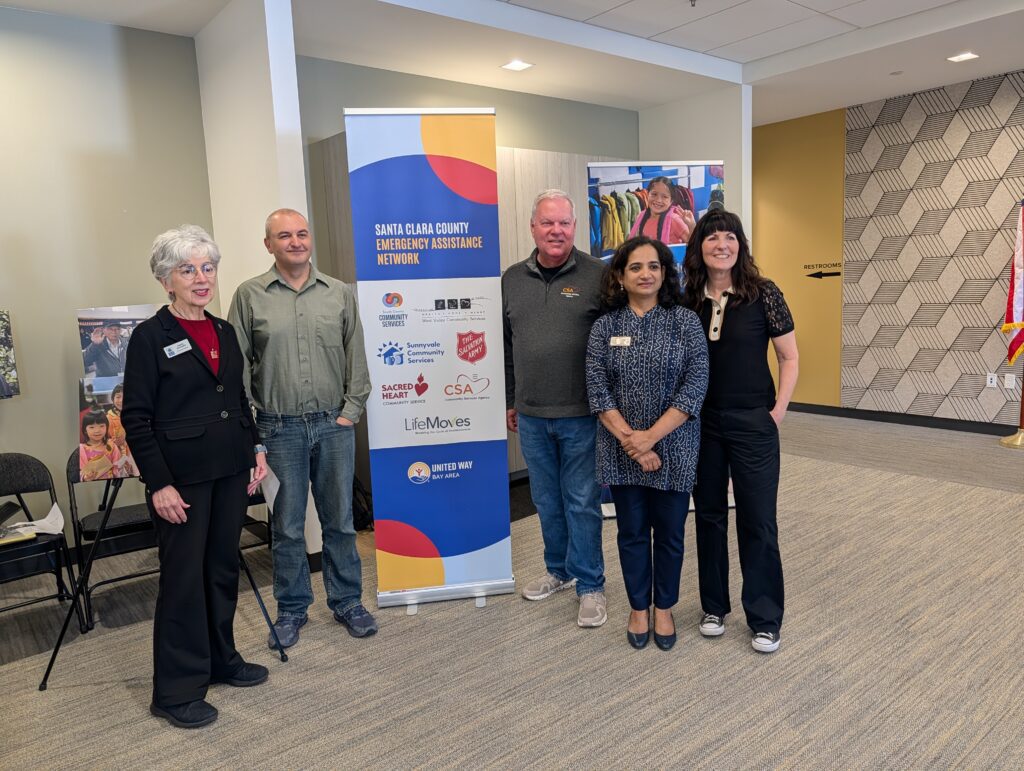
The Emergency Assistance Network, a collaboration of Santa Clara County nonprofits led by United Way, is confronting a devastating lack of financial assistance due to federal and county budget cuts. The network provides coordinated support for residents facing food and housing insecurities. The group is trying to raise $900,000 in emergency assistance from local governments, corporations, philanthropies and individuals to prevent evictions and homelessness, and $800,000 in support for food operations to fill the gap.
Laura Escobar, vice president of safety net services for United Way Bay Area, joined the organizations at Sunnyvale Community Services on Wednesday to clarify how dire the situation has become.
“Any cut to the financial resources available to these agencies are cuts to families in Santa Clara County,” Escobar said. “They assist clients with rent and it helps prevent evictions. It helps prevent more families living in their cars … I work with every food bank here in the Bay Area. They have all told me that we are now back at pandemic level era food assistance.”
The network is comprised of seven organizations serving Santa Clara County, including Community Services Agency, LifeMoves, Sacred Heart Community Service, The Salvation Army, South County Community Services, Sunnyvale Community Services and West Valley Community Services.
“We have people literally lining up for food every day at our agencies,” Tom Myers, chair of the Emergency Assistance Network, said. “We cannot count on Washington to help provide us with safety net services. So, we are asking you to step up to the plate.”
One in four Santa Clara County households struggle to meet their basic needs, such as housing, childcare, food, healthcare and transportation, according to the Emergency Assistance Network. More than 200,000 households in the county spend more than 30% of income on rent, according to United Way Bay Area.
After a divorce and the loss of her business and home, Debra Townley was living in her car with her disabled son when she turned to West Valley Community Services for assistance.
“They really saved our lives,” Townley told San José Spotlight. “The level of depression that hits when you lose everything … I’ve never experienced anything like that in my life. But knowing that we were not going to starve, and we would be able to … talk to a case manager and (access) other resources they referred us to was invaluable.”
Townley, now a West Valley Community Services board member, said she understands what it means to need help as someone who experienced homelessness and food insecurity.
“Having enough food means children can focus in school, parents don’t have to skip meals to feed their kids and families can avoid watering down baby formula to make it last,” she said. “Access to supplemental groceries also allows families to afford other essentials, such as medical copays, gas for work and rent, which helps prevent evictions.”
Marie Bernard, executive director of Sunnyvale Community Services, said federal cuts mean up to 55,000 Santa Clara County residents are at risk of losing CalFresh, California’s version of SNAP. She said one in three children face food insecurity and go to school hungry. She also pointed out that nearly half a million residents are at risk of losing Medi-Cal due to federal cuts.
Bernard said individuals, philanthropies and corporations must invest in their communities.
“We need local governments to continue to lead with urgency, compassion and bold investments,” she said.
Sujatha Venkatraman, executive director of West Valley Community Services, said an increase in community requests for food, emergency financial assistance and wraparound services is stretching its resources and budget.
“Last year, we served 6,200 individuals, a 30% increase,” Venkatraman told San José Spotlight. “We serve West San Jose, where there are high-performing schools … like Prospect High School. But Prospect High School is a Title I school. That means 80% to 90% of the families qualify for federal assistance. Food cost is what’s driving families into eviction.”

Poncho Guevara, executive director of Sacred Heart Community Service, said the organization served 50,000 people last year seeking food, clothing and emergency financial assistance.
“Families have to decide whether to have medicine in order to live, food on the table or a roof over their heads,” he said. “This network of organizations has been the core of leading efforts to prevent people from entering into homelessness. This intervention not only saves our community money but actually saves the lives of so many. It is the basis of choices that we make as a community, whether or not we’re going to step up for our brothers and sisters, and we can do better.”
Contact Lorraine Gabbert at [email protected].

Leave a Reply
You must be logged in to post a comment.