

|
Getting your Trinity Audio player ready...
|
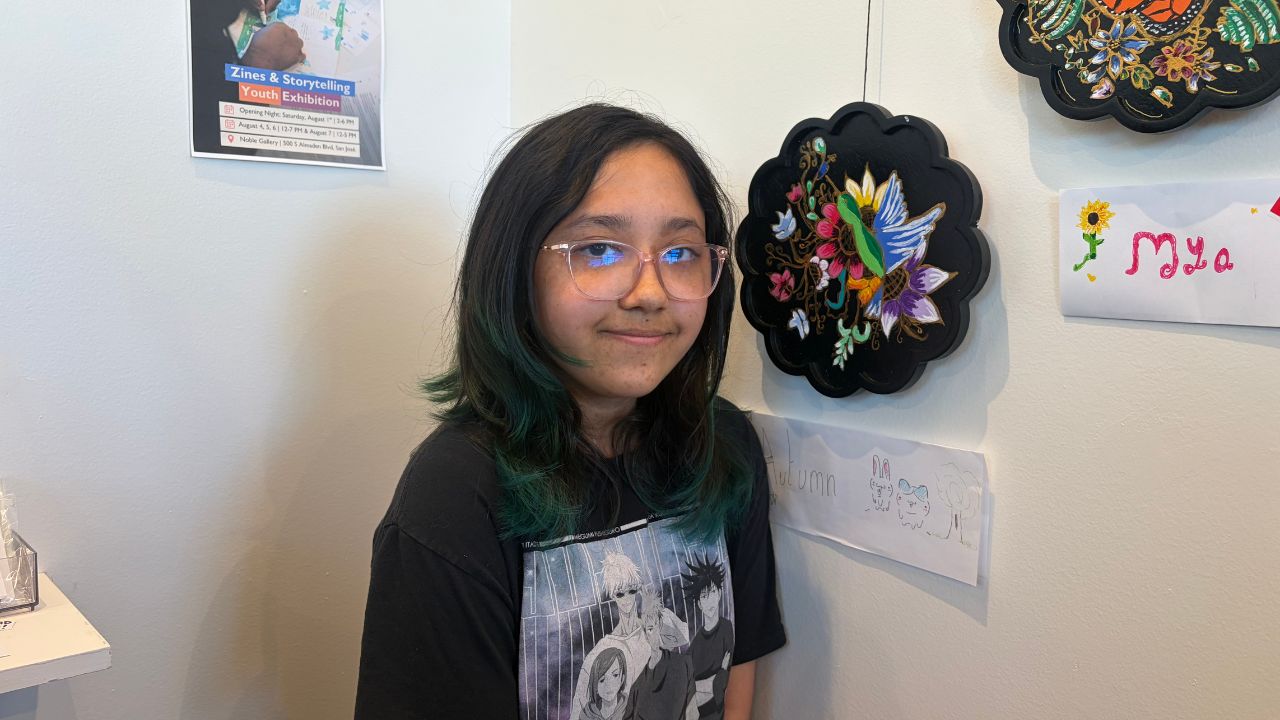
The hummingbird hanging beside 13-year-old Autumn Medina isn’t just another painting.
Its purple, blue and green feathers remind her of her grandmother, who loved hummingbirds and whose yard was filled with the tiny birds every summer. The painting is in the style of maque y la laca perfilada, a traditional lacquer art form from the Mexican state of Michoacán, that Medina had never heard of until this summer.
Now her work is on display in a downtown San Jose gallery.
@sanjosespotlight A San Jose artist is preserving a centuries-old Mexican lacquer art form by teaching middle school students through a local youth program. Regional Reporter Maryanne Casas-Perez takes a look.
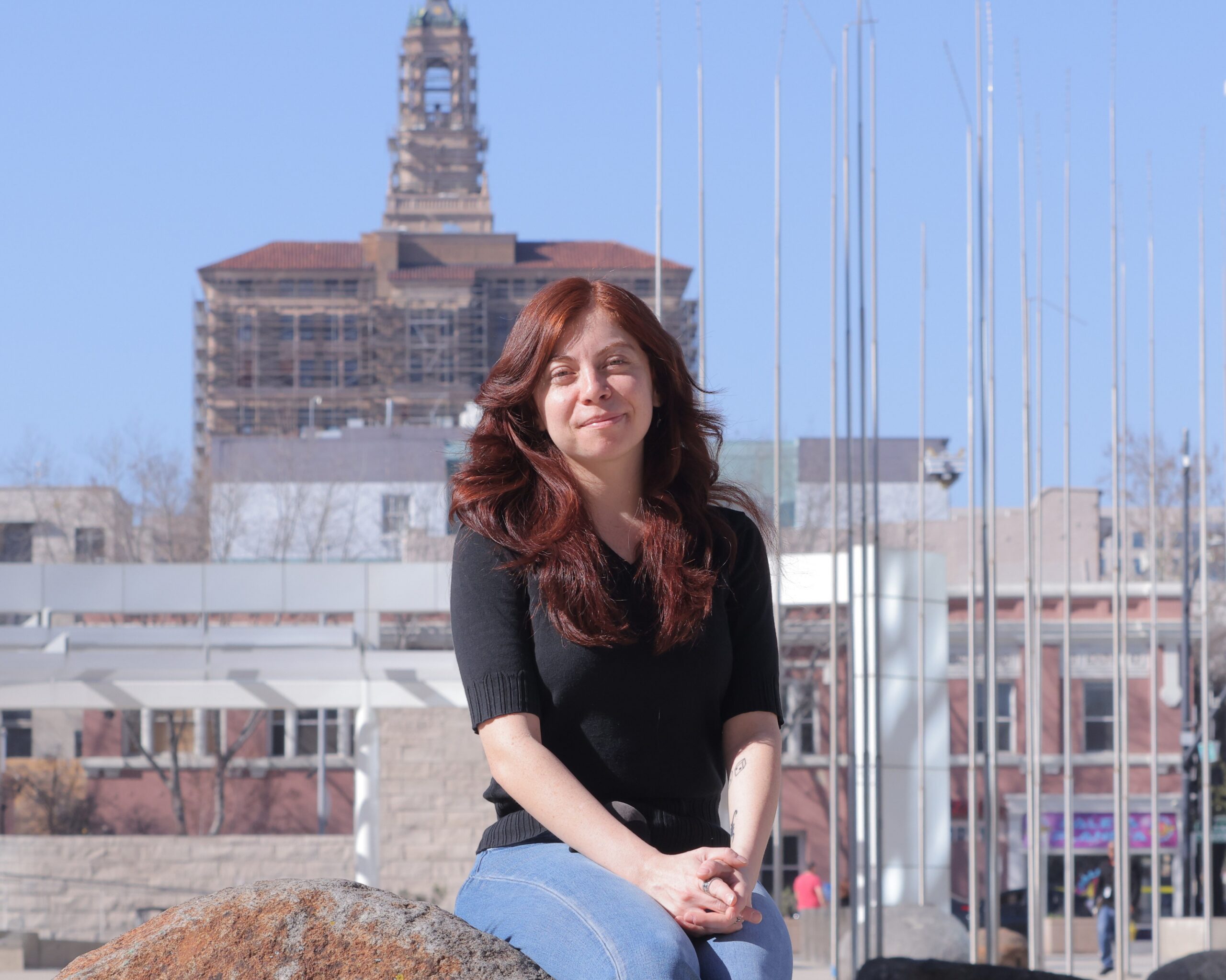
The painting is one of a dozen created by middle school students who spent the past week learning the centuries-old tradition from San Jose artist Arely Cárdenas. Their work debuted Saturday at Noble Gallery and remains on display through Aug. 7, offering visitors a glimpse of an art form Cárdenas is determined to preserve by passing it on to the next generation.
“My mentor said he didn’t want the art form to die with him,” Cárdenas told San José Spotlight. “I was really excited because I felt like I wasn’t just teaching a workshop to teach it.”

Cárdenas returned to her family’s hometown of Uruapan, Michoacán last winter for the first time in nearly 18 years — searching for an elder artisan who specialized in maque y la laca perfilada, or Mexican lacquerware, where artisans use intricate hand-painted designs outlined in gold to decorate lacquered wood and dried gourds.
She found Hector Zarco Vargas, who Cárdenas said is one of the last people in Uruapan still teaching the art form. Over four days, he taught her the intricate painting techniques while sharing he continued teaching local children the art to keep it alive.
Returning to San Jose, Cárdenas built a weeklong curriculum introducing students ages 10 to 13 to the traditional art form while encouraging them to tell their own stories through it.
“I think more powerful than teaching someone how to develop a skill is how you made them feel when they were learning,” she said.
That philosophy resonated with Medina, who almost didn’t sign up for the workshop.
“I wasn’t sure because I’m not good at socializing and talking to people,” Medina told San José Spotlight. “But … I love art, so (I thought) it would be good to learn more about art, do art and make new friends.”
As she learned the careful gold outlines, layered colors and floral patterns characteristic, Medina also learned about the history behind the tradition.
The lacquer art traces its origins to Indigenous communities in Michoacán, where artisans decorated wooden objects, gourds and furniture using natural oils, minerals and pigments long before Spanish colonization. Over centuries, Indigenous techniques blended with European artistic influences, evolving into the intricate floral and wildlife designs recognized today.
The tradition has survived through generations of artisans who teach the craft by hand, often within families or apprenticeships.
“I’m glad I took this art class because it showed me a lot of the history behind the maque art, and I got more connected to my culture,” Medina said.
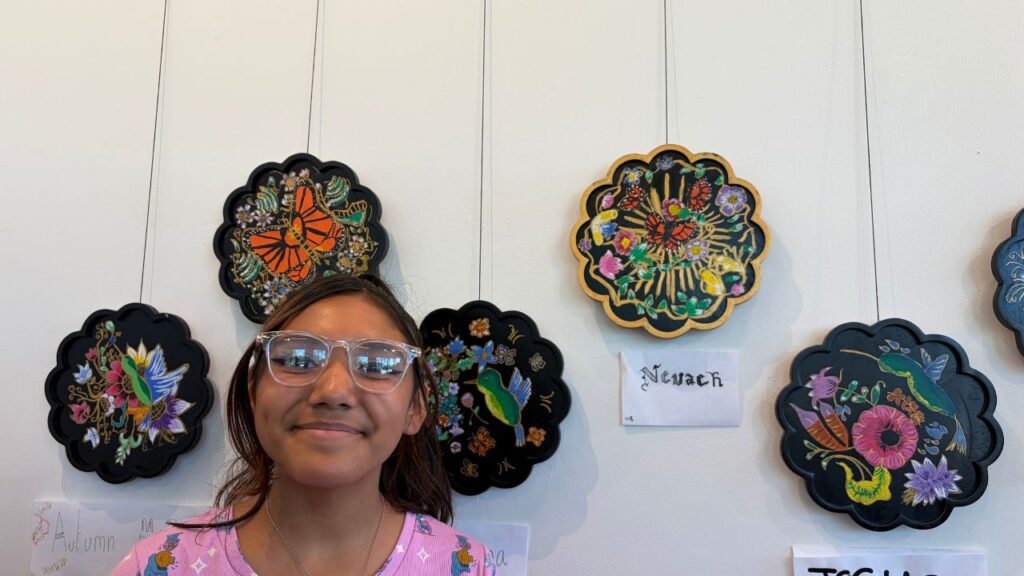
For 13-year-old Nevaeh Gonzalez, the tradition inspired a monarch butterfly honoring her own grandmother. By the beginning of opening night, the painting had already sold.
“Whenever I see a monarch butterfly I think of her (my grandmother),” Gonzalez told San José Spotlight.
Cárdenas’ workshop was hosted through Local Color’s Color Me Rad youth program, which gives students the chance to learn directly from professional artists, exhibit their work in a gallery and receive a $100 stipend recognizing the value of their creative work.
“All labor, including creative artistic labor, has a value,” Carmen Gaines, deputy director of Local Color, told San José Spotlight. “We want to make sure that kids know, even at a young age, you’re creating work, you’re spending time creating work or exhibiting work — that has value.”

As families wandered through Noble Gallery stopping to admire hummingbirds, monarch butterflies and colorful floral designs outlined in gold, Cárdenas saw more than a week’s worth of student artwork.
“I’m passing on something that was passed on to me,” Cárdenas said.
Contact Maryanne Casas-Perez at [email protected] or @CasasPerezRed on X.
Leave a Reply
You must be logged in to post a comment.