


|
Getting your Trinity Audio player ready...
|
Residents on all sides of San Jose’s housing debate are spoiling for a protracted fight, after the City Council advanced a plan to increase density limits across the city’s sprawling single-family neighborhoods.
The policy framework approved Tuesday in an 8-3 vote will guide deliberations over the coming year, as San Jose planners craft an update to the city’s general plan to meet state housing mandates requiring it to make room for denser homebuilding. Councilmembers Domingo Candelas, George Casey and Bien Doan voted against the measure, echoing residents’ concerns that a glut of new developments in single-family neighborhoods could create traffic problems and strain infrastructure.
The vote leaves open tough questions about where the city will focus new housing growth. In the face of intense pushback from residents, councilmembers declined to fully endorse a controversial recommendation to quadruple density limits — from eight homes per acre to 32 — across the 85% of San Jose’s residential land zoned for single-family homes. Instead, they directed staff to study several density options before returning to council with a finalized proposal next December.
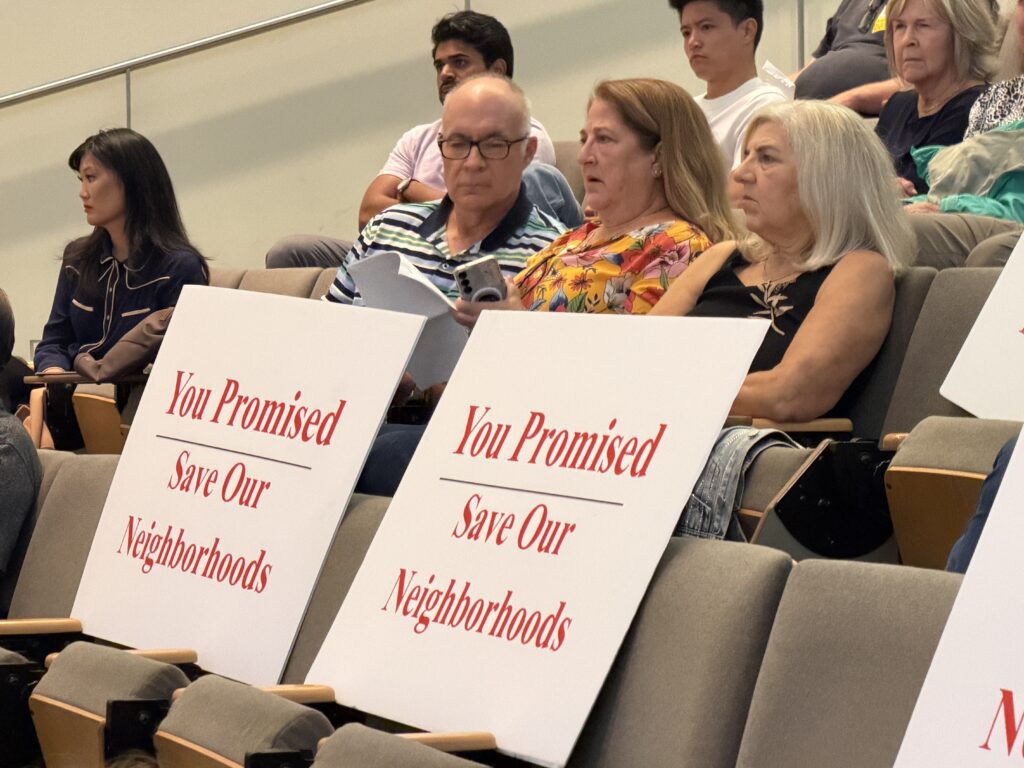
Over the course of a marathon public comment session Tuesday, the proposals met with an outpouring of condemnation from suburban residents who warned loosening housing controls could “destroy” San Jose’s single-family neighborhoods. Some even raised the possibility that councilmembers who support high density plans could face recalls.
“We’re going to be putting a lot of pressure on our councilmember as well as the mayor,” Alain Mowad, the president of a community association representing neighborhoods in South San Jose, told San José Spotlight. “Blanket upzoning of single-family home neighborhoods is just not in the best interest of the city or of the people living there.”
But others said such changes are necessary for the city to build enough housing to tame an affordability crisis that has already pushed many low- and middle-income families to move elsewhere.
“The desperate, desperate need for housing in this city is the issue not only of the day, but of the decade,” said one speaker who did not give their name.
As both sides dug in, Mayor Matt Mahan offered assurances that residents will have more opportunities to provide input as the policy is refined. Meanwhile, he also hinted he may favor a more targeted approach to adding density than staff’s initial proposal.
“We have led so many times in saying yes to housing,” Mahan said at the meeting. “But I do think we really need to be thoughtful about how we manage change out in our neighborhoods.”
The density decision is just one of many policy changes taking shape as the city conducts a once-every-four year review of its general plan, which sets the rules for what gets built where.
Planning staff had originally recommended councilmembers advance a plan to add housing density by increasing the limit for residential lots from the current eight homes per acre to 32.
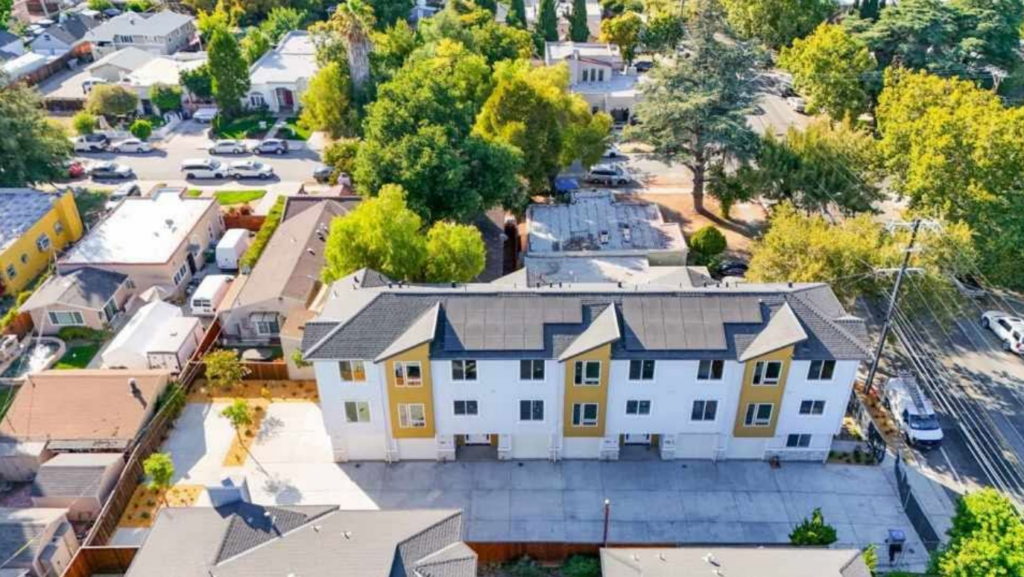
On a typically-sized parcel, such a limit would open the door to developments with about four homes and buildings as large as three stories, planners said. Larger parcels could accommodate as many as 10 homes. Such housing could run the gamut from duplexes to townhomes to small apartment buildings.
“The policy objective is to really create more housing choices in parts of the city where those choices are limited somewhat today,” San Jose’s Director of Planning, Building, and Code Enforcement Chris Burton said at the meeting.
The package approved Tuesday includes the 32 homes per acre option, but also asks staff to consider density options that range as low as 16 homes per acre as well.
Backers contend the change, which could also lead to streamlined approvals for such projects, is a necessary step to satisfy state housing mandates requiring the city to plan for an additional 62,000 homes over the coming years. Failure to reach the city’s housing commitments could result in a range of penalties, including the loss of state funding for transportation projects. State housing officials could also strip the city of its authority over development decisions.
Councilmembers also stepped in with a request that the final proposal include minimum parking requirements in neighborhoods with limited access to public transit. The move, which runs counter to the city’s decision to eliminate such requirements in 2023, seeks to address concerns that when new homes go up, all the extra cars could trigger parking chaos in surrounding neighborhoods.
For San Jose’s housing boosters, Tuesday’s vote comes as a troubling sign that city leaders, even in the face of intense state pressure, may not have the appetite for a more ambitious housing agenda.
“It definitely was not the outcome I was hoping for,” Ali Sapirman, a city housing commissioner who also represents the Housing Action Coalition advocacy group, told San José Spotlight. “The denser buildings are, the more likely they are to pencil out and actually get built. It doesn’t help if we’re zoning for things that can’t get built and are infeasible.”
The decision has also reopened a longstanding debate over where the city should focus efforts to promote housing growth.
Candelas, who represents the East Side suburban neighborhoods of District 8, criticized the plan as a policy overreach. He argued the city should instead continue to focus growth in downtown neighborhoods as well as areas surrounding high-traffic corridors.
“I believe that we’re essentially being asked to take a shortcut,” Candelas said at the meeting. “A one-size-fits-all approach that treats the entire city as if every neighborhood is the same.”

In contrast, District 3 Councilmember Anthony Tordillos, a former Planning Commission chair who won his downtown seat on a pro-housing platform, argued that San Jose will never break out of its housing rut unless it expands its housing plans to more of the city.
With San Jose’s housing sector still struggling in the wake of pandemic-era market disruptions, the city is now on track to produce only a third of the 62,000 homes required by 2032 under the state’s mandate, Tordillos said.
“I think as a city we need to move past the notion that somehow we’re going to build all the housing we need for a city of a million people without ever touching the 80% or 90% of land that is currently zoned to only allow single-family homes,” Tordillos said at the meeting.
Contact Keith Menconi at [email protected] or @KeithMenconi on X.
Leave a Reply
You must be logged in to post a comment.