


Santa Clara County’s largest school district could close up to nine elementary schools due to declining enrollment — a game changer for the district as it redefines its future.
The San Jose Teachers Association is urging San Jose Unified School District to consider restructuring the system due to enrollment and equity issues. There are 41 schools in the district, of which 26 are elementary schools. The district formed a Schools of Tomorrow advisory committee, which completed its work last semester. A separate implementation committee will make its recommendation on closures by March 5, and the school board will make the final decision March 12.
The implementation committee — comprised of district and union representatives, teachers and parents — is tasked with choosing which schools to consolidate and where to redraw attendance boundaries and relocate special programs. It strives to provide additional resources for students, as well as balanced school sizes districtwide.
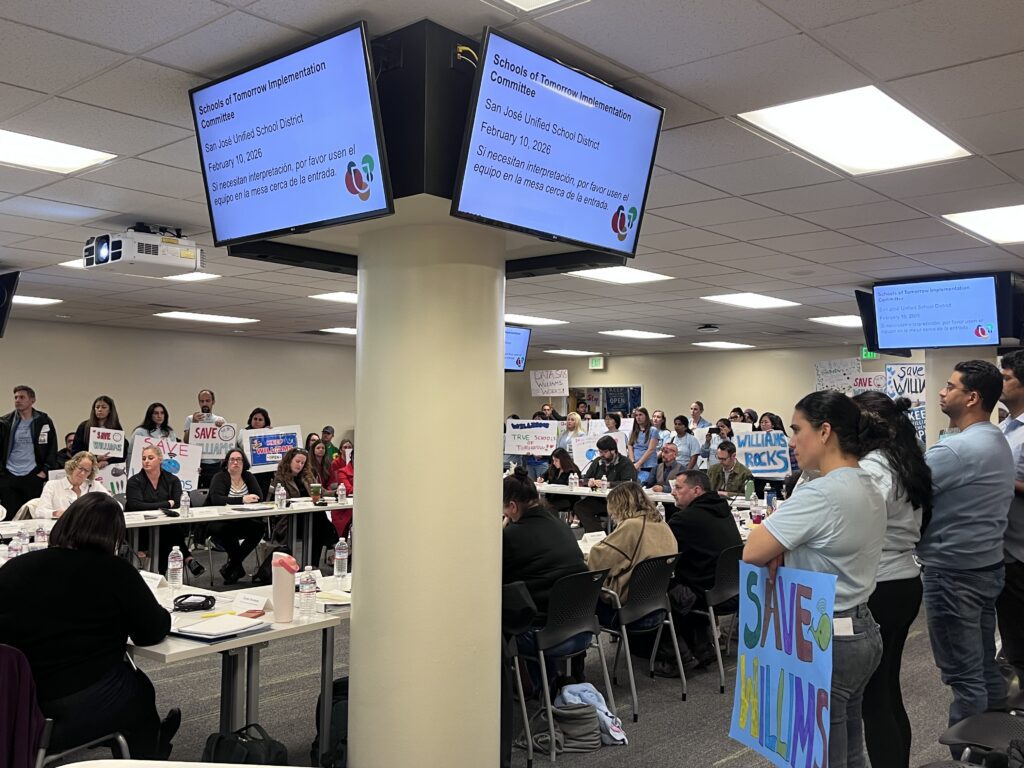
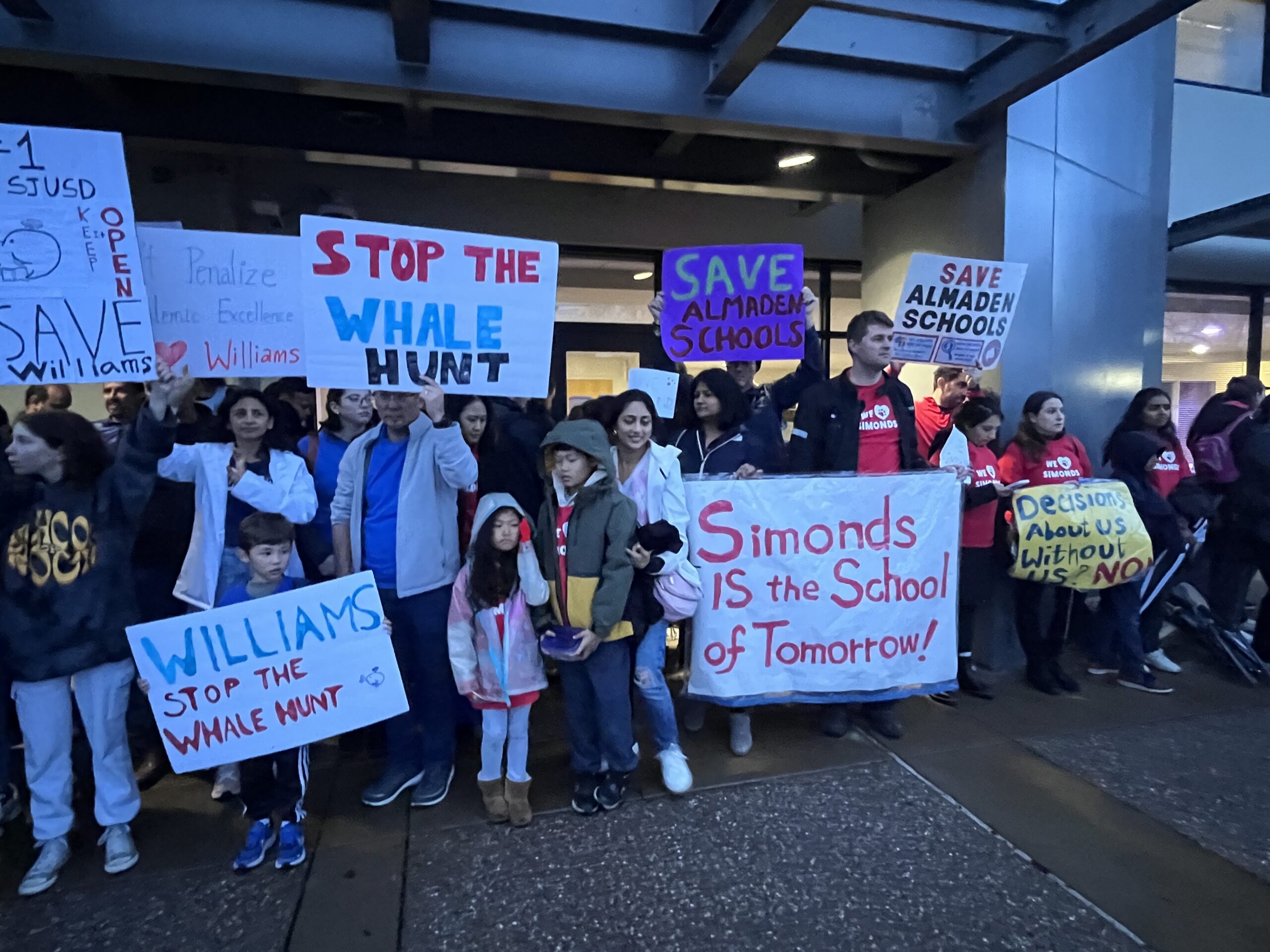
Hundreds of people, including young children, braved the cold and rain to protest their school being on the chopping block at the school district office before Tuesday’s committee meeting. The main meeting room and overflow spaces were at capacity, with many people holding signs saying “Williams: Stop the Whale Hunt,” “Simonds IS the School of Tomorrow!” and “Lowell is Where I Learn, Play and Dream.”
“We recognize that many of you are here tonight because you care deeply about your school communities,” Committee Chair Patrick Bernhardt said at the meeting. “This process is difficult.”
The committee discarded one option during the meeting, and added new ones that included not separating students in special education classes from their schools.
The first option would close nine elementary schools — Almaden, Anne Darling, Canoas, Gardner, Lowel, Rachel Carson, Selma Olinder, Simonds and Walter L. Bachrodt — with Hammer Montessori located at Galarza relocating to the Rachel Carson facility.
The second option would close Empire Gardens, Gardner, Lowell, Rachel Carson, Reed, Selma Olinder, Terrell, Walter L. Bachrodt and Williams.
At a virtual town hall the night before, Trustee Nicole Gribstad said school closures should be the last resort.
“I don’t think two months’ time is enough time to fully look at the picture and allow for stakeholders to come and have their say,” she said. “We want to have transparency. We want to have accountability.”
According to San Jose Unified School District, enrollment has declined by more than 6,000 students since the 2017-18 school year, with 12 elementary schools having fewer than 350 students and the largest more than 800. The district has 25,000 students, from transitional kindergarten through grade 12.
“The number of students at a school directly impacts how many teachers and support staff — counselors, nurses, campus supervisors, etc. — can be assigned there,” the district said on its website. “The number of staff, in turn, affects which programs schools can offer, such as science, arts, and music. Staffing numbers also affect whether we need to create ‘combo classes’ in which two grade levels are taught by one teacher in the same classroom. The Schools of Tomorrow … will enable us to address declining enrollment in a positive, student-centered way.”
Declining enrollment is a statewide issue. Various districts in San Jose have already closed a dozen campuses. Franklin-McKinley School District closed three elementary schools in 2025. In 2024 Berryessa Union School District closed three schools and Alum Rock Union School District closed six schools.
Renata Sanchez, president of the San Jose Teachers Association, said the committee is being thoughtful in its deliberations.
“This work is challenging and emotional, and we all want what is best for our students,” she told San José Spotlight. “It was also beautiful to see so many communities come out and express the love they have for their school. Each of the speakers brought up good points for the committee to consider.”
Sanchez said the unions have negotiated with the school district to ensure no teachers or staff will lose their jobs due to consolidations. She sees this as an opportunity to address racism and disparities.
“It was important to the committee that we’re making the decisions not based on academic achievement, because academic achievement is an imperfect measure of the effectiveness of a school and the effectiveness of teaching staff,” she said. “What is different are the circumstances that our students are living in and the experiences that they’re bringing with them to the schools.”
Lizeth Hernandez, a Lowell Elementary parent, is concerned closing schools will negatively affect struggling communities.
“These shifts often create big challenges for families who already have the least flexibility,” she said at the meeting. “New school models can mean longer commutes, transportation issues, child care gaps and parents having to rearrange work schedules … when you are already juggling multiple jobs.” Parent Travis Curran said a benefit of walkable neighborhood schools is the opportunity to converse with his children.
“You’re not making eye contact and you’re in motion and you’re just kind of walking side by side. It makes my kids speak up a whole lot more and share with me about how their day was,” he told San José Spotlight. “You lose things like that if you look at shutting down a community school.”
Contact Lorraine Gabbert at [email protected].
Leave a Reply
You must be logged in to post a comment.