


|
Getting your Trinity Audio player ready...
|
Santa Clara County employees want guardrails on the use of artificial intelligence as the growing technology sparks displacement fears.
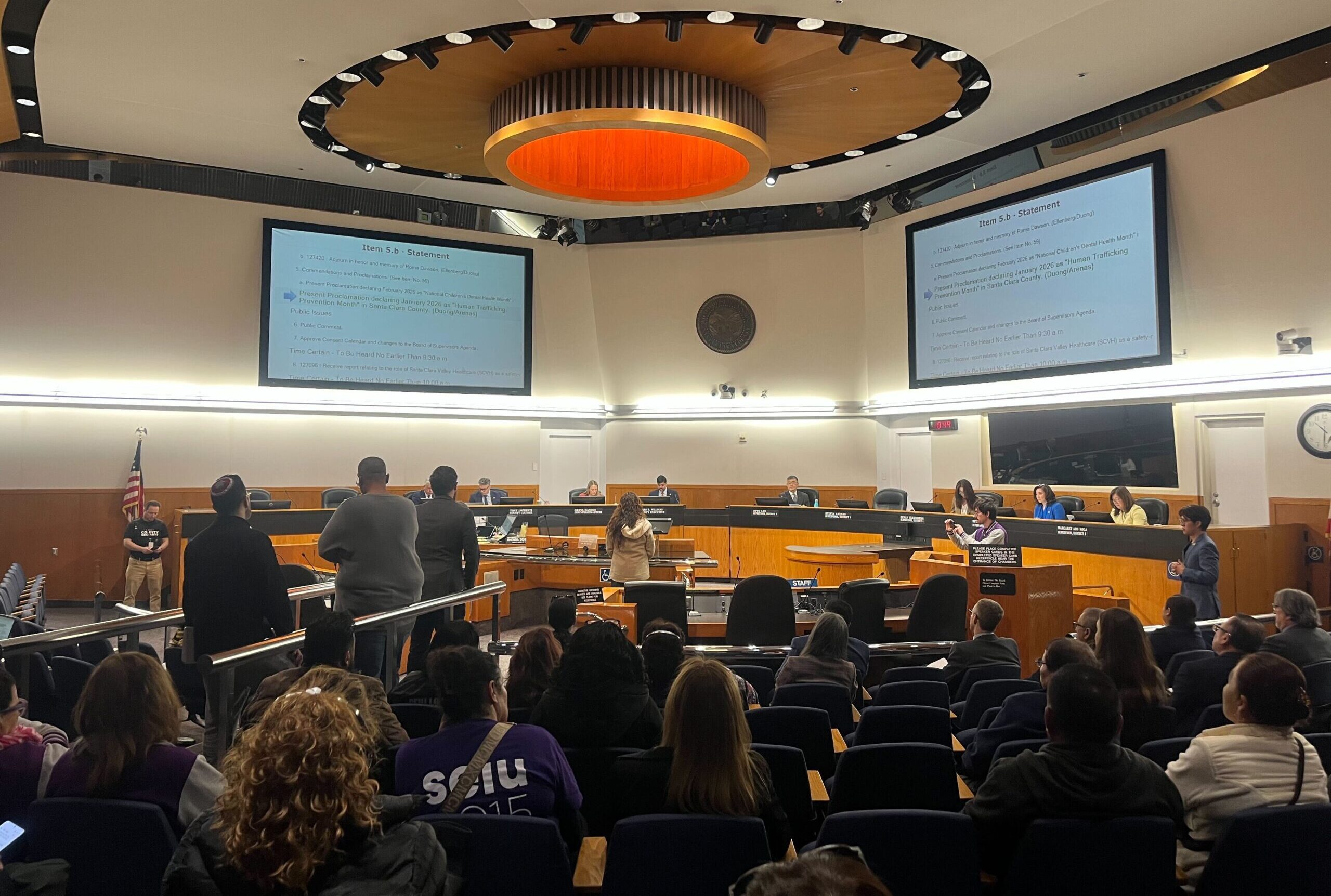
The Board of Supervisors on Tuesday could move forward with a comprehensive study on how AI is used across its various departments, including the public hospital system, which is California’s second largest. County leaders will consider guidelines including disclosing when AI is used in county operations, clearly defined prohibitions on using AI for budgetary or personnel decisions and measures to ensure AI is helping county workers — not replacing them. If approved, a policy would return before supervisors for adoption at a later date.
District 5 Supervisor Margaret Abe-Koga, who is spearheading the discussion with Board President Otto Lee, said she’s mainly concerned about AI replacing human public servants.
“Fundamentally our goal is not to replace workers, but to augment and help streamline their work,” Abe-Koga told San José Spotlight. “Our resolution includes
It comes as labor unions have voiced concerns about AI’s potential future effects on the county workforce.
“Everything is knowable now,” Zeb Feldman, a union leader for County Employees Management Association, told San José Spotlight. “We’re excited about the referral discussing prohibited use cases, not wanting AI to be used to make firing or discipline decisions.”
A county representative did not respond to a request for comment.
Abe-Koga said she is having staff look into various AI tools.
“There are tools to create employee training videos, for example,” she said. “There is a speech-to-text platform that synthesizes doctors’ notes. We’re also doing a Microsoft CoPilot program at select departments to see whether it is helpful to those staff. The goal is to expand it through all county departments, based on our experience with the select departments.”
As the county considers AI regulation, some of its local cities have already gotten started.
San Jose is integrating AI into local government at full speed, having launched the national GovAI Coalition to set standards for responsible use of AI in government, with hundreds of cities and public servants signing on.
Mayor Matt Mahan’s office uses ChatGPT to help write speeches and draft talking points. The city is already using AI-powered software to optimize public transit, translate public meetings, review official documents and catalogue street-level blight and safety problems such as potholes, graffiti, broken street lights and illegal dumping.
Maria Noel Fernandez, executive director of local advocacy group Working Partnerships USA, said local governments such as Santa Clara County can be models for the state and nation when it comes to responsible AI use.
“Unions, community groups and our elected allies here in Silicon Valley are fighting for a vision where AI empowers workers and protects our values,” she told San José Spotlight.
Feldman said it’s crucial to protect county workers and the public from irresponsible AI usage. His union represents just more than 3,000 workers in Santa Clara County.
“We just need to understand the rules of the road so AI can be helpful — especially in our current budgetary crisis — rather than harmful,” Feldman said.
There may be differing visions over what type of AI to focus on. A draft referral up for consideration Tuesday makes several references to generative AI, which creates information, text, images, music and models based on existing data. Some county workers said they want the focus broadened to AI in general, as some AI isn’t generative but still has social impacts.
“Using AI in programming is a force multiplier and makes programmers more effective and efficient — so we’re not inherently anti-AI,” Feldman said. “But we want it to be appropriately used with safety and privacy and respect.”
Feldman said county employees are prohibited from using certain AI products or platforms without county approval — a policy he doesn’t necessarily oppose given county workers often deal with sensitive information. However, he said the process for getting approval takes too long.
South Bay Labor Council Executive Officer Jean Cohen said the county should co-create and implement these policies with workers and address concerns that AI could be used for surveillance on the job site.
“I don’t know that that’s been happening in a more formal, organized fashion,” Cohen told San José Spotlight. “There needs to be human oversight on AI tools and a human in the loop.”
The Board of Supervisors meets Tuesday at 9:30 a.m.
This story will be updated.
Contact Brandon Pho at [email protected] or @brandonphooo on X.
Leave a Reply
You must be logged in to post a comment.