




|
Getting your Trinity Audio player ready...
|
Dozens of altars honoring loved ones who have died will return to Mexican Heritage Plaza in East San Jose for Avenida de Altares, with an eye on safety for people celebrating.
Organizers are moving forward with Día de los Muertos celebrations across the South Bay while taking steps to prepare for potential U.S. Immigration and Customs Enforcement (ICE) activity. At Mexican Heritage Plaza, that preparation includes coordinating with the Santa Clara County Rapid Response Network ahead of Avenida de Altares, the plaza’s annual celebration on Oct. 31.
Edgar Ochoa, director of community engagement for Mexican Heritage Plaza, said the federal government’s anti-immigration and enforcement policy and increased ICE activity in the state can’t be ignored.
We actually gathered as a team to discuss, ‘Hey, what does this look like?’” Ochoa told San José Spotlight. “We’re literally known as a Mexican Heritage Plaza. We know that we serve a large immigrant community, not only Mexicans, Latin Americans and even Asian Americans.”
Mexican Heritage Plaza has coordinated with the Rapid Response Network since last year to have trained responders at events, Ochoa said. The network was present at the plaza’s events last year and provided training to staff on how to respond if immigration officers appeared.
The training included a practice exercise in which participants from Amigos de Guadalupe posed as immigration agents, including covering their faces, to help staff practice how to respond.
The plaza also established communication procedures for staff, including walkie-talkies and a Slack channel, so team members can document incidents and communicate with leadership if something happens.
Jacklyn Alonzo Heredia, who coordinates event support for the Santa Clara County Rapid Response Network, said services vary depending on the size and needs of a gathering. For large cultural events, the network generally combines visits from responders with patrols and readiness to act as legal observers. Organizers can contact the network directly or through email to request support. The network evaluates requests based on its capacity, and the two-week notice allows coordinators time to arrange coverage.
Huy Tran, executive director of Services, Immigrant Rights and Education Network (SIREN), which is part of the Rapid Response Network, said the organization is reviewing emergency response plans amid reports of immigration enforcement activity elsewhere in California. To date, Tran said SIREN had not received indications that the activity had reached the Bay Area.
“The Rapid Response Network, though, is preparing, we’re going through our emergency response plans,” Tran told San José Spotlight.”We have kind of already given the responders a heads up to be extra alert for any calls that may come through.”
Avenida de Altares is celebrating its 10th year, and Ochoa said about 5,500 people attended last year’s event. The festivities span three blocks along Alum Rock Avenue, from the Mexican Heritage Plaza west to Highway 101. It include nearly 40 altars inside and outside the plaza, along with performances, food, retail vendors, art workshops and family activities.
The altars vary in style. Some are traditional displays commemorating people who have died, often with photographs, food and personal belongings. Others are artistic interpretations created by local artists.
Ochoa, who grew up in San Jose with parents who emigrated from Mexico, said the altars offer a way for people to remember those who have died and maintain a connection with them.
“It’s a commemoration, like celebration of life, and then connection,” Ochoa said. “Within that, people still have opportunities to have folks and invite them back, whether they’re direct, close family members or ancestors from deep in the past, that maybe they don’t even know.”
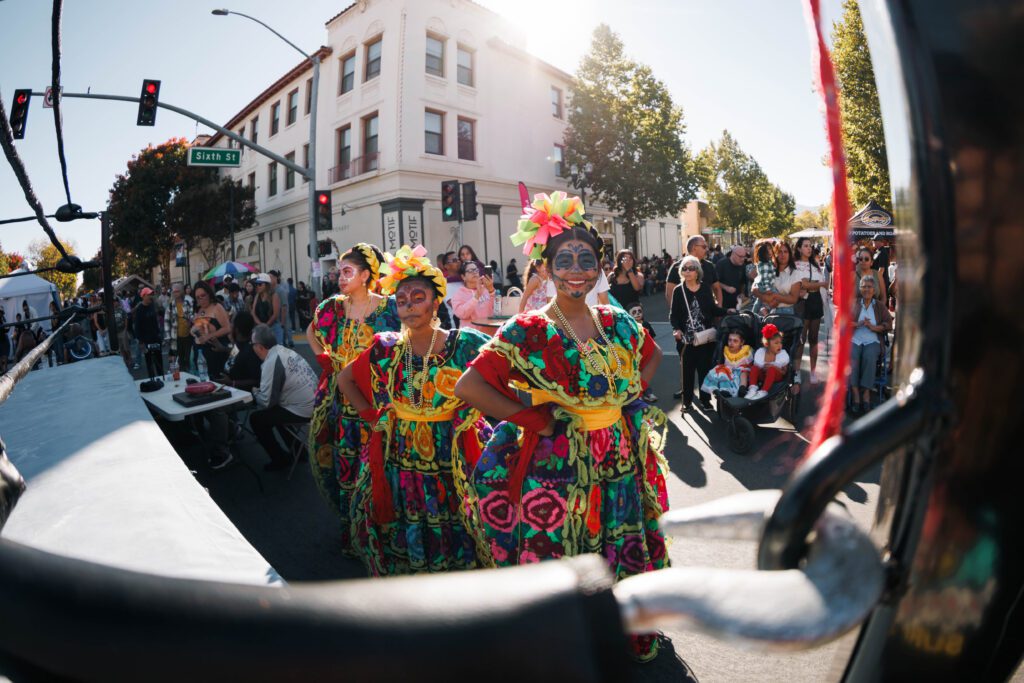
In South County, La Casa de Cultura y Arte is hosting its fourth annual La Ofrenda Festival Saturday in downtown Gilroy, a free event sponsored by the Gilroy Foundation. Last year 8,000 people attended, according to Festival Director Ruben Dario Villa.
He said various ICE OUT of Gilroy Coalition and the Rapid Response Network members will be present to provide support during the festivities. Last year, the event implemented a coordinated safety protocol involving a network of public agencies and grassroots coalitions, including protocols for potential immigration enforcement activity, which will continue this year.
“We recognize the uncertainty many families are experiencing, but we remain prepared and confident in the strength of our public and private partnerships to support the safety and well-being of our community,” Dario Villa told San Jose Spotlight.
While mass immigration enforcement actions like past federal deployments in Los Angeles and Minneapolis, Minnesota haven’t occurred in Santa Clara County, the region is one of the most impacted areas for targeted ICE operations, according to SIREN. Fears of ICE have kept students from attending class and slowed foot traffic at Latino-owned businesses. Some undocumented county residents have chosen to self-deport.
The fears are especially palpable in Gilroy, where an ICE facility is planned just east of city limits. A federal judge in September granted a preliminary injunction blocking construction on the facility as the larger legal battle plays out.
Dario Villa said La Casa de Clutura y Arte has been intentional in its approach, building a broad network of support that prioritizes preparedness, coordination and discretion to address potential concerns without creating unnecessary fear.
“Despite the current climate, we’re not operating out of fear,” he said. “We’ve worked closely with the city of Gilroy, Gilroy Fire Department, Gilroy Police Department, private EMT and security providers and a broad network of community organizations and grassroots coalitions to prepare for a safe and beautiful celebration.”

Back in San Jose, Tran said the Rapid Response Network had received calls about social media posts and AI-generated images that portrayed enforcement activity elsewhere in California as if it were happening locally.
“Every single time, there’s something happening in some part of the state. Our phones light up because people get scared,” Tran said. “And they start thinking that they’re seeing it happen here or they’re recording whatever they see on social media.”
Contact Maryanne Casas-Perez at [email protected] or @CasasPerezRed on X. Contact Giovanni Albanese Jr. at [email protected].

Leave a Reply
You must be logged in to post a comment.