


|
Getting your Trinity Audio player ready...
|
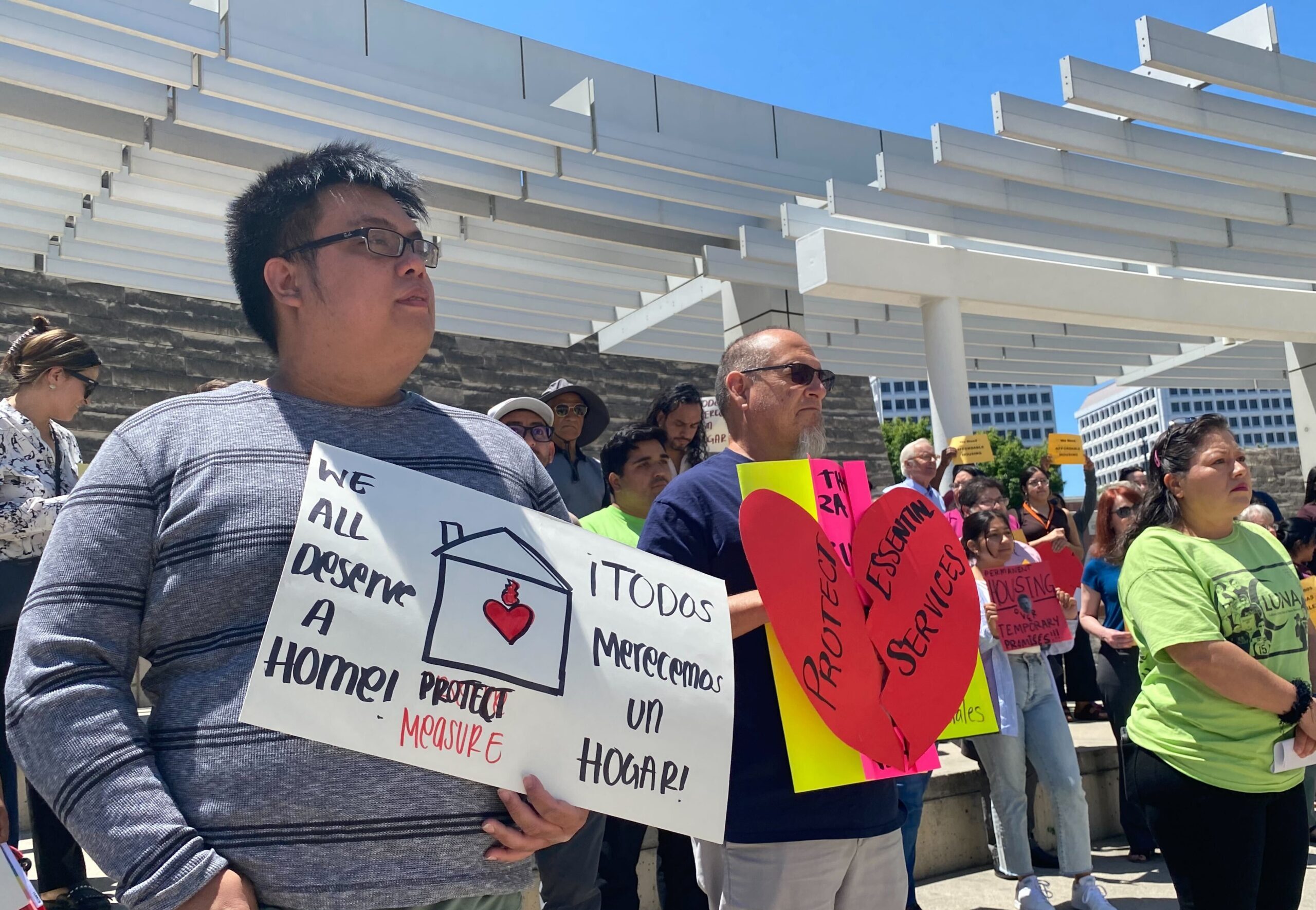
San Jose leaders are rallying opposition to a measure headed for the statewide November ballot that could undermine a cornerstone of the city’s efforts to keep low-income people housed.
The measure, championed by the Howard Jarvis Taxpayers Association, raises the threshold to pass local voter-sponsored tax initiatives, and also limits the amount cities can tax property sales. The proposal has raised eyebrows around San Jose City Hall because it applies retroactively, meaning it would nullify Measure E, the city’s 2020 voter-approved transfer tax that has raised hundreds of millions of dollars to fund the creation of below market-rate homes and expand the city’s homeless shelter system.
The San Jose City Council will consider taking an opposing position against the ballot measure — known as initiative No. 1983 because it hasn’t yet received an official proposition number — during its meeting Tuesday. Several officials have signaled they are ready to take such a step, which would put San Jose in line with the League of California Cities and other statewide organizations that have already mobilized against the proposal.
“Eliminating (Measure E) would significantly undermine the City’s ability to address some of its most urgent challenges that voters explicitly approved,” Councilmembers Pamela Campos, David Cohen, Rosemary Kamei and Anthony Tordillos said in a joint memo. “Our work to address homelessness and build affordable housing would be decimated if the initiative were to pass.”
The proposition seeks to limit local government’s ability to impose new taxes in two ways. First, it would mean local tax initiatives earmarked for specific purposes and placed on the ballot by voters would need a two-thirds majority for approval, rather than a simple majority. Second, it also blocks voters from approving transfer taxes above the 0.11% limit imposed by Proposition 13, landmark anti-tax legislation approved by state voters in 1978.
Supporters of the change argue the law simply closes loopholes, opened up by various court rulings, that have allowed cities to skirt the clear intent of several voter-approved laws limiting new taxes, such as Proposition 13.
“This statewide initiative will not only restore taxpayer rights, but it will also provide clarity in the law upholding the two-thirds vote protection,” Howard Jarvis Taxpayers Association President Jon Coupal wrote in the Tahoe Daily Tribune.
It’s not the the first time California tax hawks have attempted to pass a ballot initiative intended to make it harder to approve new taxes. In 2024, a similar measure, which also included other restrictions — such as a requirement that California voters sign off on all new tax hikes from the state legislature — made it on the ballot, but it was axed by a ruling from the California Supreme Court.
San Jose’s Measure E imposes a tax on property transfers over $2.3 million. Previous estimates place the revenue from the tax at roughly $55 million each year.
The measure became the subject of intense political wrangling in 2024 when Mayor Matt Mahan led a successful push to divert most of the tax fund away from affordable housing and toward the city’s shelter programs. Still, San Jose’s affordable housing advocates continue to see it as an indispensable bulwark of the city’s housing efforts.
“(The proposed ballot measure) will end new affordable housing for working class families in California, and take all the people San Jose has moved indoors in the last few years and put them back out in the streets,” Sandy Perry, board vice president for the South Bay Community Land Trust, told San José Spotlight. “Not a good look for the richest place on the planet.”
Meanwhile, even some of San Jose’s most vocal opponents of new taxes have voiced doubts about the proposed statewide anti-tax ballot measure.
“I’m not a big fan of retroactivity, so I would have a hard time supporting that,” Pat Waite, president of the San Jose-based Citizens for Fiscal Responsibility, told San José Spotlight. “I don’t have a problem with raising the threshold, but making it retroactive is unfair to voters and municipalities.”
Contact Keith Menconi at [email protected] or @KeithMenconi on X.
Leave a Reply
You must be logged in to post a comment.