

|
Getting your Trinity Audio player ready...
|
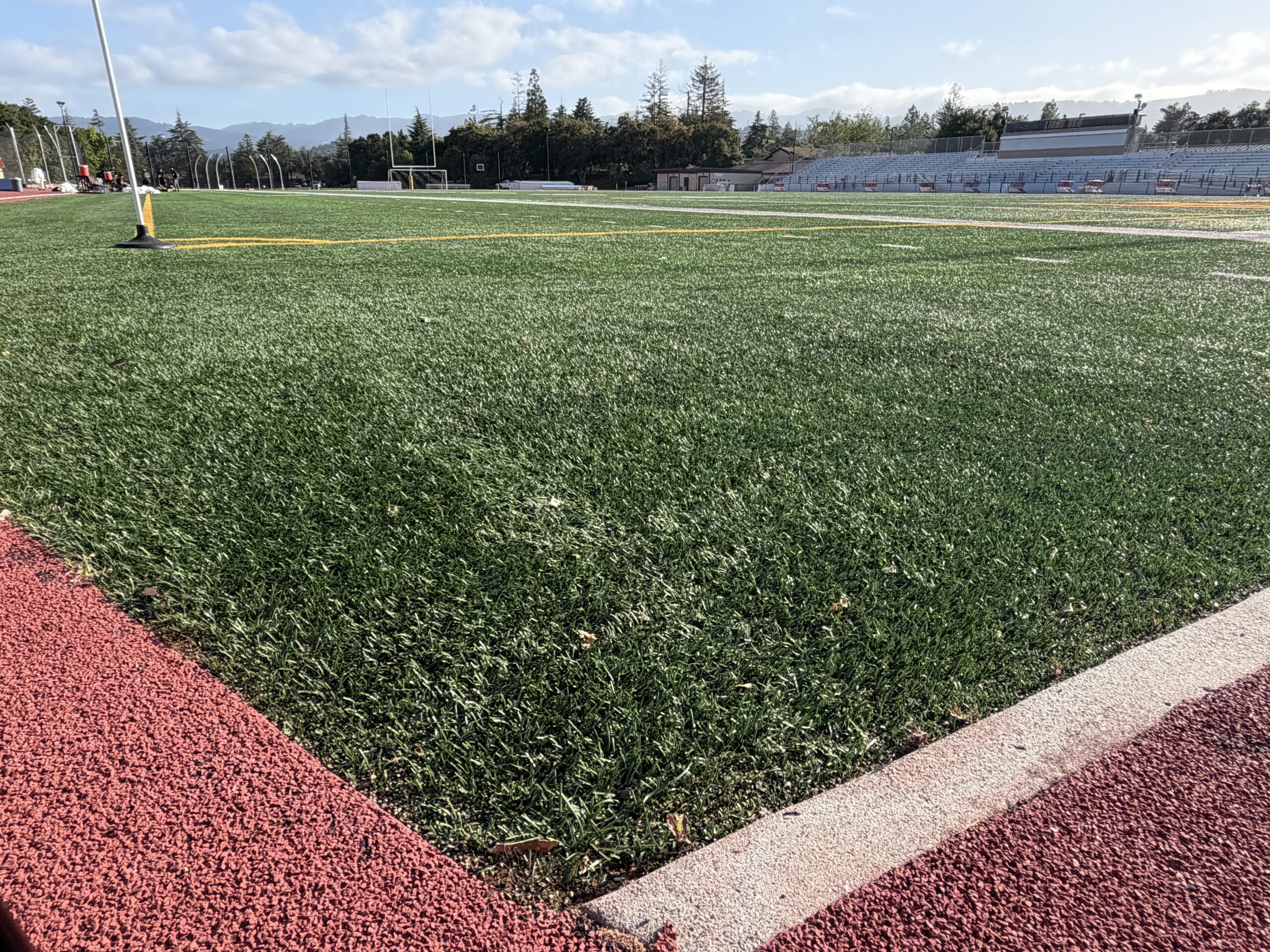
Plans to upgrade the athletic fields at De Anza College in Cupertino are raising concerns from students and residents about what material should be used.
The school’s aging artificial turf fields must be replaced because they’re nearing the end of their lifespan — and college officials need to chose between synthetic turf or natural grass. While synthetic turf offers lower maintenance costs and increased field use, some community members are urging the district to reconsider the material, citing concerns related to heat, chemical exposure and long-term environmental effects. The college district board of trustees will receive recommendations on the best option as early as May 11.
“I think there’s pros and cons to it. Turf is convenient,” Skyline College soccer coach Mike Shirabi, whose was using the De Anza College field to play Hartnell College, told San José Spotlight. “Once it’s put in that’s it. People don’t really need to worry about it for a while.”
Still, Shirabi said he has seen synthetic turf cause ankle and knee injuries because players’ cleats get caught in the turf. He said injuries are common regardless of the turf and natural grass would be preferred, but it always comes down to the college’s budget.
A 2024 policy recommendation from the Santa Clara County Medical Association warned synthetic fields may pose environmental and health concerns, particularly for children. Studies have identified chemicals in artificial turf materials that are linked to cancer, including PFAS and certain rubber compounds. However, public health agencies say current research has not established a clear link between playing on turf fields and increased cancer risk.
“Every 10 years, you’re pulling up about two acres of plastic and dumping it somewhere,” Sue Hinton, chair of the Sierra Club’s Loma Prieta Chapter Plastic Pollution Prevention Committee, told San José Spotlight.
De Anza soccer coach Rusty Johnson said the synthetic turf has worked well for the college’s athletic programs, offering reliable playing conditions and frequent use without major issues.
“In 23 years, I have not heard of a lymphoma or something like that from playing on turf,” Johnson told San José Spotlight.
The debate at De Anza mirrors similar discussions across the county and cities, including Palo Alto and Sunnyvale that have grappled with the environmental and health impacts of synthetic turf. Last January, the Santa Clara County Board of Supervisors was unable to agree on whether to ban artificial turf and took no action after lengthy discussions that began back in 2024 over whether artificial turf should be consider at the county fairgrounds.
While officials and policymakers continue to debate the issue, student athletes who regularly play on the fields prefer natural grass over most synthetic turf. Kevin Salto, a Skyline College soccer player, found the De Anza field a bit slippery — but the main issue was the temperature.
“When I’m playing with my cleats, the turf gets really hot — it feels like my feet are melting,” Salto told San José Spotlight.
College officials on April 17 said the decision as to what materials should be used involves more than health concerns. District staff presented data showing synthetic turf fields cost significantly less — about $1.3 million over a decade compared to roughly $10 million for natural grass, which requires ongoing watering and maintenance.
Turf fields can also support significantly more use, accommodating up to 4,000 hours of play annually — more than double the capacity of grass fields, the presentation showed. Switching to natural grass could reduce field availability and limit use by athletic programs and community groups.

Still, some board members questioned whether the district’s evaluation fully captures the risks. Trustees raised concerns about how synthetic turf retains heat, noting some studies show surfaces can reach significantly higher temperatures than natural grass.
“I think it depends on where you are. I think it can get very hot if you’re in Sacramento or Arizona, somewhere where it’s really hot out there,” Shirabi said. “It adds about 20 degrees, maybe 20 to 30 degrees.”
Trustees at the meeting emphasized the role athletic fields play in student access and opportunity. They said limiting field availability could disproportionately impact students from underserved communities, where sports can provide pathways to education and economic mobility.
“We can’t lose sight of the equity side of this especially for students from low-income and marginalized communities, this can be a pathway to education,” Foothill College President Kristina Whalen said in the meeting.
Contact Maryanne Casas-Perez at [email protected] or @CasasPerezRed on X.
Leave a Reply
You must be logged in to post a comment.