


|
Getting your Trinity Audio player ready...
|
Few buildings epitomize the evolution of Silicon Valley better than the sprawling, lofty structure on Portage Avenue, which began its life as one of the nation’s largest fruit canneries and later evolved into one of Palo Alto’s major retail destinations, best known for Fry’s Electronics.
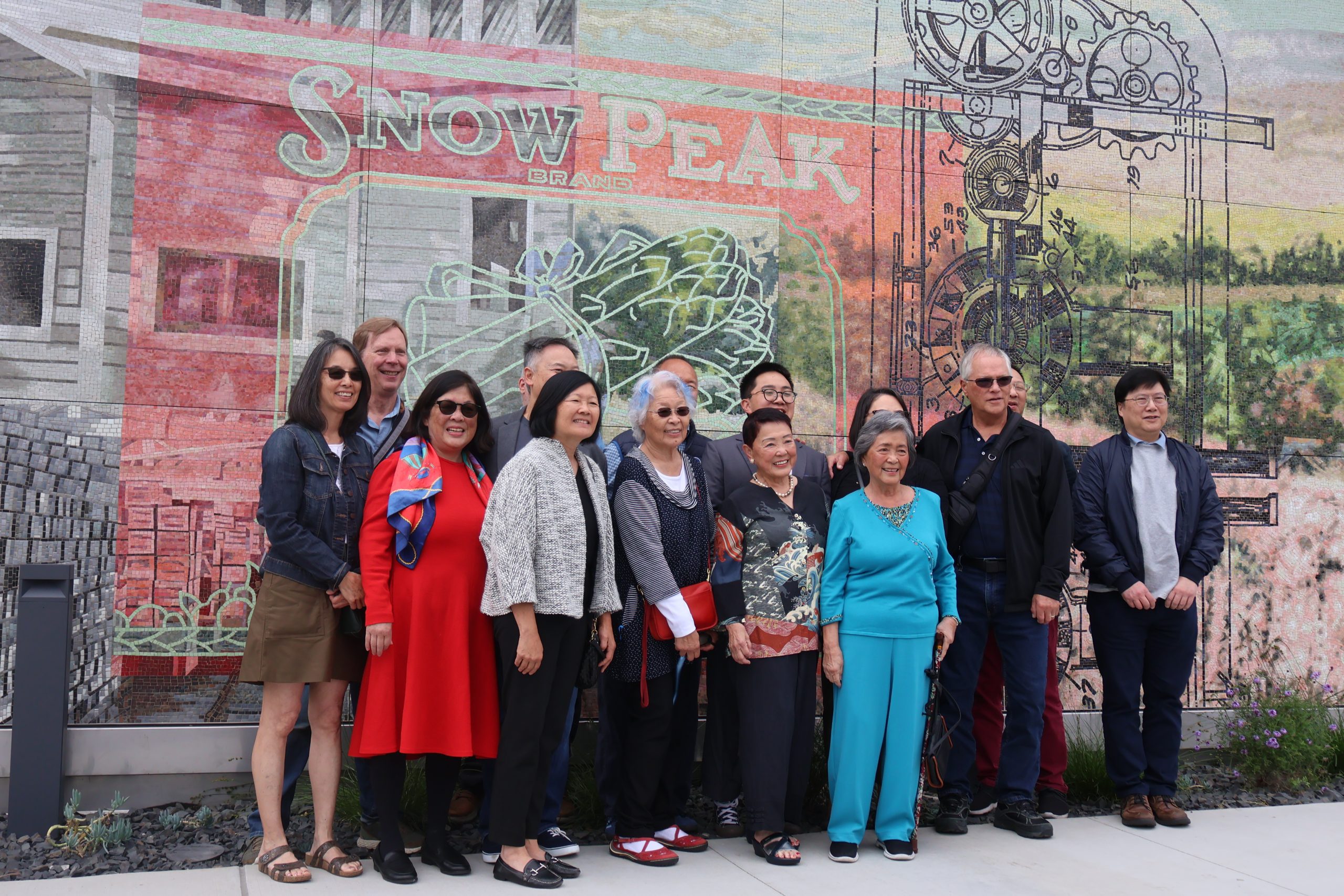
On Tuesday, the 73,000-square-foot building that was once known as Bayside Cannery launched its next chapter as an all-electric commercial building that will soon welcome commercial tenants to its completely refurbished interior. But to visitors and residents, the most visible new feature is an expansive mosaic at the building’s exterior that celebrates its agricultural past and the life of Thomas Foon Chew, the entrepreneur who opened the cannery in 1918. Leading up to the building is a sculpture made up of cans, their labels spelling out “Bayside Canning Company.”
The refurbishment of the building at 340 Portage Ave. is part of a broader redevelopment of the Ventura property near Park Avenue. In the next year, Sobrato Organization plans to build 74 townhomes directly across from the cannery building. Elsewhere on the site, Palo Alto is planning to construct about 100 below-market-rate apartments and a new public park.
The projects were all part of a development agreement that the city reached with Sobrato in 2023, a time when the city was considering sweeping zoning changes to the portion of Ventura that includes the former Fry’s site. Former Mayor Tom DuBois, who was part of a council committee that negotiated the development agreement, said he was impressed with the refurbished building, which he said exceeded his expectations.
“You look at how big this building is and you can imagine how much fruit was here when it was a cannery,” DuBois said. “I think it’s great that we found a way to honor his memory and have this building modernized and reused.”
DuBois was part of a crowd that attended the Tuesday ceremony honoring the restored cannery, a roster that included dozens of local dignitaries, city staff, architects, developers and members of Chew’s family.
John Sobrato, the developer and philanthropist whose company is behind the project, said the story of Chew resonated with him. Sobrato’s own father emigrated from Italy and opened a restaurant business in San Francisco, he said at the ceremony. After his father passed away, his mother took the proceeds from the restaurant and invested them in real estate, which created a foundation for the Sobrato Organization.
“Thomas Foon Chew arrived with the same determination and built one of the largest canneries in the country right here on this land,” Sobrato said.
The cannery, he said, is the most sustainable building that Sobrato Organization has developed in its 70-year history — fully electric, “net zero” emissions and on the way to be certified as LEED-platinum.
City leaders were similarly buoyant. Mayor Vicki Veenker lauded the project’s commitments to historic preservation and environmental sustainability, calling the refurbished building a “tremendous adaptive reuse project.” City Manager Ed Shikada highlighted the community’s involvement in shaping the project, including its focus on celebrating the building’s illustrious history through art.
“Palo Alto expects a lot from its developments, and this is really a classic example, an extreme example in some ways, and really a testament to the community engagement,” Shikada said. “I know we’ve got community members here who have been involved in the imagining of what this could be and ultimately making it a reality. So, it’s really extraordinary.”
The most conspicuous feature of the renovated cannery is the expansive mosaic mural at the entrance. Created by artist Kyungmi Shin, the artwork relied on historical photos from Chew’s family, including pictures of labels from old asparagus and apricot cans and a black-and-white image of cannery workers. These are juxtaposed with an image of a computer amid a sea of zeros and ones, an homage to the building’s more recent history.
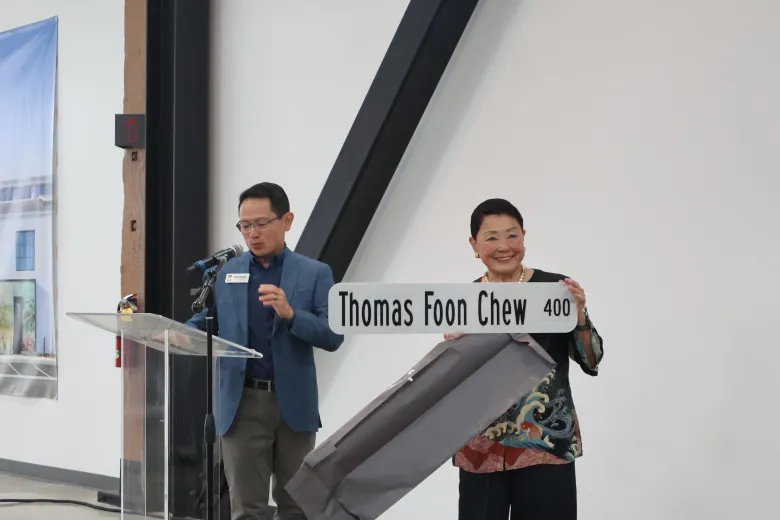
As part of the Tuesday ceremony, the city awarded Gloria Hom, a local resident who is a granddaughter of Chew, with a street sign bearing her grandfather’s name. This follows the council’s decision last fall to rename Portage Avenue to Thomas Foon Chew Avenue.
Hom recalled her family’s history in Palo Alto, from her great-grandfather’s move to California from China to her grandfather’s ascent to becoming the “Asparagus King.”
“This building that we’re standing in now was one of his smaller canneries, specializing in apricots, pears and peaches,” Hom said. “Under the Bayside Cannery label, his products became known for their exceptional quality.”
Chew operated the cannery until 1928, when he sold it to Sutter Packing Company. For a period of time, the cannery was the city’s largest employer. When Chew died at the age of 42, his funeral was attended by about 2,500 people, Hom said, including local dignitaries and civic leaders. She thanked the city and Sobrato for honoring her grandfather’s legacy in the refurbished building.
“My heart is just overflowing with gratitude,” Hom said.
This story originally appeared in Palo Alto Weekly. Gennady Sheyner is the editor of Palo Alto Weekly and Palo Alto Online. As a former staff writer, he has won awards for his coverage of elections, land use, business, technology and breaking news.

Leave a Reply
You must be logged in to post a comment.