

|
Getting your Trinity Audio player ready...
|
South Bay housing advocates have long touted the benefits of mass timber, a wood-based class of construction materials said to save builders time and money. After years of false starts, it appears their long wait to see mass timber housing projects get off the ground may finally be coming to an end.
An affordable housing complex in Los Altos that incorporates mass timber is slated for completion later this year, making it a likely candidate for the first residential building using the material to ever be completed in Santa Clara County. Meanwhile, a planned affordable housing complex in Sunnyvale that uses mass timber received a $50 million award from state housing authorities earlier this month. And a handful of other mass timber projects in early stages of development are taking shape elsewhere in the county as well.
“There’s a lot of momentum,” Alex Shoor, executive director of San Jose housing group Catalyze SV, told San José Spotlight.
For Shoor and other South Bay housing boosters, mass timber is a crucial piece of the puzzle needed to get more homes built in the region.
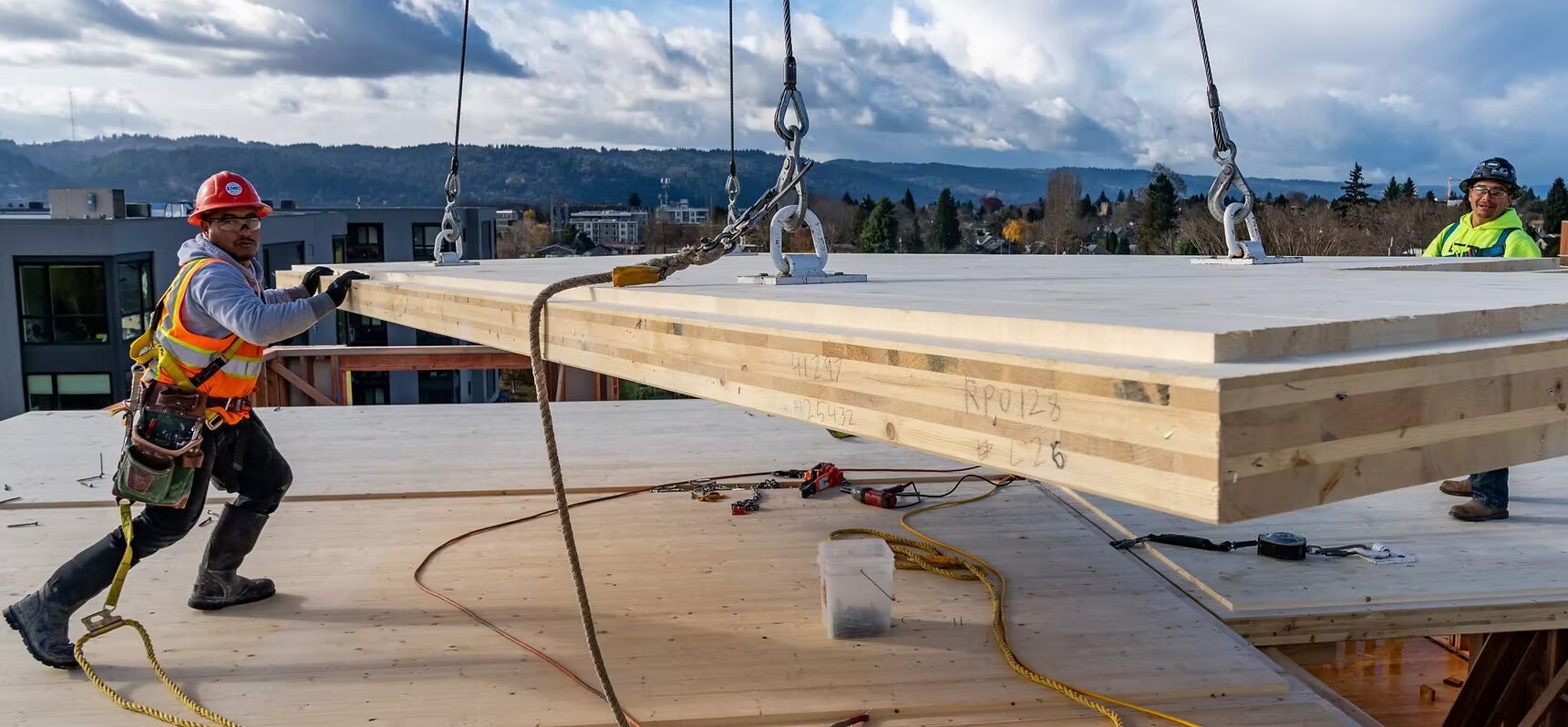
Mass timber describes a variety of wooden construction materials created by binding together layers of wood, often using adhesives. This creates a stronger material that can bear more structural load, allowing developers to build beyond the typical five-story limit for traditional wood-framed buildings.
The cost savings from mass timber — which stem from the reduced need for steel and concrete, as well as the relatively simple construction processes that the material enables — could make dense, residential development projects more economical. It’s a tantalizing possibility in the South Bay, where high construction costs have held the local housing industry in a state of near stasis for years.
Mass timber boosters also contend wood-based construction produces less greenhouse gas emissions, and that the woody finished products are more aesthetically pleasing than steel and concrete covered in sheet rock.
Despite its potential, building with mass timber still remains a fairly niche practice in the housing sector. Shoor sought to spark interest in the construction material when he helped to organize a series of events centered on the topic in the spring that drew together industry professionals, housing advocates and government leaders.
“We decided that this was a moment in time where we wanted to advance the opportunities and ideas of mass timber to try to move this from a few early adopters to mass adoption,” Shoor said. “Despite it not getting as much attention as other (housing) solutions … I think mass timber is going to rise up the rankings of importance and impact.”
A maturing industry
As of June, 187 mass timber projects have broken ground in California since the turn of the century, according to figures gathered by WoodWorks, a trade group supporting the wood industry.
In the South Bay, mass timber has already been used in several office and school buildings, but residential projects have been slower to materialize.
State and local building codes have become more accommodating for mass timber in recent years, but housing advocates say further reforms are still needed to hammer out regulatory kinks holding back the industry. In addition, the lack of familiarity with mass timber in the housing sector makes some firms reluctant to sign onto projects, creating even more roadblocks, Chelsea Drenick, a regional director for WoodWorks, said.
“There’s a lot of things that can kill a project, and it’s challenging to push for these new things,” Drenick told San José Spotlight. “It is happening slowly, and it does take leaders in this space.”
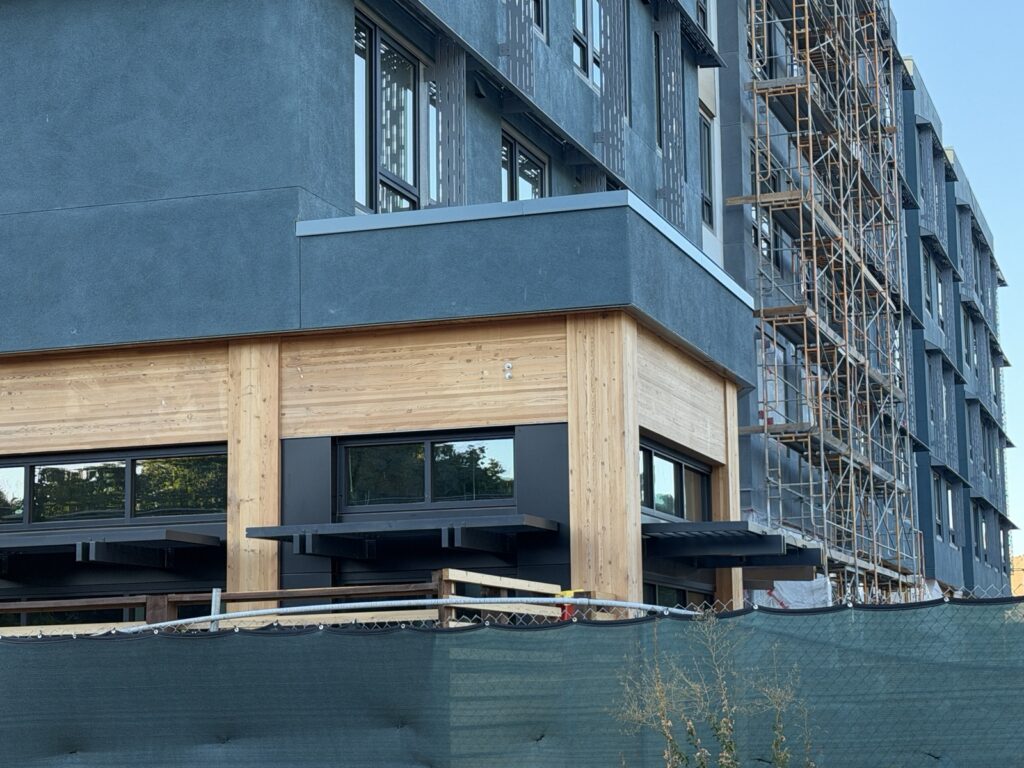
In a major milestone for mass timber in the South Bay, construction work on a five-story affordable housing complex at 330 Distel Circle in Los Altos is expected to wrap up later this year. The modular residential building rests on a ground floor made of mass timber.
The builders behind the project opted to use a partial mass timber design primarily for environmental and aesthetic reasons, Randall Thompson, a preconstruction executive who works for the project’s general contractor Nibbi Brothers, said.
While not a major cost saver for the project, the use of mass timber likely shaved off several months of build time, Thompson said.
As Shoor might hope, the positive experience has encouraged Randall’s team to consider using mass timber again.
“We’re looking forward and working on opportunities to try to apply that and scale that up to larger projects” Thompson told San José Spotlight. “We feel there definitely is a place in the industry for mass timber for residential construction. It’s just finding the right opportunity to apply it.”

Tucked away in a Campbell industrial park just west of Highway 17, MassFrame Solutions is another construction firm that has been at the forefront of mass timber innovation.
Founded by James Woodbury at the start of 2025, the subcontractor has developed a hybrid approach to mass timber construction. The firm designs and fabricates modular building components that combine metal frame walls with mass timber floor panels. Woodbury said mass timber’s durability makes it better suited to modular construction, which requires components built to precise dimensions.
“It just seemed like a really good fit to do something new and try to deliver what society is asking for, which is more housing — and higher quality and better, faster, cheaper,” Woodbury told San José Spotlight.
He estimates the hybrid approach reduces building costs by 30% compared to traditional wood-framed designs. The firm recently completed work at a student housing project for UC Santa Cruz, and has begun early design work for teacher housing in the Alum Rock School District.
Complicating the development math, the raw material costs of mass timber are higher than for traditional lumber. As a result, the greatest cost savings from projects using a fully mass timber design are typically realized in high-rise buildings, industry experts said.
Danny Haber, a housing developer who has helped lead groundbreaking high rise mass timber projects in Oakland, said that could limit the technology’s appeal in the sprawled out South Bay.
“In most of the Peninsula and South Bay, you’re building six to eight-story buildings,” Haber told San José Spotlight. “And six- to eight-story buildings — you’re not going to use mass timber.”
But as builders refine their techniques, more possibilities could open up for mass timber’s use. Woodbury noted the UC Santa Cruz dorm built with his firm’s hybrid mass timber modules stands at six stories tall.
“We know we can build it better,” Woodbury said. “It’s just a matter of being able to find early adopters out there that also want to take the leap with us and find projects that make a lot of sense.”
Contact Keith Menconi at [email protected] or @KeithMenconi on X.

Leave a Reply
You must be logged in to post a comment.