


|
Getting your Trinity Audio player ready...
|
A developer’s plan to build dozens of row houses in Mountain View sailed through the City Council last week, although it prompted some discussion from city leaders who questioned why more affordable home ownership options were not on the table.
In a 6-0 vote, the City Council approved a 36-home row house development at 924 and 940 San Rafael Ave., directly across the street from a future city park near the junction of U.S. Highway 101 and Highway 85. Mayor Emily Ann Ramos recused herself from the vote at the Nov. 10 meeting.
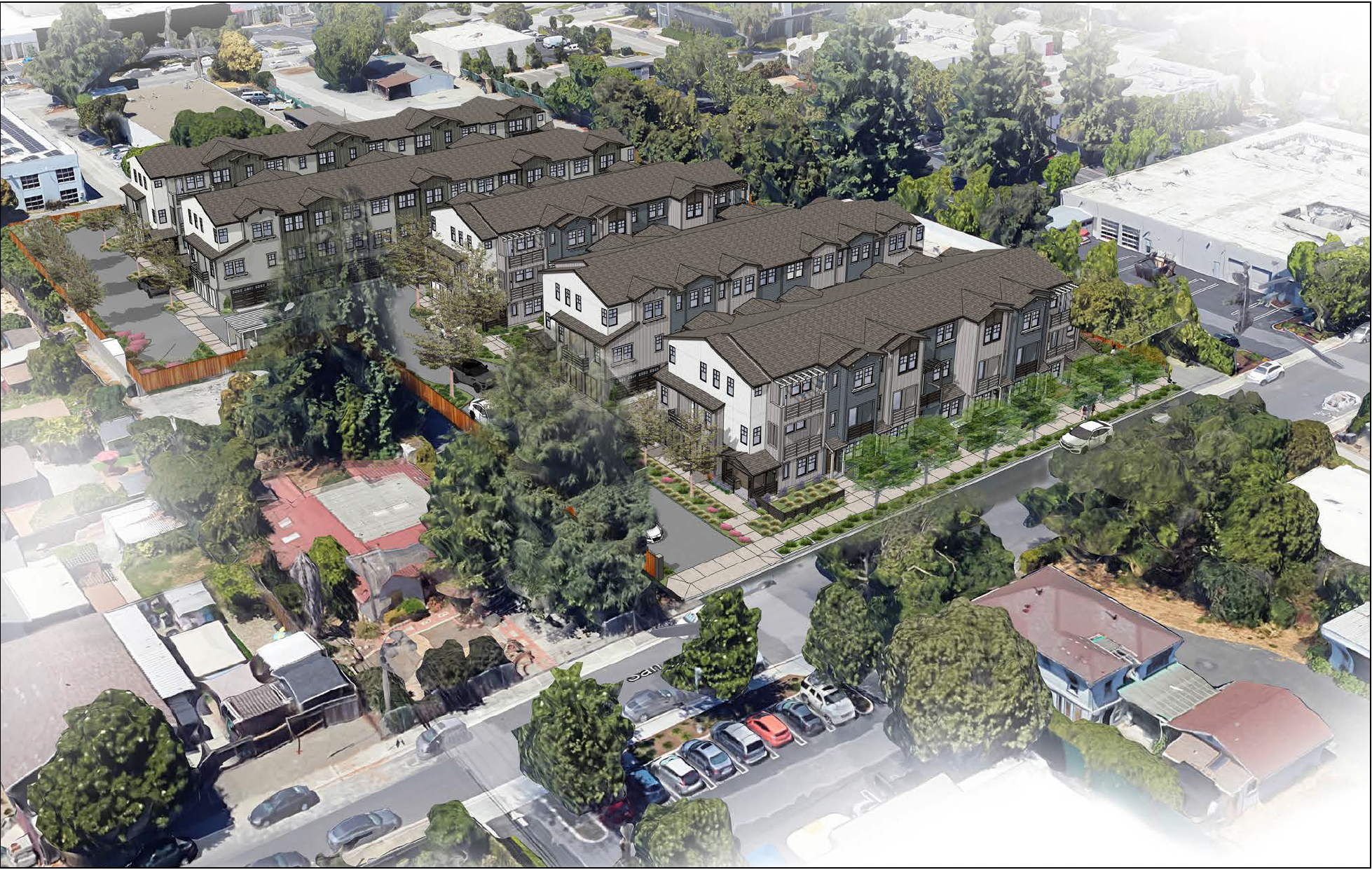
Prometheus, the real estate developer, is proposing to build 36 three-story homes, including nine below-market rate, spread across five buildings on a 1.8-acre project site. The development would replace two industrial buildings and a vacant parking lot.
Councilmembers generally supported the project on the basis that it would add more homes in a part of the city that has a lot of industrial businesses, but is slated for major housing growth. Those plans include a 108-home affordable apartment building at 1020 Terra Bella Ave., a 303-home housing project at 1001 N. Shoreline Blvd. and a 38-home row house development on the 900 block of San Leandro Ave.
“The residential developments we’re seeing move forward will actually complement and fit in nicely with the density that will be increasing in the area,” Councilmember Ellen Kamei said.
However, a few councilmembers expressed disappointment that developers in Mountain View are frequently choosing to build row houses instead of for-sale condos. Row houses are single-family residences that share walls with adjacent buildings and include land ownership. In comparison, condos are usually smaller, do not include land ownership and typically have homeowner association fees.
As a result, condos generally have a lower price point for entry-level home ownership than row houses. Councilmembers also noted that condos tend to create opportunities for denser housing, more green space and other community benefits, as compared to row houses.
Mike Ducote, senior director of development for Prometheus, responded to some of those concerns, noting that state law protects condo buyers from bearing the cost of fixing defects in newly built homes for up to 10 years.
“From our experience, most condo projects are highly litigious due to construction defect litigation, and so it’s something that you’re not seeing a lot of that going on because of that type of issue,” Ducote said.
Ducote added that the project site is surrounded by single-family homes, describing the row house development as a better fit for the neighborhood.
Councilmember Alison Hicks pushed back on some of those arguments, giving examples of condos in Sunnyvale transitioning well with single-family homes while adding a few more units than row houses.
“I’m wondering what we’re doing here to get this (row house) configuration repeatedly, and what we might do differently to encourage what I would personally see as a better outcome,” she said.
Christian Murdock, the city’s community development director, said row house developments are highly profitable for developers, driving the market conditions for those types of projects.
“Collectively you’re seeing carte blanche to some extent for developers to design projects that are most economically desirable for them, which doesn’t always necessarily align with the livability or good design that some members of our community might appreciate,” he said.
To mitigate the issue, Kamei suggested the city back condo legislation reform as part of its state and federal lobbying efforts. A state bill to boost condo construction did not get a final vote before the legislation period ended earlier this year.
Leave a Reply
You must be logged in to post a comment.