


|
Getting your Trinity Audio player ready...
|
Every Labor Day, we remember the fights that built the modern workplace: the eight-hour day, the weekend, the right to organize. This year, we’re writing the next chapter: to establish workers’ rights to shape how emerging technology, including artificial intelligence, gets deployed on the job.
Technology has always been part of work. At its best, the gains get shared between employers and workers but history shows that doesn’t happen automatically. The last time machines reshaped work this fast — the Industrial Revolution — the gains were hoarded. It deepened inequality, hardened occupational segregation and left workers worse off. But not for long. Workers organized and won new labor standards and rights. We’re at a similar turning point now.
Now, technology isn’t just helping do the job. In many cases, it’s deciding who works, how and for how long.
Some of what gets deployed simply doesn’t work, leaving workers to troubleshoot glitches. Others work exactly as intended. Workers call this second category bossware: technology built to watch, analyse, score, manage, pay and even replace the people doing the job.
This isn’t confined to Amazon warehouses or gig corporations. Hospitals, retailers, security firms, hotels: Employers everywhere are adopting the same tools, often as a way to cut costs, and with less scrutiny and few resources to catch it when something goes wrong. The billionaire defenders of this technology treat any effort to limit its harms or share its gains, be it through wages, taxes or rights, as an attack on progress itself. This is not innovation, it’s a race to the bottom.
We’ve heard what this looks like on the ground. A security officer describes being so tethered to a monitoring app that it prevents him from doing his job well, and almost caused a harmful accident. A triage nurse worries she and her colleagues will start performing for the algorithm listening in on patient visits, instead of focusing on the patient in front of them, and that processing systems will override her judgement. A hotel worker describes her schedule being built and rebuilt by an algorithm that doesn’t understand her workload.
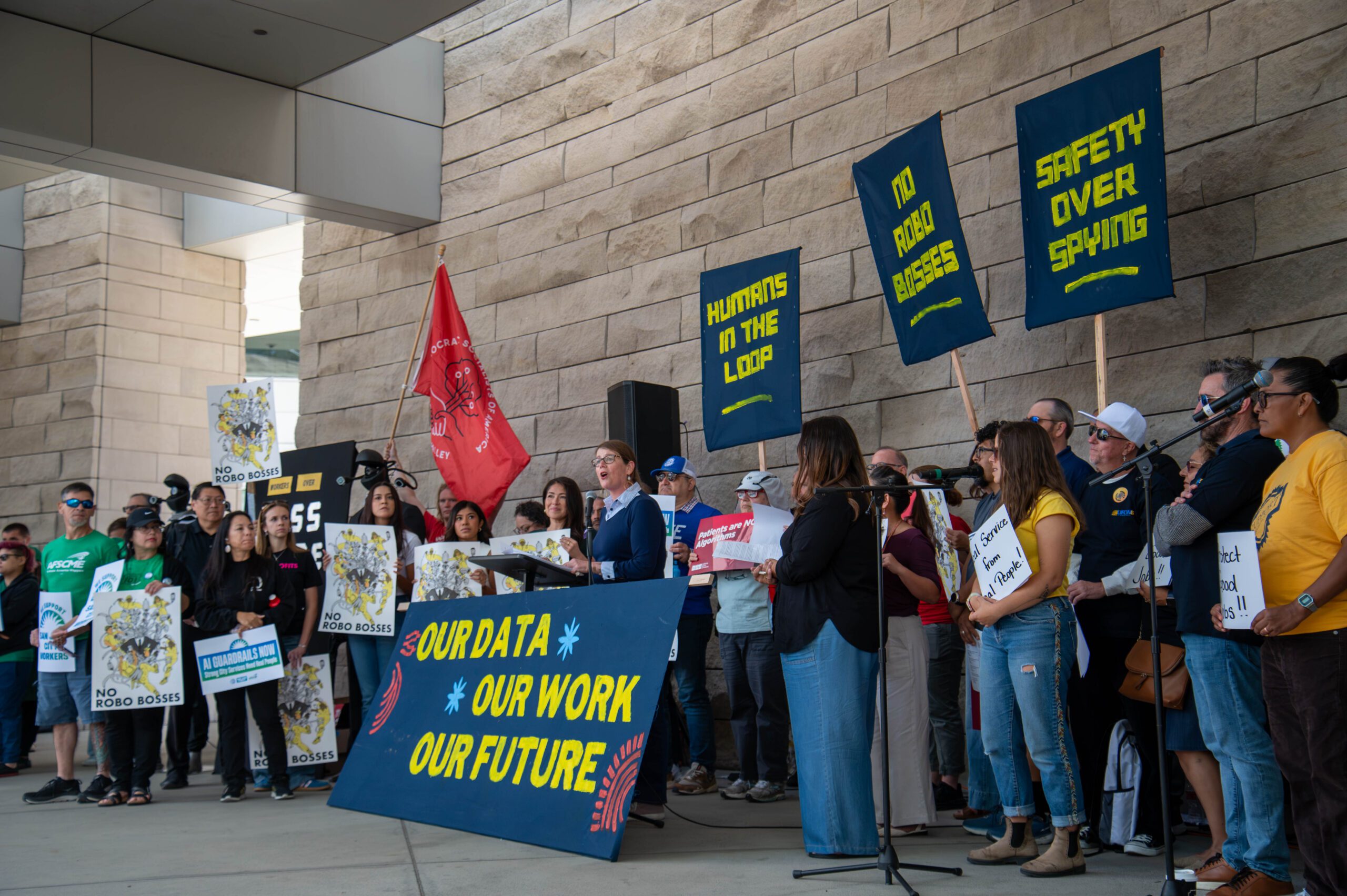
For these workers, the fight around emerging technology and work isn’t only about jobs disappearing, but also about the jobs that remain. Workers are organizing, and lawmakers have an opportunity to write 21st century rights before the worst harms become permanent. The California Federation of Labor Unions has led on this front, and currently six bills that would regulate tech in employment are awaiting Gov. Gavin Newsom’s signature, including Senate Bill 947, the No Robo Bosses law, and Senate Bill 1246, which would set the first real safety and workforce protections for autonomous vehicles.
In Santa Clara County, we launched the People’s Tech Coalition, bringing labor and community groups together to ensure we all have a say in how these systems get deployed locally. Similar coalitions are rising across the state.
Cities and counties, where workers actually feel the impact, have always been where workers win first. From paid sick days to the living wage all started local before they became state law.
As leaders in Silicon Valley’s labor movement, we know what makes technology work for people instead of against them: enforceable rights over how emerging technology, including AI, gets used in our workplaces. The right to know before a monitoring or AI system is put in place. The right to a human reviewer before anyone is disciplined or fired on a machine’s recommendation. The right to see and correct the data collected about us, and the right to appeal when the system gets it wrong.
We’re determined to fight to affirm these rights.
We can allow innovation to thrive, while defending the workers of the future. Tech companies are spending hundreds of millions of dollars at the federal and state level to write the rules in their favor. We’ve organized before, and we’re organizing again, until the rules are not written only to benefit Big Tech, but reflect the voices and needs of workers and communities.
Maria Noel Fernandez is executive director of Working Partnerships USA. Jean Cohen is executive officer of the South Bay Labor Council.
Leave a Reply
You must be logged in to post a comment.