


|
Getting your Trinity Audio player ready...
|
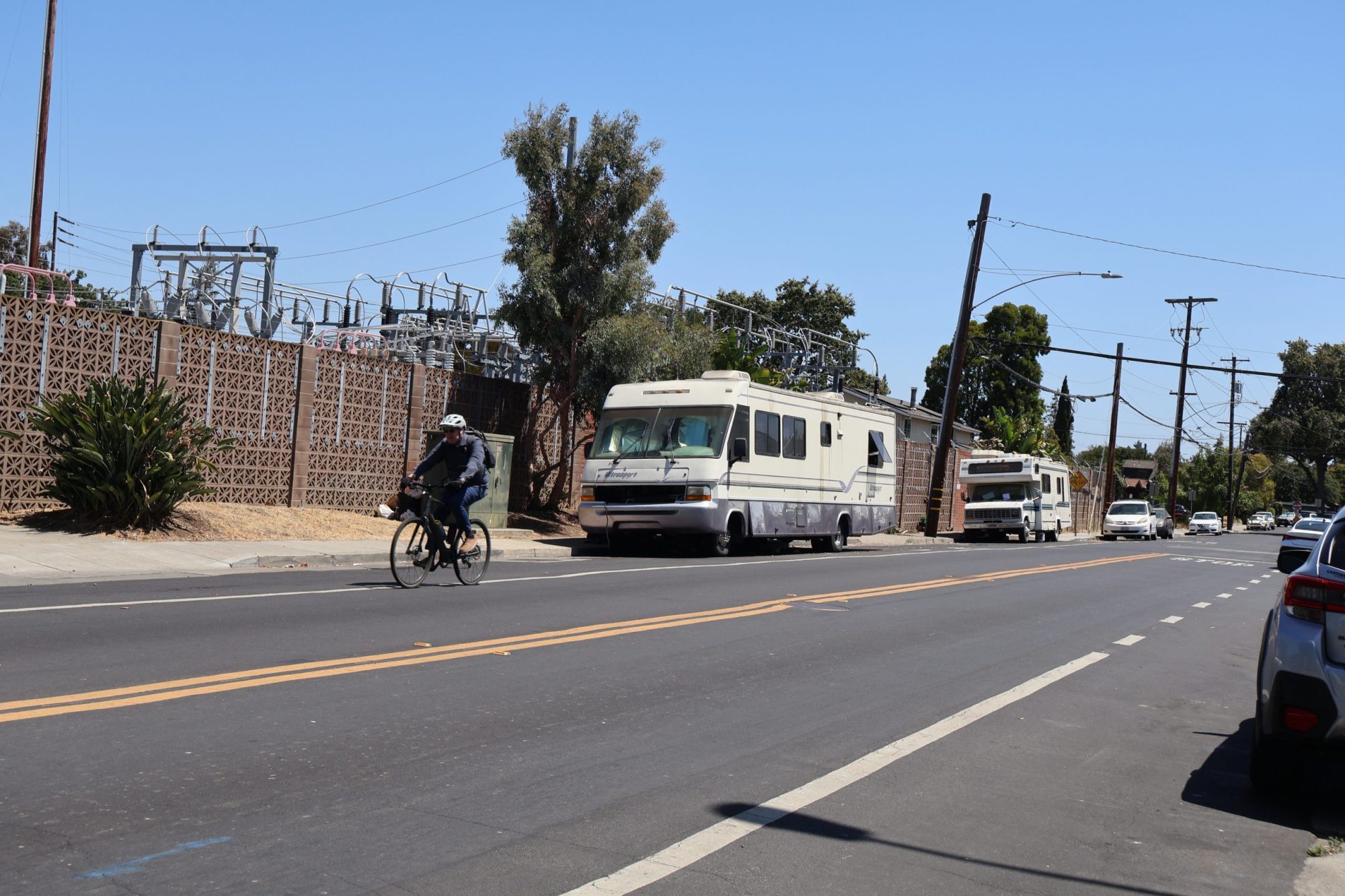
Facing pressure from local residents and businesses to address a growing number of recreational vehicles in local neighborhoods, Palo Alto city leaders are considering a new solution: requiring vehicle dwellers to buy permits and designating sections of Embarcadero Road and Coyote Hill Road for their habitation.
In addition, the city’s pilot program would limit parking to one side of the street on 13 street segments, requiring cars to move to alternating sides every six months.
The plan, which the City Council is expected to to discuss on Aug. 24, follows more than a year of sustained pressure from local residents and business owners who have seen their blocks fill with recreational vehicles over the past two years. According to the Santa Clara County point-in-time count, the city’s population of homeless individuals has more than doubled between 2023 and 2025, with the vast majority of them living in vehicles. City staff reported that about 73% of Palo Alto’s unhoused individuals live in vehicles, far above the countywide figure of 53%.
The council has already taken several steps to address the influx, including voting in December to ban detached trailers and prohibiting vanlords, RV owners who rent out their vehicles while they are parked on public streets. Under the city’s multiphased approach, councilmembers have also expressed interest in further restricting RV parking and providing more services to residents who live in vehicles.
In June, the city reported that the number of oversized vehicles had declined from 191 to 133 between Jan. 15 and May 6. Yet the impact remains uneven, with some streets still inundated with RVs and trailers. Robert Marinaro, a resident who regularly surveys oversized vehicles in local neighborhoods and submits photos of street conditions to city leaders, reported earlier this month that a segment of Fabian Way, near West Charleston Road, is “lined back-to-back with oversized vehicles.”
“We have been dealing with this situation for far too long and we are near the breaking point,” Marinaro wrote. “A year has gone by and the incremental measures implemented by the city in this past year have only marginally fixed the problem. This particular section of Fabian Way is a disaster and it is not fair to the residents and businesses here.”
If the council approves the proposed plan, the city’s new program on Coyote Road and Embarcadero would launch March 1, 2027, according to a report from the office of City Manager Ed Shikada.
“The OSV parking permit pilot is intended to reduce impacts on business districts and residential neighborhoods, provide a more structured approach to supporting individuals living in oversized vehicles, connect OSV dwellers with case management, and help them transition into permanent or more stable housing,” the report states. “Other vehicles would not be allowed to park in the permit zone.”
The Coyote Road segment, which is just west of Hillview Avenue in Stanford Research Park, is expected to accommodate about 20 oversized vehicles. Another 17 would be located on a segment of Embarcadero, east of the U.S. Highway 101 and near Palo Alto Airport. Participants would pay $15 for monthly permits, which they would have the option of renewing.
Concurrently, the city would clamp down on oversized vehicle parking in other neighborhoods, most notably Ventura. But rather than an outright ban, the city would limit parking to a single side of the street in select areas for a six-month period. Vehicles would then be required to move to the other side of the street for the following six months.
The city is proposing the following streets for the “alternative sides” program, which would launch in January 2027:
- 4000 Block of Transport Street
- 900 Block of Commercial Street
- 900 Block of Industrial Avenue
- 100 Block of Page Mill Road
- 2800-3200 Block of Park Boulevard
- 200-400 Block of Olive Avenue
- 2900 & 3200 Block of Ash Street
- 200-400 Block of Lambert Avenue
- 1000 Block of Elwell Court
- 1000 Block of Corporation Way
- 1000 Block of East Meadow Circle
- 2400 Block of Embarcadero Way
- 2400 block of Faber Place
City staff acknowledge the program will likely drive some vehicles to other blocks in the neighborhoods. They plan to monitor these impacts as the program unfolds, according to the report. The “alternating sides” program would accommodate about 116 oversized vehicles during the initial six months and 125 vehicles during the remaining six months, according to staff.
The two pilot programs have a cost estimate of about $823,000.
The program followed a series meetings by the council’s recently established Oversized Vehicles Impacts and Services Ad Hoc Committee, which is chaired by Councilmember Ed Lauing and includes Councilmembers Julie Lythcott-Haims and Keith Reckdahl. If the council approves the programs on Aug. 24, staff will spend the following six months doing outreach and notifications to surrounding business, neighborhoods and vehicle dwellers, according to the report.
“While the Ad Hoc and staff continue to pursue expanding safe parking locally and regionally, finding adequate locations for safe parking is challenging due to high land costs and limited suitable sites,” the report states.
This story originally appeared in Palo Alto Weekly. Gennady Sheyner is the editor of Palo Alto Weekly and Palo Alto Online. As a former staff writer, he has won awards for his coverage of elections, land use, business, technology and breaking news.
Leave a Reply
You must be logged in to post a comment.