

|
Getting your Trinity Audio player ready...
|
A trip through the airport can be a lot to handle. But the stress and anxiety from crowded queues and unfamiliar sights and sounds can be even more pronounced for children with autism or other sensory sensitivities.
San Jose Mineta International Airport will soon be opening a room specially designed to provide these young travelers with a place to calm frayed nerves.
Billed as The Nest by Nutanix, the 800-square-foot sensory room, designed by the Children’s Discovery Museum of San Jose, will have many of the features of any children’s play area, but will also be equipped with design elements to help dampen sensory overload. Those include calming textures, soothing sounds and interactive installations to help kids blow off steam, according to the project’s backers.
Viviana Barnwell, a mother of an autistic child who provided input during the planning process, said the opening of such an amenity would be a major relief to families like hers.
“Traveling, in general, is very hard for autistics,” Barnwell told San José Spotlight. “Going through security is extremely stimulating to the senses because of all the auditory input, the beeps, the banging of trays, the talking. Having the room right there will help autistics decompress and regulate in a peaceful, well planned space.”
The Nest, set to open between Terminal A and B later this year, is part of a broader movement to make air travel more accessible for neurodivergent travelers. A number of airports, including SJC, have adopted a sunflower lanyard program, which provides a visible marker to help airport staff identify passengers with invisible disabilities who may need additional assistance. Meanwhile, SJC officials have been fielding a growing number of requests to provide “acclimation tours” through the airport as a way to help ease anxious travelers into an unfamiliar environment.
SJC spokesperson Ana State said the sensory room project is a response to the growing demand for such assistance, describing it as the final piece of the puzzle to complete the airport’s broader accessibility campaign.
“So a passenger that is traveling to SJC and needs support now has absolutely all the support it requires from reaching the airport, until takeoff,” State told San José Spotlight.
Autism diagnoses have been rising steadily over the past 20 years. As of 2022, about one-in-31 eight-year-olds had received a diagnosis, according to figures gathered by the Centers for Disease Control and Prevention.
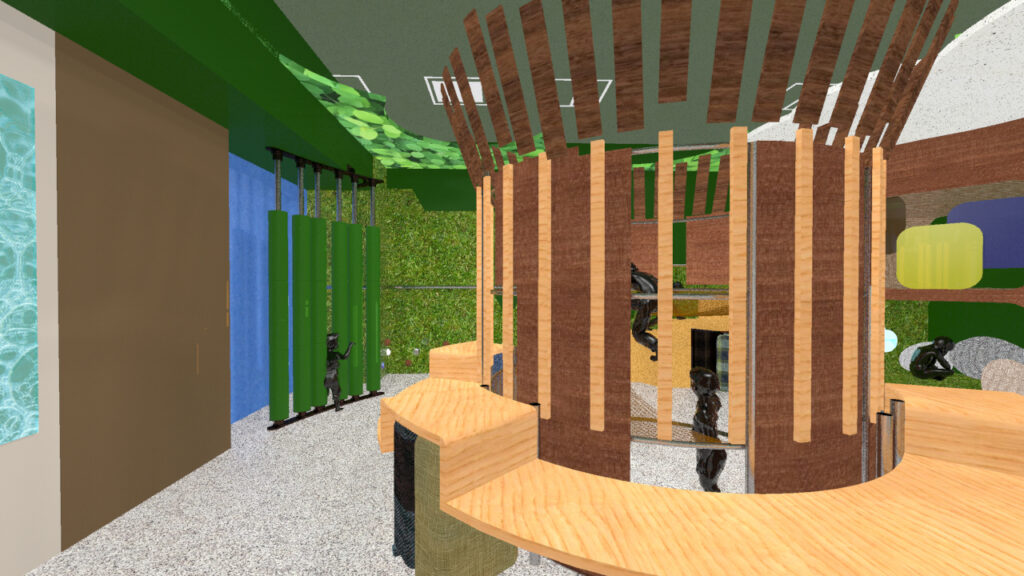
The amenities and decorations of the planned sensory room are tied together with a calming nature theme. The centerpiece will be a climbable tree installation designed to offer several ways to relax, including rope hammocks and hideaway spots for kids to escape from noise and distractions.
Importantly, unlike the airport’s other play area for children, the Zoom Zone, The Nest will come equipped with a door.
“The door will close. All of a sudden, the sounds and all of the overstimulation is going to go away,” Rich Turner, chief operating officer at the Children’s Discovery Museum, told San José Spotlight. “Hopefully, kids will be able to go inside and have a place to be able to just sit down, reset themselves and check in with the parents.”
As another key feature, the room will also include interactive lighting and sound exhibits that will change their displays based on inputs from visitors.
“That’s a very big topic with kids that have invisible disabilities is they like to be in control,” Turner said.
The roughly $2 million project has received a $250,000 grant from San Jose-based tech company Nutanix, according to museum officials. It has also received in-kind support from architecture firm Corgan and construction firm Swinerton Builders. The project’s backers are still seeking to raise another $250,000 for ongoing costs.

The Children’s Discovery Museum comes to the project with 20 years of experience designing exhibits and programs for neurodivergent children and their families. Even still, while hammering out the details of The Nest, the organization drew together an advisory panel made up of local experts, educators and about 30 families.
Jacqueline Kao, whose 5-year-old autistic son has struggled on past family trips, was among those who participated in the focus group series. She said much of their discussion revolved around the tricky question of how best to meet the needs of different children — with some needing a mellow place to relax and others needing play opportunities to blow off steam.
“Trying to find a way to balance both, since all kids are kind of different in what regulates them,” Kao told San José Spotlight.
Vera Umansky, a doctorate candidate in developmental psychology at UC Santa Cruz who is autistic and also contributed to the advisory panel, said such outreach work makes a difference.
“By having actual autistic people and people who are part of the community take part in these conversations, we can make sure that the actual needs of autistic folks are being met rather than an assumption of what a particular autistic person needs,” Umansky told San José Spotlight.
Contact Keith Menconi at [email protected] or @KeithMenconi on X.
Leave a Reply
You must be logged in to post a comment.