


|
Getting your Trinity Audio player ready...
|
With the launch of a new housing voucher program, San Jose intends to strike two birds with one stone: Provide below-market rate homes downtown and stabilize a financially struggling residential complex.
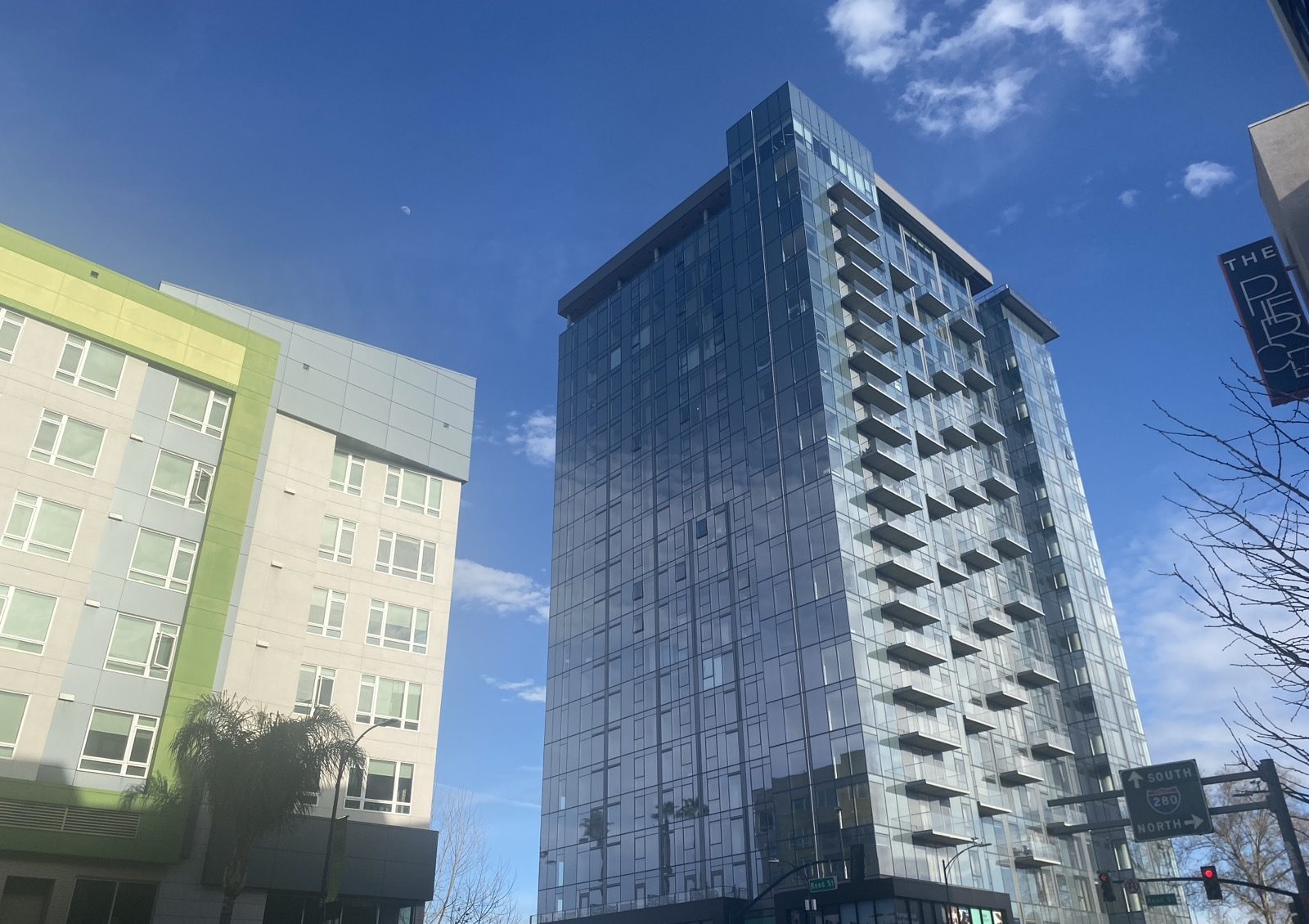
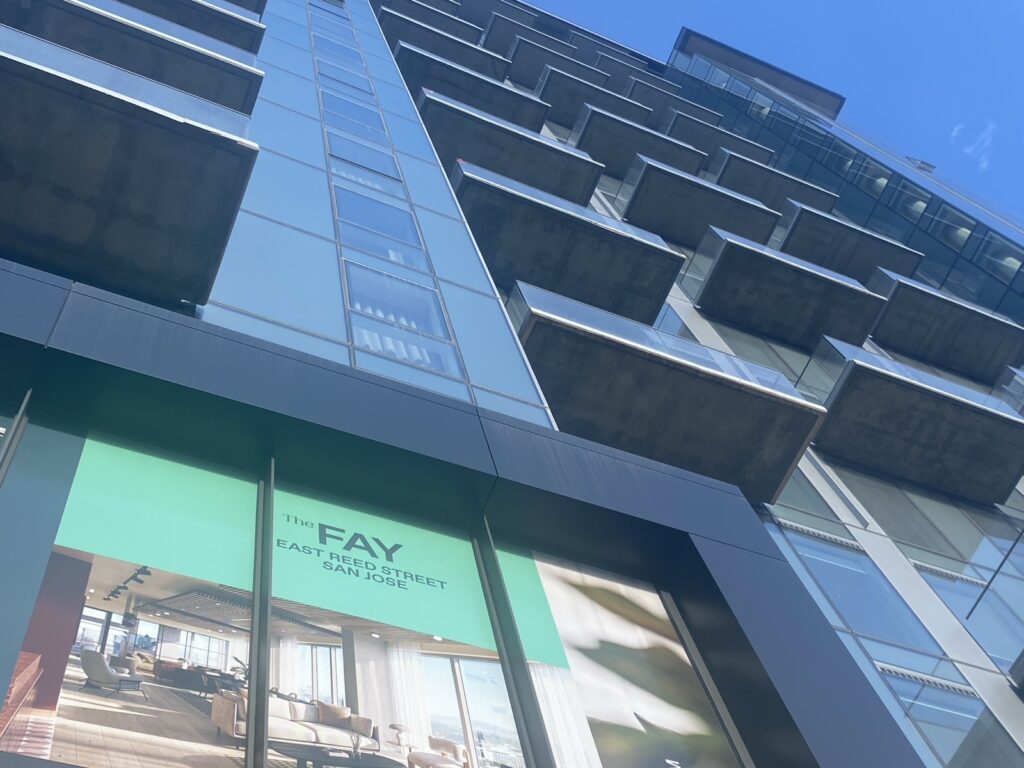
Under the first rollout of the Lower Income Voucher and Equity Program, approved by the City Council Tuesday, San Jose will provide up to $11.2 million to subsidize rents for 197 apartments at the 23-story glass-walled high-rise in the SoFA District. The property at 10 East Reed St., known as The Fay, is a luxury apartment complex that first opened in 2024. Since then, it has struggled to fill its 336 homes and reportedly faced bankruptcy.
“We hope to stabilize that asset and get people actually living in these vacant units, bringing some more foot traffic and some more density to the southern part of our downtown,” District 3 Councilmember Anthony Tordillos, who represents the area, told San José Spotlight.
The voucher program targets middle-income tenants earning between 80% and 110% of the area median income, which is roughly $111,000 to $150,000 in annual earnings. The program includes a preference for city workers, who will be bumped to the front of the line in the applicant pool.
The pilot voucher program employs a novel approach to affordable housing in San Jose. Under the plan, the city will become a master tenant at the property, entering an agreement with ASJ Development, a subsidiary of Canadian-based real estate company WestBank.
WestBank representatives did not respond to a request for comment. The company has several projects in downtown San Jose, including a proposed data center and hundreds of homes at 300 S. First St.
As master tenant, the city will work out rental terms for the 197 apartments covered by the program. Qualifying tenants will pay lower monthly rents, depending on their income levels, and the city will cover the difference.
Unlike other affordable housing programs, this one won’t produce permanently rent-reduced homes. Over time, the rents will gradually increase in the covered apartments, returning to market levels after 10 years.
A two-bedroom apartment for a family making 80% of the area’s median income would cost $3,590 in rent each month, according to affordable housing formulas for San Jose set by the U.S. Department of Housing and Urban Development.
Brian Kurtz, CEO of the San Jose Downtown Association, said drawing more middle-income workers, including city employees, into the heart of downtown would provide the area with an economic win.
“Having employees live where they work is a tremendous value add,” he said at the meeting. “It strengthens connections. It shortens commutes, supports local businesses and reinforces a sense of shared investment in place.”
Officials with the San Jose Housing Department said the subsidy will grant the city an ownership stake in The Fay, allowing it to recoup the city’s full $11.2 million investment with interest over the course of the program. Money for the vouchers will come from a fund created by Measure E, which was passed by San Jose voters in 2020 to fund affordable housing through a property transfer tax.
Public documents outlining the program did not include a detailed explanation of the planned financing mechanism. Housing officials did not respond to a request for additional information.
“We think there is a strong demand side for this program that could hopefully lease up the building in order to create stabilization,” Housing Director Erik Soliván said at the meeting.
The Fay opened to great fanfare in 2024. Marketed as a luxury apartment building, city leaders touted the property as a business win for downtown. Prices at opening ranged from $2,750 a month for a studio up to $4,330 for a two-bedroom apartment.
“Get the investment, get the housing, the residents, all that vibrancy and then in the long run, know that by growing the pie and having more economic activity, we’ll have the revenue to fund services,” Mayor Matt Mahan said at the building’s opening celebration just over a year ago.

But while the building’s studios are fully leased out, a large share of its one- and two-bedroom apartments remain empty, leading to a vacancy rate of 60%, according to a city memo.
City leaders warned a rapid collapse of the property’s value could trigger negative effects for other housing developments, as downtown investment comes to be seen as a riskier bet.
With other residential properties in San Jose facing their own financial struggles, city officials are already contemplating using the master lease approach to aid other developments.
“The goal here is by applying this tool and using it in different sites beginning with this initial site, we’re able to advance some of the work we’re doing in attracting capital to the downtown,” Soliván said.
John Tucker — a senior union representative for AFSCME Local 101, which represents public employees in San Jose — said the program will be a win for city workers. However, he added it also highlights the growing housing challenges these workers face.
“Even employees earning ‘middle-class’ public salaries are increasingly priced out of homeownership here,” Tucker told San José Spotlight. “Public servants qualify for income-assisted housing while city leadership salaries near half a million dollars. That’s less a housing solution and more a warning sign.”
Contact Keith Menconi at [email protected] or @KeithMenconi on X.
Leave a Reply
You must be logged in to post a comment.