

|
Getting your Trinity Audio player ready...
|
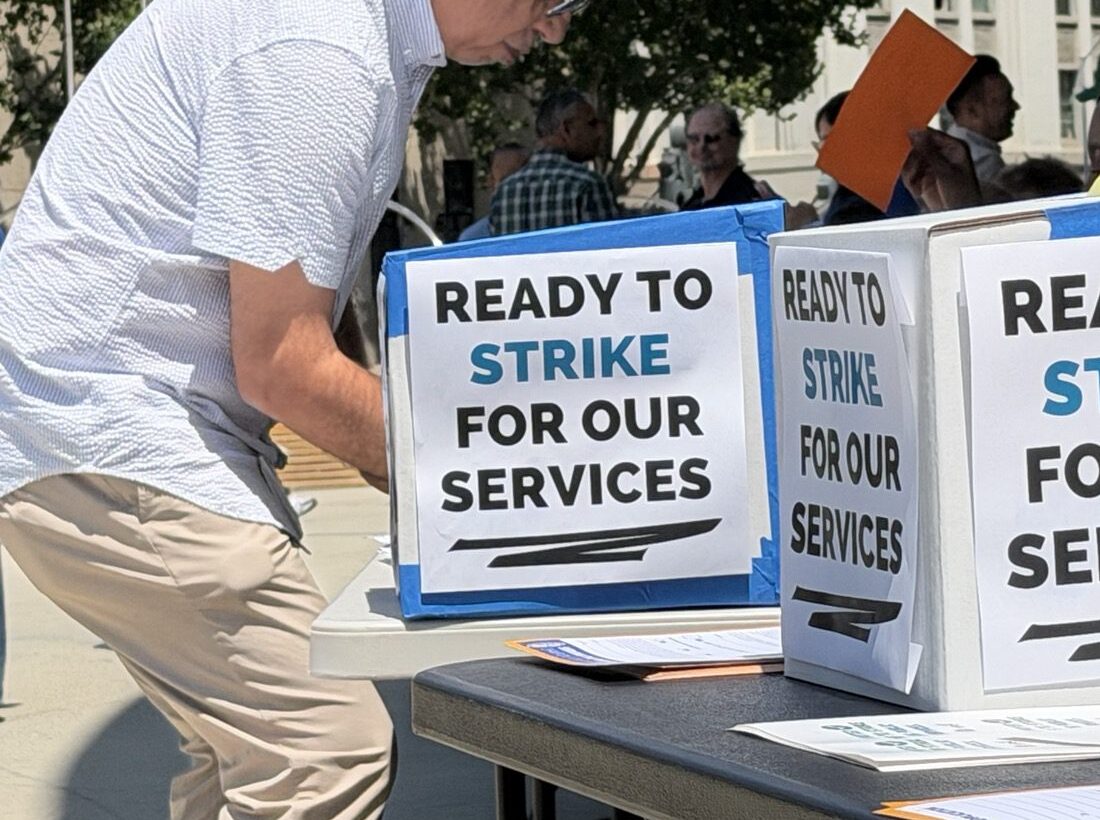
Thousands of San Jose city workers have voted to authorize their bargaining representatives to call a strike, ratcheting up the pressure on City Hall amid a protracted contract dispute.
After a week of voting, support for the authorization came in at 97%, according to a Monday announcement from IFPTE Local 21 and MEF-AFSCME Local 101. While the outcome does not immediately trigger a work stoppage for the two unions — which together represent more than half of the city’s nearly 8,000-strong workforce — it does empower their bargaining team to call for a three-day strike should they determine contract negotiations have reached an impasse.
Workers and the city are at odds over wages, as well as other economic benefits. Workers are also pressing for firmer protections against displacement risks posed by San Jose’s rapid embrace of artificial intelligence tools.
Union representatives are making the case that stagnant wages have led workers to leave multiple departments at high rates, contributing to staffing shortages and degraded city services.
“There’s a retention issue, and it’s something that’s not affecting any single department — it’s various departments throughout the city,” Carlos Murillo, an engineer at San Jose Mineta International Airport who serves on the bargaining team, told San José Spotlight. “These are services that people need and rely on, and that’s what we’re fighting for.”
Such a strike would represent the largest labor action to take place in San Jose since 1981, according to union officials.
The city narrowly avoided a worker strike in 2023 after months of impasse. Mayor Matt Mahan was the lone holdout when the City Council approved a deal that scraped together enough funding to meet workers’ wage demands.
Officials said the city is preparing for possible service disruptions, including to libraries and community centers. However, essential public health and safety services would continue to operate regardless of the strike, they said.
Negotiations have been taking place since February to replace three-year contracts that expired Jun. 30. But unions rejected what the city called its last best and final offer in June, and since then negotiations have continued under mediation.
“The city remains committed to reaching agreements that recognize the contributions of its workforce while ensuring the city can continue delivering essential programs and services to our community now and into the future,” Demetria Machado, spokesperson for the City Manager’s Office, told San José Spotlight. “The city has communicated to (the unions) that it is ready to return to the bargaining table or mediation at any time, including evenings and weekends.”
The city’s offer included wage increases that amount to 9% over the next three years.
But workers said such an increase, which falls short of the 15% increase provided by the just-expired three-year contract, would not even keep pace with inflation in the South Bay.
“It is already ridiculously expensive to live in this area,” Riley Knight, who works for the city’s residential garbage and recycling program and also serves on the bargaining team, told San José Spotlight. “Most people honestly cannot live in this area because they can’t afford to live in this area, despite loving San Jose so much that they’ve come to work at that sacrifice.”
Workers have asked for a 14% salary increase for the coming three years, according to negotiation documents filed in June.
Workers have also asked for the city to commit to a prohibition against using AI tools to replace workers. The city’s counter-offer included only a pledge to “consider training, upskilling, reskilling and reassignment options” rather than laying off workers due to AI efficiencies.
San Jose is facing tight budget constraints. The $5.5 billion budget passed in June balanced a $50 million deficit by tapping into reserve funds and making wide ranging service cuts. The city is forecasting deficits of $27 million and $12 million in the next two fiscal years as well.
As the city navigates this labor impasse, Mahan said city leaders must balance demands for wage increases with the need to preserve funding for essential city services.
“We cannot allow public services to become unaffordable or unavailable because labor demands go beyond our annual tax revenue,” Mahan told San José Spotlight. “There is still hope for a solution that is fair to everyone — and I very much hope the unions that have not settled will agree to return to mediation so we can give people the raise that they deserve and we can afford.”
Contact Keith Menconi at [email protected] or @KeithMenconi on X.
Leave a Reply
You must be logged in to post a comment.