


Filipino students at San Jose State University are finally receiving the recognition they’ve been fighting for.
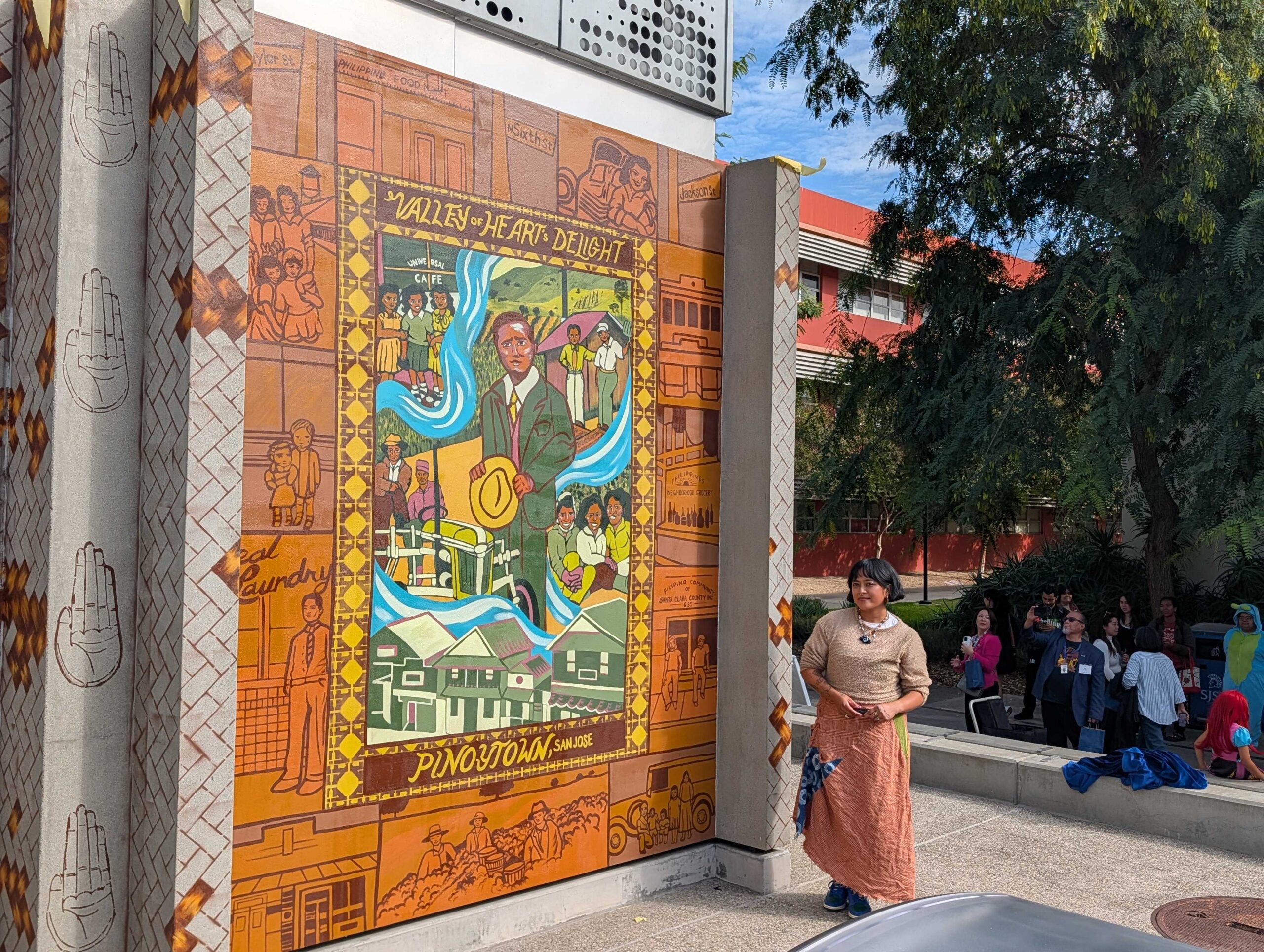
After years of advocating for permanent artwork to commemorate Filipino laborers who contributed to the farmworkers rights movement, SJSU students are celebrating the creation of a Filipino American history mural on campus. The four-sided panorama, painted by artist Francesca “ChiChai” Mateo, graces a pillar in front of the Diaz Compean Student Union. Volunteers also painted part of the artwork during a community paint day last month. School officials unveiled the mural during a ceremony Friday.
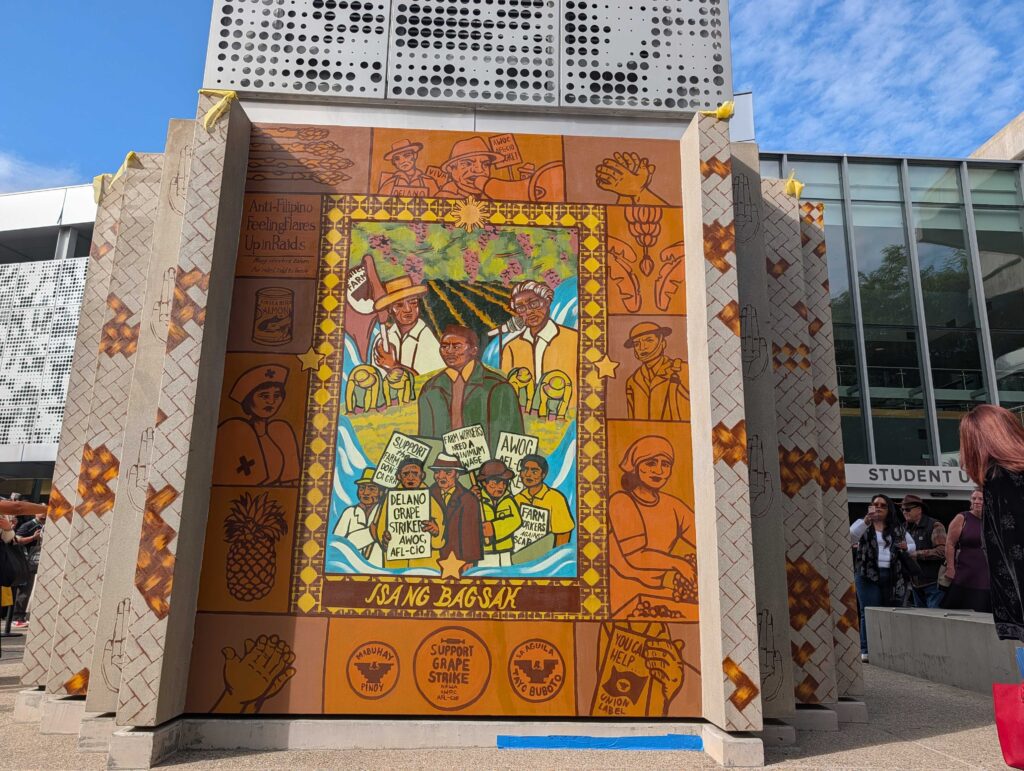
Filipino American leaders of the Agricultural Workers Organizing Committee, the union behind the Delano grape strike that kicked off the farmworkers rights movement in the 1960s, are featured in the mural, including Larry Itliong, Philip Vera Cruz and Pete Velasco.
Other panels depict the “Valley of Heart’s Delight” — the name given to Santa Clara Valley when the land was known for its abundant fruit orchards — and alumni including aerospace engineer Robert Ragsac Sr.; LEAD Filipino Executive Director Angelica Cortez; Emerita Estella Habal, a SJSU professor of interdisciplinary social sciences; Lloyd LaCuesta, a journalist and former president of the national Asian American Journalist Association; and Erwin Mina, executive board president of the Filipino American National Historical Society Museum.
“It’s an amazing thing to have happened,” SJSU alumna Kayla Taduran told San José Spotlight. “When we started the whole project, I wondered if people would care.”
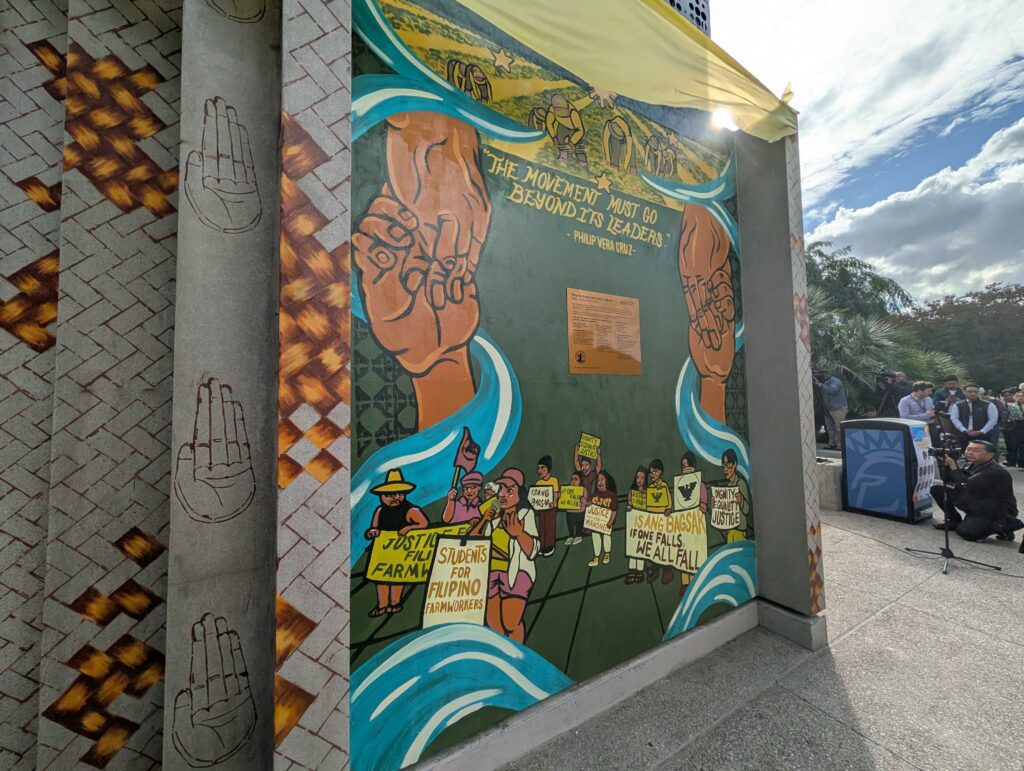
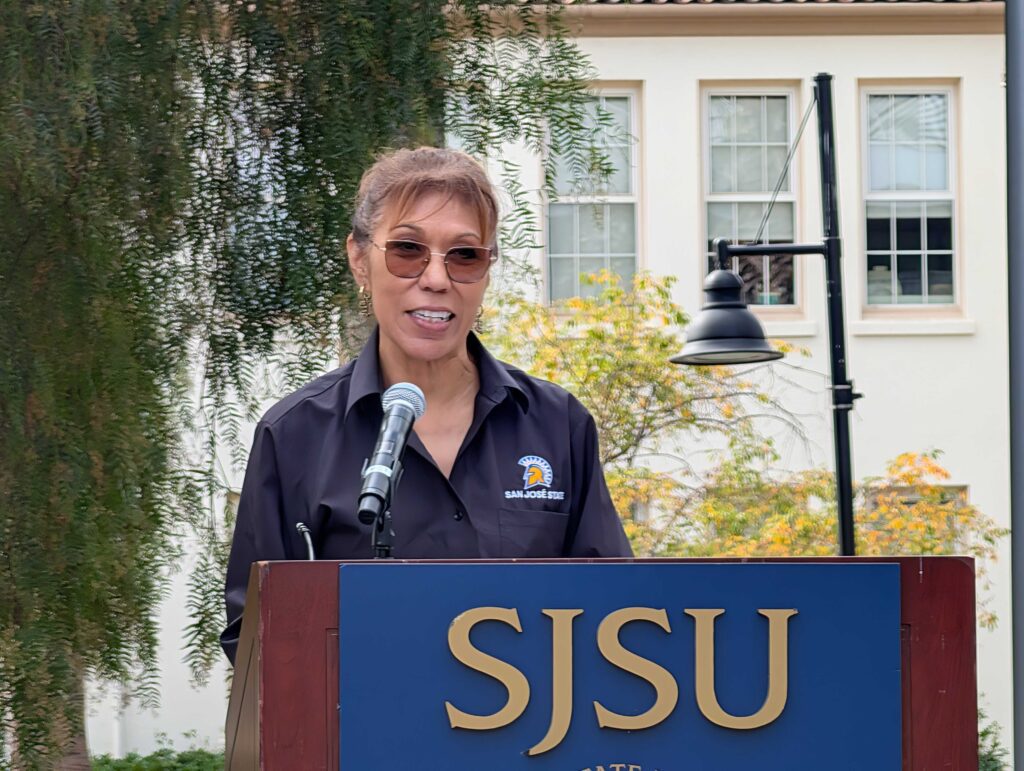
SJSU President Cynthia Teniente-Matson said what the mural represents goes beyond the images it depicts.
“It reflects the strength of a community, the persistence of student and alumni advocates and the importance of preserving the stories that shape our collective identity,” she said at the ceremony.
A community fundraising campaign spearheaded by SJSU’s Filipino Alumni Network raised $100,000 for the mural. Alan Gouig, founder and president of the Filipino Alumni Network, said about $50,000 will go toward the long-term preservation of the mural. They are seeking an additional $30,000 to produce a documentary highlighting the advocacy which led to its creation, as well as to help cover other project costs.
Gouig appreciates the chance to create a lasting legacy on campus, especially during Filipino American History Month and the 50th anniversary of the Akbayan student club.
“This is going to be the next major cultural landmark on campus since the ‘Victory Salute’ statue and the ‘Arch of Dignity, Equality and Justice,'” Gouig told San José Spotlight. “This means representation for the Filipino American students.”
He said as Filipino farmworkers were omitted from the “Arch of Dignity,” the mural being located nearby provides a more holistic picture of the farmworkers rights movement — which started with Itliong and other Filipino laborers before Mexican American farmworkers such as Dolores Huerta and César Chávez joined. The panels of the mural also feature Filipino contributions to technology, public health and civic engagement.
“What we’re going to try to do is make sure that people see the regional impact of Filipinos,” Gouig said.
Faith Castro, SJSU student and president of its Akbayan club, said the mural shows the university listens and is a testament to the power of students working together toward a greater purpose.
“This is a milestone in history and I’m happy I get to be a part of it,” she told San José Spotlight. “For alumni, it’s going to be unbelievable to see. For incoming students, it’s going to spark questions. ‘What is this mural?’ ‘What does it mean for Filipino Americans that immigrated here?’ This is our small way of getting our history out, because we had to fight for this history.”
Wayne Jopanda, assistant professor of Asian American Studies at San Jose State University, said the mural serves as an educational platform. He believes it will cause people to delve deeper into the involvement of Filipinos in the farmworkers rights movement.
“We are a huge part of that organizing effort,” he told San José Spotlight. “And unfortunately, the history books seemed to leave us out. I’m excited for this to be a tool to reeducate folks around that history and the solidarity efforts between Filipino folks and other communities. It’s a beautiful way for us to build community moving forward.”
Contact Lorraine Gabbert at [email protected].

Leave a Reply
You must be logged in to post a comment.