

|
Getting your Trinity Audio player ready...
|
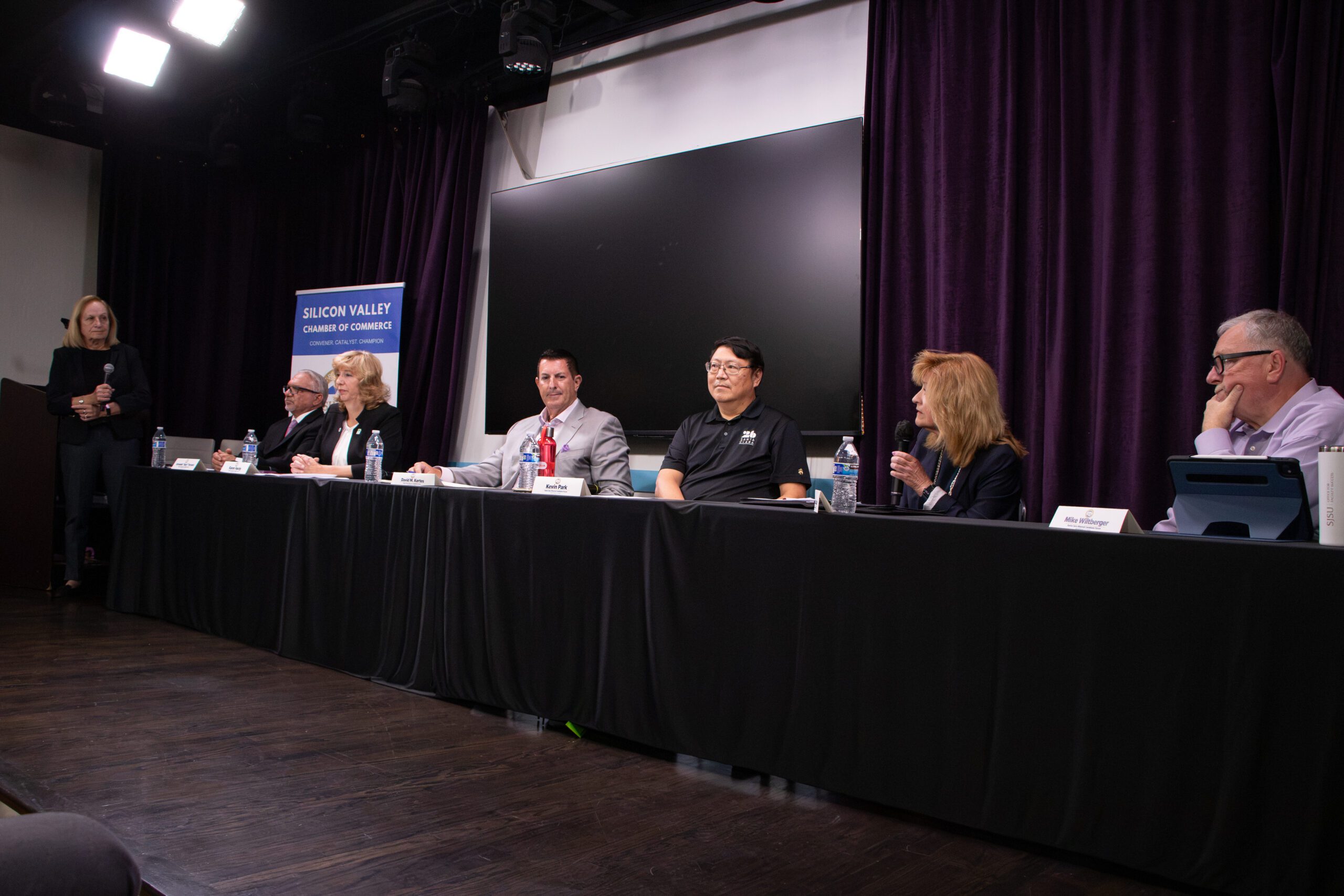
Six candidates vying to become Santa Clara’s next mayor laid out competing visions for the city at an election forum that discussed council dysfunction, data center growth, budget stability, Great America and the San Francisco 49ers’ role in local politics.
Candidates include former city maintenance worker and labor representative Armando “Gary” Ferraris, David Kertes, director of sales for North America at Novanta, Councilmembers Karen Hardy and Kevin Park, former Councilmember Kathy Watanabe and tech entrepreneur Mike Wiltberger, with Mayor Lisa Gillmor terming out in December.
The Sept. 27 forum was hosted by the Silicon Valley Central Chamber of Commerce, League of Women Voters of San Jose/Santa Clara and San José Spotlight. The questions covered some of the biggest issues facing the city, from housing and infrastructure to economic development and government transparency.
Council discord
Candidates offered different ideas for addressing the divisiveness that has plagued Santa Clara City Council meetings in recent years.
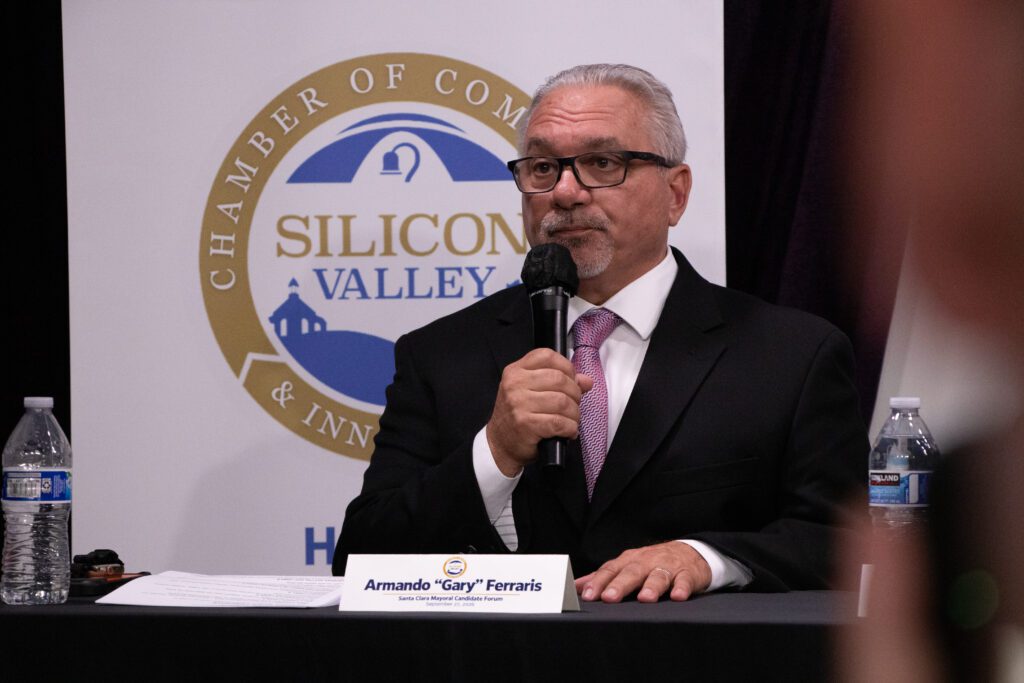
Ferraris said disagreement is inevitable, but it should not prevent councilmembers from efficiently working together.
“I welcome differences on the council and, in fact, with seven different people I would expect differences, but those differences don’t need to become dysfunctional,” Ferraris said.
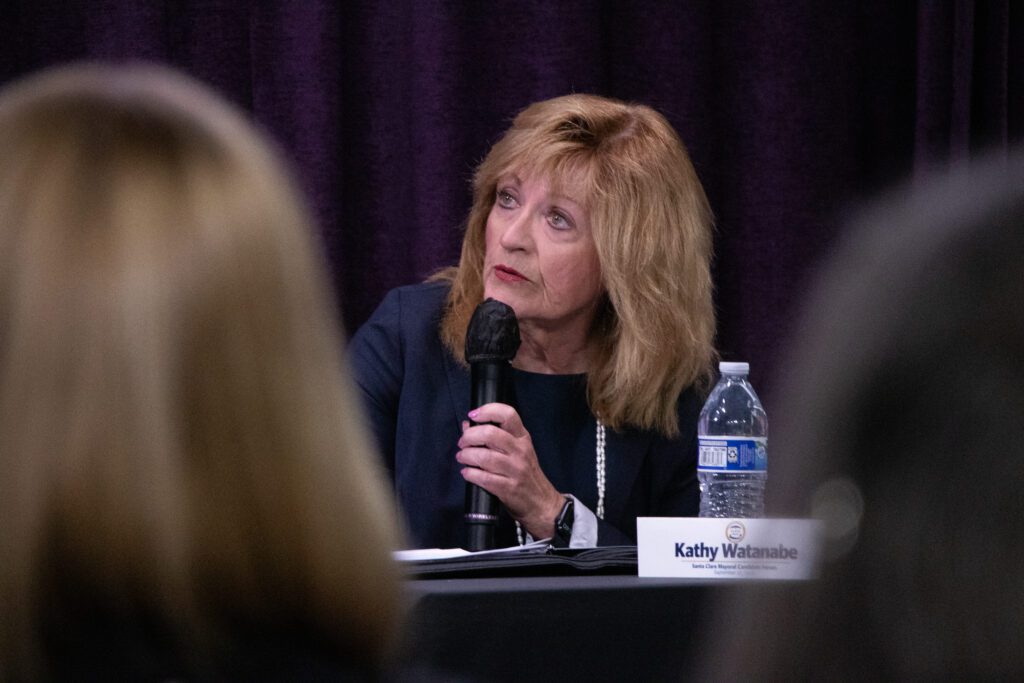
Watanabe pointed to a 2024 Santa Clara County Civil Grand Jury report that criticized the council’s infighting and recommended establishing an independent ethics commission, among other changes. The report said councilmembers’ inability to communicate respectfully and work together had undermined effective governance and city morale.
“(The civil grand jury) had several recommendations that they made to the city. One of them was an ethics, an independent ethics commission. That was never done,” Watanabe said. “I would like to see that happen in order to help build cohesiveness, collaboration and democracy back on our council.”
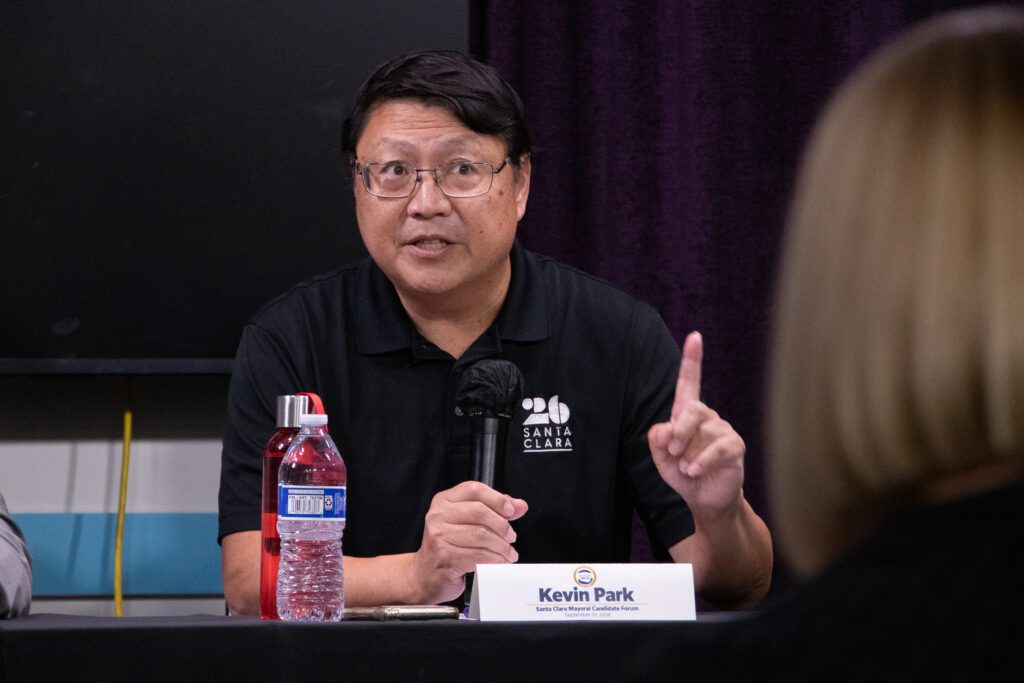
Park said council dysfunction has also affected the city’s ability to conduct business, pointing to lengthy late night meetings, agenda management and times when the council could not conduct business because of a lack of decorum.
“The chair sets the whole game,” Park said. “The chair sets the agenda, the chair decides how long we’re going to talk about things, the chair decides whether people get to speak.”
Data centers
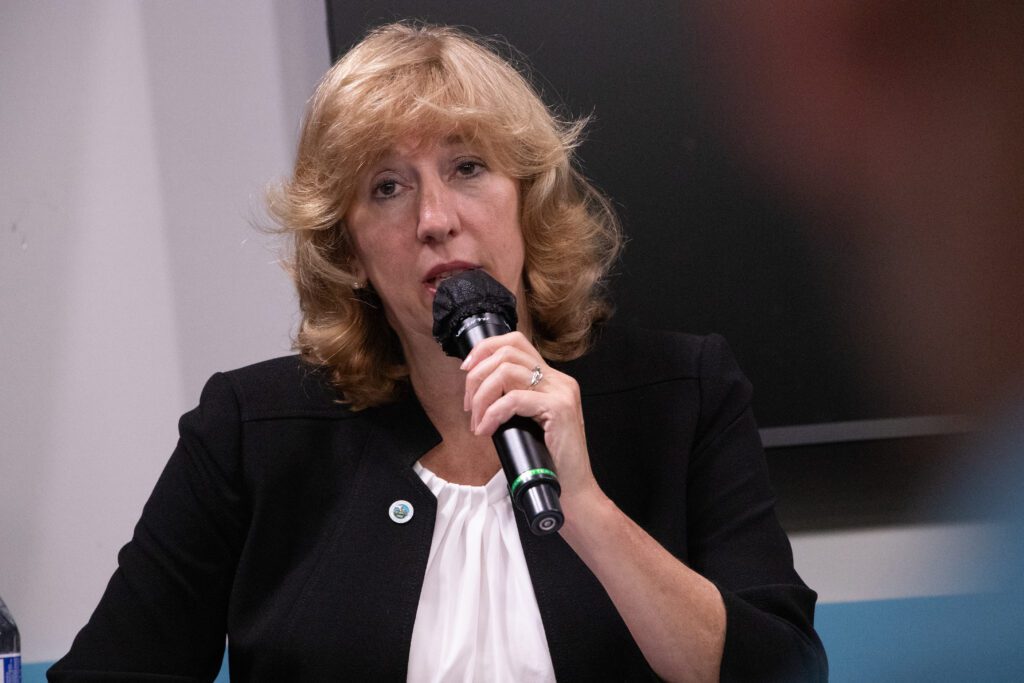
The candidates also differed over how Santa Clara should manage and whether they should continue to approve more data centers, which have grown to about 60, as their demands impact the city’s infrastructure. Hardy said she supports a moratorium on new data centers while residents’ concerns about electricity, water and other infrastructure are addressed.
“I have called for a moratorium on data centers,” Hardy said. “I am tired of people saying we need to look at it. I’m doing something about it.”
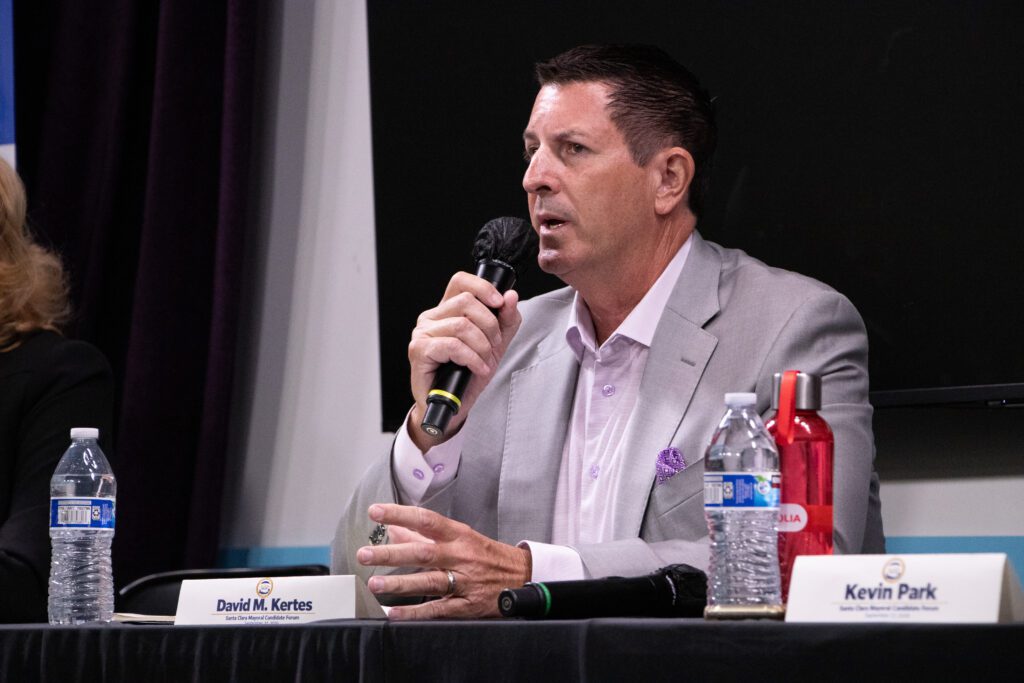
Kertes said he is not opposed to data centers, but wants them limited to industrial areas — an issue residents have also raised during discussions about new projects — and be required to pay for the infrastructure they need.
“I want to make sure that when we do infrastructure, we have the power going to those data centers that they’re paying for it, not the residents,” Kertes said.
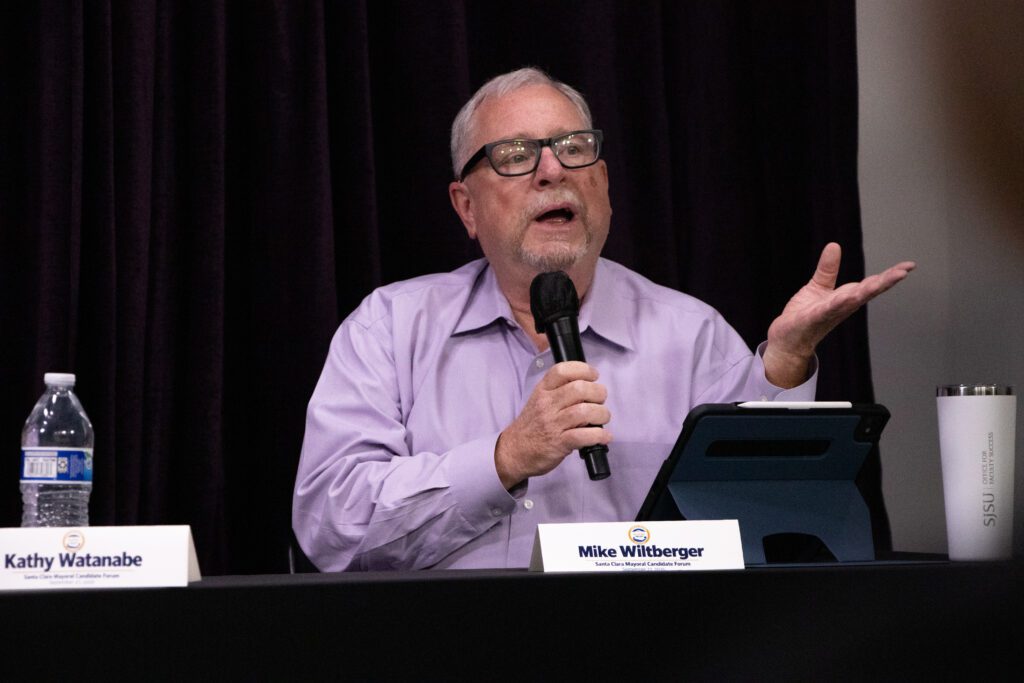
Wiltberger took a more pragmatic view, saying artificial intelligence and the data centers supporting it are not a passing trend and that Santa Clara needs to account for the technology’s continued growth.
“Anybody that does AI is here to stay,” Wiltberger said. “It’s not just a bubble. And what’s coming up behind it, it’s gonna be even more. … So nobody likes it, but let’s be realistic.”
Housing affordability
As Santa Clara faces high housing costs, a state housing mandate requires the city to plan for 11,632 homes by 2031, of which 6,506 need to be below market rate, or below 120% of the area median income.
“I think we need to have developers incorporate affordable housing into the same projects, rather than letting them help fund other projects,” Ferraris said.
Ferraris also pointed to transit corridors as an opportunity to add housing without placing as much pressure on existing neighborhoods, but parking is an ongoing concern.
Kertes somewhat agreed and said increasing the housing supply alone will not necessarily make homes affordable, particularly for lower-income residents and essential workers. He said the city should look at incentives to create more housing affordable for residents earning 30% to 40% of the area median income and help first-time homebuyers.
“Supply and demand doesn’t solve the affordability problem,” Kertes said.
Hardy said Santa Clara needs to explore different types of housing to give residents more options and help reduce costs.
“We have not done something they’ve done back east — cooperative housing — and I want to look into that and why we are not doing that on the West Coast,” Hardy said. “I want to make certain that we have more options. That’s what will bring down our costs.”
Wiltberger said the city needs to consider whether people who work in Santa Clara can afford to live in the community rather than being priced out. He acknowledges high density buildings can’t continue to be built on main streets like El Camino.
“My kids can’t live here. They can’t afford to live where I live,” Wiltberger said.
Aging infrastructure
The candidates also acknowledged the city’s infrastructure is in disrepair, and the $400 million Measure I approved by voters in 2024 was not sufficient when the actual need totals approximately $624 million.
Ferraris said the city needs to strategically prioritize maintenance with the remaining bond funding after the estimated $22 million allocated for the international swim center to prevent the infrastructure backlog from growing.
“We need to make sure that we’re maintaining what we have so that we don’t get into another situation where we’re going to have to go back to the voters for another bond,” Ferraris said.
Kertes said the city should dedicate money to infrastructure each year and prioritize its most pressing needs, including fire stations built in 60s and 70s, roads, sewer systems and parks.
“We need to start putting $30 million to $40 million aside,” Kertes said. “When you start looking at that, you can start putting $30 million to $40 million.”
Great America development
Candidates weighed in on the future of California’s Great America, which is expected to close after the 2027 season unless its owner Prologis extends its land lease. Prologis purchased the 112-acre property from previous operator Cedar Fair for $310 million in 2022 and leased it back to the amusement park operator.
The city once owned the property through its former Redevelopment Agency, but state redevelopment-dissolution laws required the agency’s assets to be sold. The Successor Agency sold the Great America property to Cedar Fair in 2019.
Park said the amusement park is an important source of jobs for local students and that any redevelopment should be closely scrutinized.
‘If we lose Great America, we will lose thousands of student jobs,’ Park said.

Watanabe said Great America’s future should involve the community and described the amusement park as an important part of Santa Clara.
“That Great America theme park is an icon in our city, and we just don’t want it to go away,” Watanabe said.
Wiltberger said the property’s location next to Levi’s Stadium makes it an important opportunity for Santa Clara to maintain an entertainment destination rather than replace it with another technology-focused development.
“I still want an entertainment center out there,” Wiltberger said. “I want people to come here for a reason, you know, not a tech center.”
49ers and local politics
The San Francisco 49ers’ long involvement in Santa Clara politics, including the team’s financial support of candidates and its independent expenditures political committees, was a big part of the discussion at the forum.
Watanabe said she has opposed outside political spending in Santa Clara and contacted the 49ers after learning about a political action committee targeting her campaign.
“I asked, could you please call off the dogs? Make it a fair election. And they said, ‘No, we’re going forward,’” Watanabe said.
Park and Hardy agreed, saying candidates should be able to seek support from voters without the 49ers determining which candidates should advance.
“The 49ers should not be picking the candidates for us to vote for,” Park said.
Hardy said the 49ers contacted her during her first campaign for city council, but she declined to meet with the team.
“I wish the 49ers would stay out of local politics,” Hardy said. “They said, ‘We’re not gonna support you.’ And I said, ‘Good.'”
Contact Maryanne Casas-Perez at [email protected] or @CasasPerezRed on X.
Leave a Reply
You must be logged in to post a comment.