


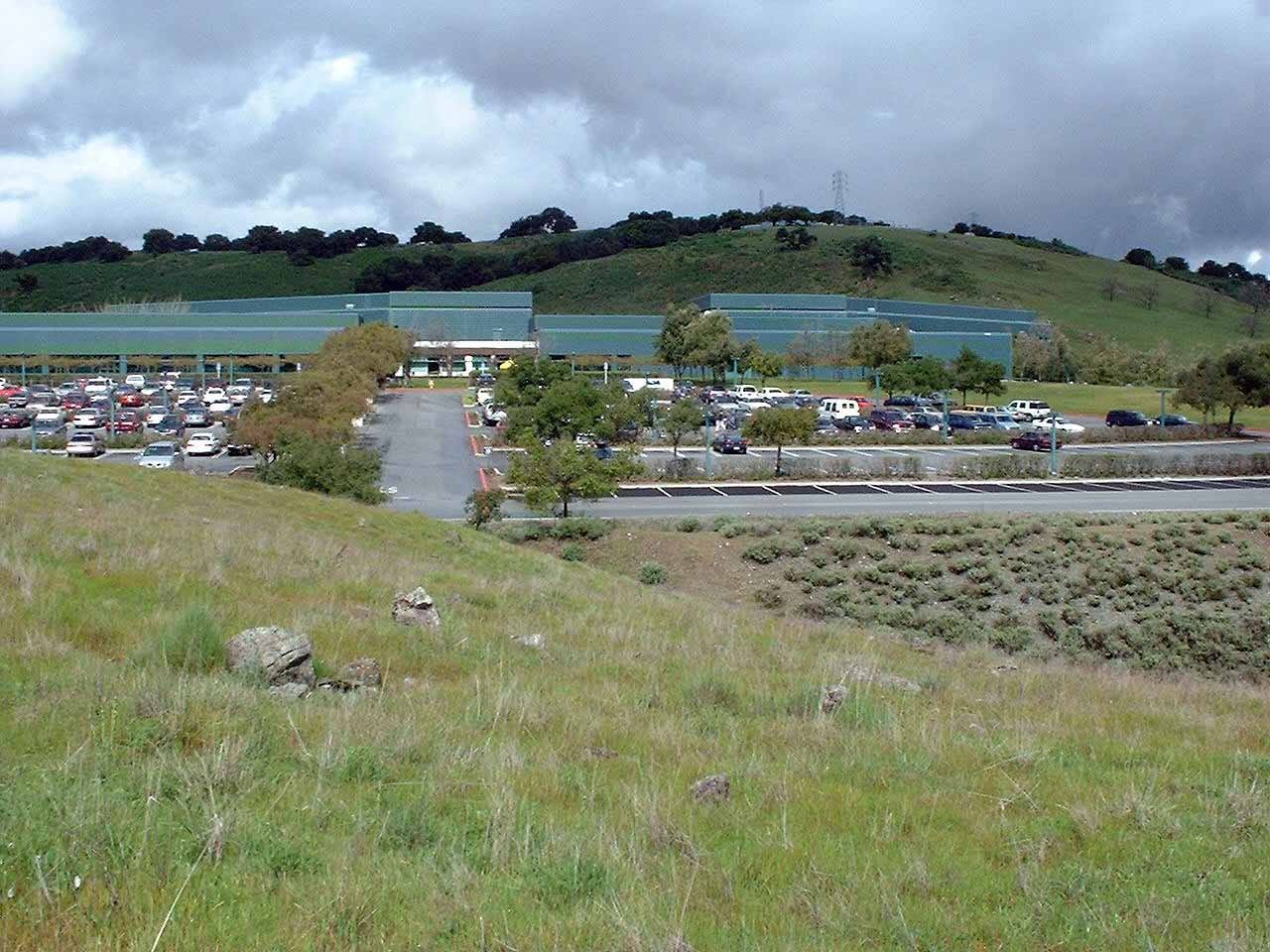
The former IBM Almaden Research Center in the rolling hills of Coyote Valley has a buyer.
Blackstart Digital — a data center development and investment firm focused on sustainable redevelopment — has entered into an agreement to acquire the historic campus in South San Jose, according to land use consultant Erik Schoennauer, a representative of 650 Harry Road LLC and Blackstart. The agreement is expected to close by the end of the year.
In August, the San Jose City Council rezoned the property — which prompted concern from residents and environmental advocates about attracting more data centers to the region before uniform standards are in place.
The property includes seven buildings containing more than 500,000 square feet within a 35-acre industrial park. A company spokesperson said Blackstart Digital doesn’t intend to develop the surrounding 565 acres of open space, knowing how much the trails and hillsides mean to the community.
“For decades, researchers on this hilltop did work that helped make Silicon Valley what it is today,” the Blackstart Digital spokesperson told San José Spotlight. “Our first goal is simply to put this campus back to work in a way that honors its legacy.”
Marika Krause, spokesperson for the San Jose Planning Department, told San José Spotlight that Blackstart Digital asked the city in June to finish an environmental review to wrap up the rezoning process. No other application regarding this property has been filed, she said, adding that once an application is submitted, the city will determine the appropriate environmental review based on application materials and any scope of work prepared by an environmental consultant.
The IBM campus was built for research and still has features that support a wide range of uses, such as advanced research and development, startup incubation and academic partnerships, quantum computing and digital infrastructure.
Blackstart Digital plans to use the campus as “a model for sustainability and safety,” with closed loop cooling, advanced battery safety systems, noise mitigation and software to reduce energy use during peak demand. Bringing the IBM campus back to life will benefit the region and its residents, the spokesperson said, by creating construction and skilled jobs, supporting local businesses and providing tax revenue for San Jose’s general fund.
“The campus is served today by an on-site 25-megawatt substation and houses multiple generations of preexisting data center facilities where we intend to expand capacity, subject to power availability,” the spokesperson said.
Development proposals would follow appropriate environmental review under the California Environmental Quality Act (CEQA) and go through a public process with San Jose, residents and conservation groups, the spokesperson said.
At the Aug. 18 council meeting where officials rezoned the property, residents and environmental groups said the action should wait until future development plans were known and uniform standards for data center projects were established. Councilmember George Casey, whose District 10 encompasses the former IBM site, wanted the land to be economically feasible and saw no reason to delay.
Casey did not respond to a request for comment.

In a joint letter to the city council, environmental groups such as the Sierra Club, California Native Plant Society and Mothers Out Front said the rezoning would be consequential, because Senate Bill 131 exempts advanced manufacturing facilities on land zoned for industrial use from CEQA review. The letter said residents deserve full disclosure and consideration of the legal, environmental and land-use consequences of the rezoning.
“We’re very concerned about the potential for a data center to be located on that site,” Alice Kaufman, policy and advocacy director for Green Foothills, told San José Spotlight.
Kaufman said the 565 acres of open space surrounding the former IBM campus are predominantly serpentine grassland, which includes rare native plants and those essential to the threatened Bay checkerspot butterfly. Serpentine grasslands are particularly vulnerable to nitrogen deposition, she said, so the potential for a data center to include diesel backup generators that emit nitrogen oxides and other pollutants is a serious concern.
“In addition, other impacts from a data center or similar industrial use, such as noise, nighttime lighting and human activity have the potential to significantly impact the ecology of this site,” Kaufman said. “We know from wildlife connectivity studies that this site is an important wildlife corridor, so anything that drives animals away from this site or deters them from using it for habitat or migration could impact wildlife movement in the surrounding area.”
Contact Lorraine Gabbert at [email protected].

Leave a Reply
You must be logged in to post a comment.