


|
Getting your Trinity Audio player ready...
|
New rules and work requirements for Medi-Cal and food stamps imposed by the federal government could strip benefits from thousands of people in Santa Clara County.
As of Monday, work requirements for people receiving food stamps, known as CalFresh in California, have expanded to include adults ages 18 to 64, raising it from the prior cap of 54. It also requires individuals previously exempt from work requirements — homeless people, veterans and those aged out of foster care — to work 80 hours a month. In addition, new work requirement hours will be imposed on individuals receiving Medi-Cal starting Jan. 1, 2027. These changes are the result of H.R.1, the federal spending bill passed last summer, that severely cut Medi-Cal and CalFresh benefits.
CalFresh and Medi-Cal recipients can also volunteer, participate in job training and enroll in education as part of the work requirements.
About 665,500 people are poised to lose their CalFresh benefits statewide due to these expanded work requirements, according to the Legislative Analyst’s Office. In Santa Clara County, where more than 132,000 people relied on CalFresh last year, about 55,000 people are expected to lose their food benefits due to the changes.
For those on Medi-Cal, the University of California, Berkeley Labor Center estimates nearly 3 million fewer Californians will have Medi-Cal in 2028 due to the various rule changes, with 129,000 losing benefits in Santa Clara County. About 460,000 county residents were enrolled in Medi-Cal last October, the latest data available.
“The work requirements were not put in place to encourage people to work. The work requirements were put in place so that people would be thrown off of Medicaid,” Bob Brownstein, strategic advisor for nonprofit Working Partnerships USA, told San José Spotlight. “The budgeting is done based on the assumption that the work requirements are going to reduce the cost. If everybody met the requirements, there’d be no savings.”
The new Medi-Cal rules also call for renewals to happen every six months rather than annually, a change that increases the burden for people dependent on health care services such as cancer survivor Julie.
Julie, a county resident who asked to only use her first name for privacy reasons, was diagnosed with breast cancer in 2024 and has been cancer free since last year. But her life still revolves around doctor appointments to monitor any recurrence, a regimen of medications and regular blood work.
Though people with disabilities are exempt from work requirements and can continue to renew benefits once a year, Julie is unsure if she falls under that category. Because Medi-Cal is her lifeline, she will do whatever it takes to keep the benefits, she said. But she worries the new rules will make it harder for her to maintain continual service.
“Something that she’s worried about is not receiving their notice (of renewal in the mail) on time,” Julie told San José Spotlight in Spanish through a translator.
Jamie Winslow, 43, anticipates the new rules and work hours reporting will complicate a process that’s already challenging to navigate.
After losing her job last year, she enrolled in CalFresh and Medi-Cal, which was a long application process requiring various documents, she said. She simultaneously applied for unemployment. Since her son is younger than 14, she is exempt from the new work requirements.
Regardless, Winslow said work requirements add an extra burden to people with families.
“If you’ve got kids, 20 hours (a week) is really tight if you are also responsible for getting them to school and picking them up,” she told San José Spotlight.
Six months into her food benefits, Winslow had to complete a form to report a change in income. Despite her meticulous review of her application, a missing document led her benefits to stall in May, and Winslow is unsure when they will be reinstated.
“They haven’t been able to process (my paperwork),” Winslow said. “They said ‘We’re just behind.'”
Winslow’s monthly food benefits — a mere $24 a month — is not enough to cover even a week’s worth of food. She relies on the food bank every week.
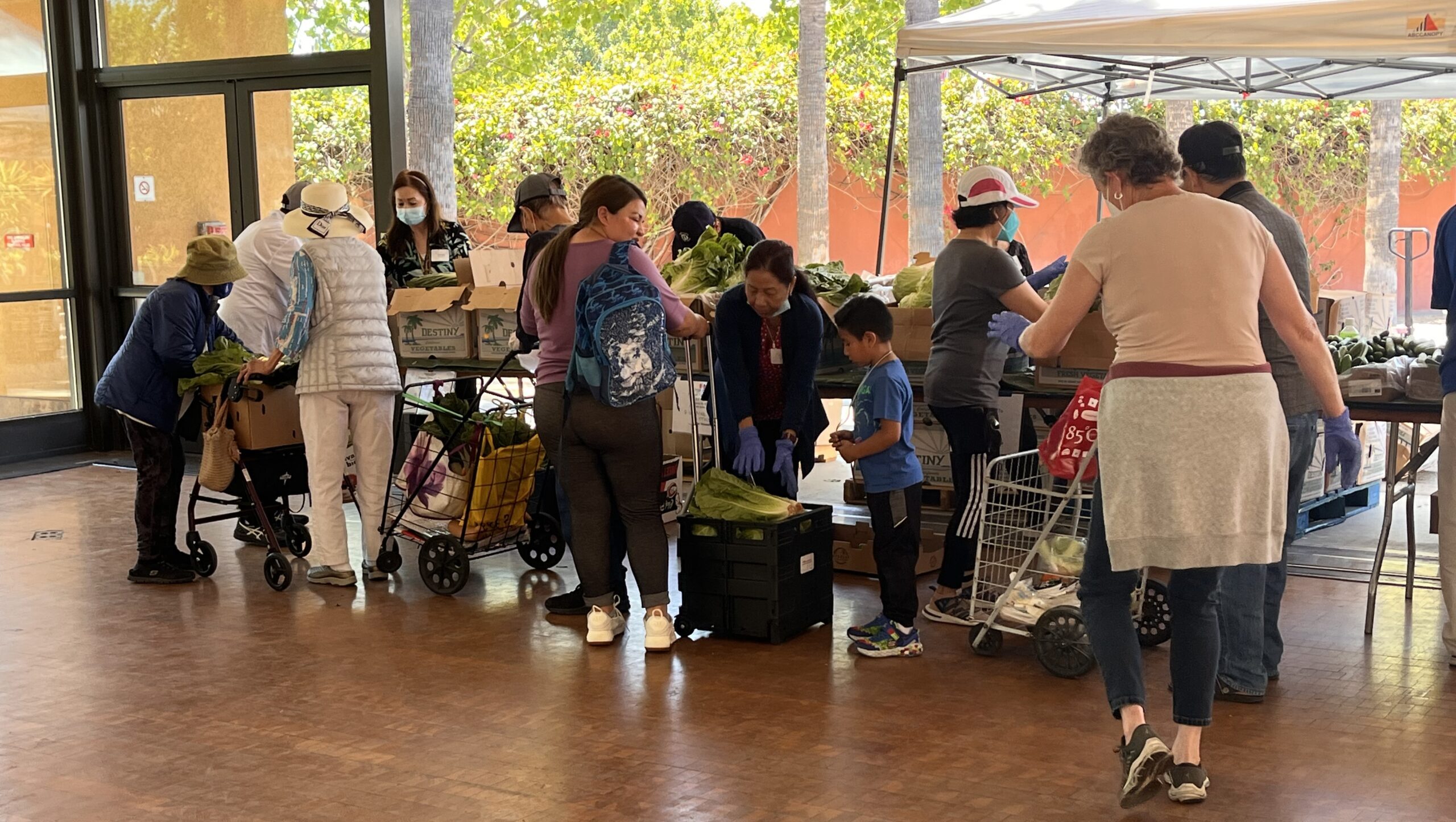
“Whenever people fall off of CalFresh, our lines get longer,” Second Harvest of Silicon Valley CEO Leslie Bacho told San José Spotlight. “We cannot possibly replace CalFresh. The value of that benefit is $32 million a month across just the two counties we serve. We are going to be doing our best to meet the increase in need.”
The food bank provides 11 million pounds of food monthly to roughly 500,000 people across Santa Clara and San Mateo counties.
Betzabel Estudillo, chief engagement officer with Nourish California, a statewide nonprofit pushing anti-hunger policy initiatives, said these work requirements add more red tape for people who are already vulnerable and were previously exempted. That includes homeless people who may not have the technology or the ability to report their hours worked.
“Seventy four percent of people subject to the time limits already work, but they face unstable hours because of the labor market,” Estudillo told San José Spotlight. “These cruel (work) requirements are going to cause these populations to lose benefits, because it is very challenging for people who are unhoused or veterans to find stable employment.”
Contact Joyce Chu at [email protected] or @joyce_speaks on X.

Leave a Reply
You must be logged in to post a comment.