


|
Getting your Trinity Audio player ready...
|
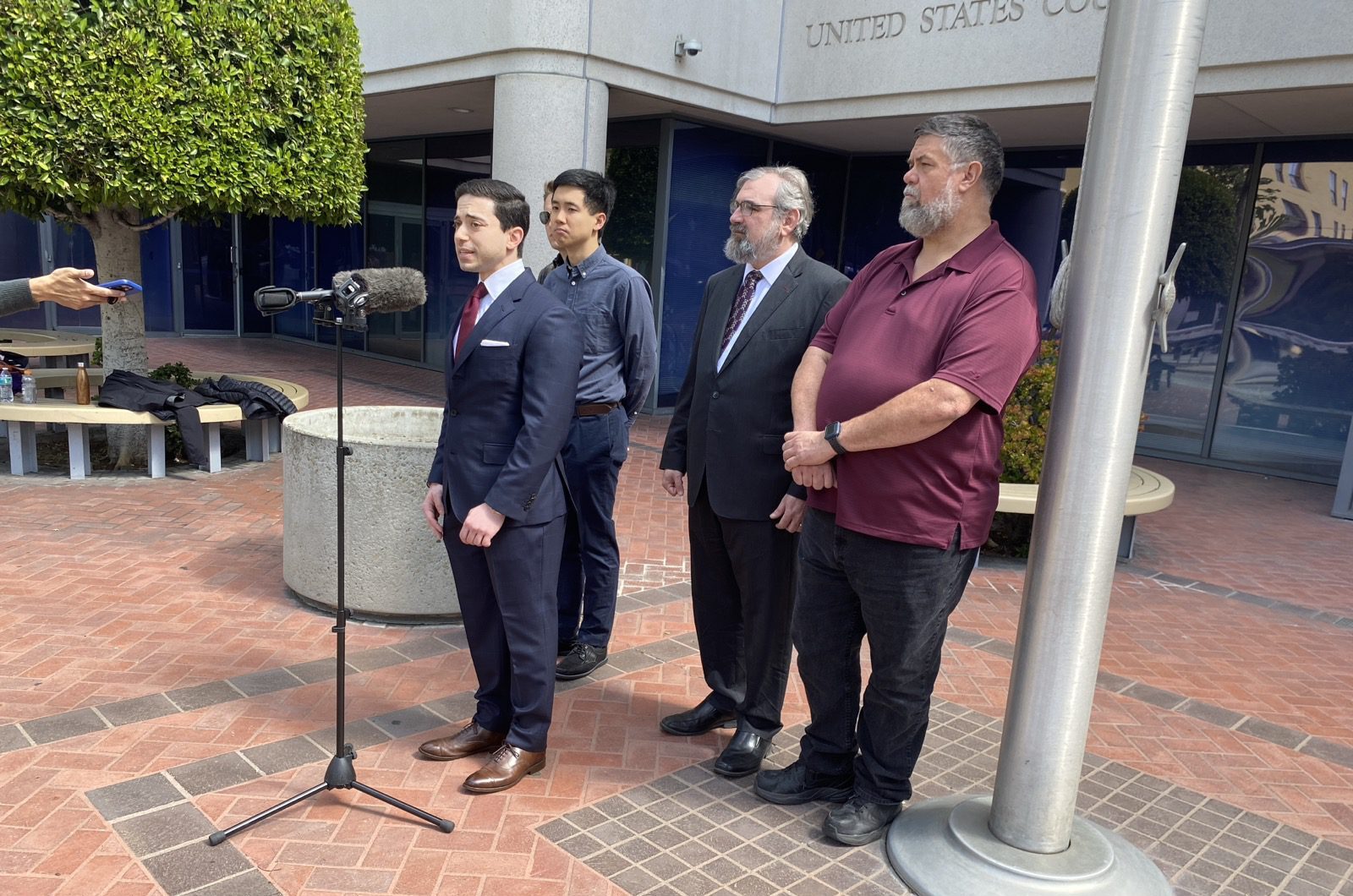
A group of San Jose residents has filed a federal class action lawsuit against San Jose to challenge the city’s automated license plate reader program.
The trio of residents — Tony Tan, Scott West and Colin Wolfson — is targeting a program first launched in 2022 that has grown to encompass a network of 474 automated cameras, which each month gathers millions of license plate images for use in law enforcement investigations. Their complaint, filed Wednesday at San Jose’s downtown federal courthouse, argues the program violates their right against unreasonable searches and seizures as guaranteed by the Fourth Amendment of the U.S. Constitution.
The plaintiffs, represented by legal nonprofit The Institute for Justice, are asking the court to require San Jose to delete license plate data within 24 hours of collection, except in special circumstances such as when police have obtained a warrant for longer retention. Presently, the city’s default retention time is 30 days.
Institute for Justice attorney Michael Soyfer said the mass collection of such data for weeks on end creates the potential for abuse.
“(Plaintiffs) haven’t done anything wrong, and their movements are being compiled in this massive government database where officers can search them without a warrant or probable cause,” Soyfer told San José Spotlight. “It’s hard to be secure against an unreasonable search if the government is compiling all of this information about you in a database that can be used for whatever purpose later.”
Responding to the lawsuit, City Attorney Susana Alcala Wood said the city’s license plate reader program is designed to follow the law while also maintaining transparency and protecting privacy rights.
“The city’s (automated license plate reader) cameras are only mounted in public areas and take pictures of vehicles as they drive on public streets and pass in view of the camera,” Alcala Wood told San José Spotlight.
The class action lawsuit only adds to the legal pressure facing San Jose’s automated license plate reader program. In November, a coalition of local advocacy groups sued the city, alleging its practice of allowing warrantless searches of its license plate data violates drivers’ privacy rights under the California Constitution.
Meanwhile, in the face of mounting criticism from residents, the San Jose City Council voted in March to adopt new safeguards for the program, including limits on where devices may be installed and how long license plate data may be stored. Previously, city policy allowed the data to be stored for up to a year.
Despite the privacy concerns, the program also enjoys considerable support. Backers contend the network of cameras has become an indispensable crime fighting tool, providing crucial leads in a variety of criminal cases. Those have included fatal hit and runs and the attempted murder of a police officer, according to police officials.
But Tan, a downtown resident who works as a privacy engineer, said he is worried the cameras will be used to track legally protected political activity. For example, Tan said he volunteers as a legal observer who responds to reports of federal immigration enforcement activity in the city.
“What if (U.S. Immigrations and Customs Enforcement) decides to retaliate against me? What if ICE decides to try to figure out who the responders are?” he told San José Spotlight. “That makes me and other responders uncomfortable, and I don’t think we have to be subjected to this.”
Concern that license plate reader data could fall into the hands of federal authorities has prompted a growing number of local governments, including several in the South Bay, to sever ties with Flock Safety, a major vendor of automated license plate reader systems. San Jose’s own network of cameras is supported by Flock Safety.
Alcala Wood maintains the city’s existing safeguards are already sufficient to prevent abuse.
“The San Jose Police Department has robust, transparent policies in place to ensure that the information is not misused in any way, including policies that prohibit direct access to the data to private entities, out-of-state law enforcement agencies or federal agencies,” she said.
SJPD officials have said the department’s own audits have confirmed the city’s database has not been accessed for any purpose that violates these policies or California law.
Flock Safety officials maintain the company’s customers are able to control who accesses their data.
Wednesday’s lawsuit is part of a larger legal campaign waged by The Institute for Justice intended to curtail the use of automated license plate reader technology. The group filed another federal lawsuit in 2024 against Norfolk, Virginia over the city’s program, which included 170 cameras, according to the group.
“Our ultimate goal is to try to drive these cases up to federal courts of appeals and ultimately to the Supreme Court, to try to get a ruling that will be binding across many states,” Soyfer said.
Contact Keith Menconi at [email protected] or @KeithMenconi on X.
Leave a Reply
You must be logged in to post a comment.