


|
Getting your Trinity Audio player ready...
|
It’s budget season in Santa Clara County, and once again the powers that be are ringing the familiar bells of control and fear. San Jose is facing a deficit. Are you surprised? I’m not.
Here’s the playbook: Elected officials keep the public locked in a scarcity mindset of “never having enough” to distract from their own lack of due diligence with public funds. When the spotlight is fixed on what we don’t have, we can’t see how they’re spending what we do have. It is a calculated strategy to lower our expectations while mismanaging collective resources.
San Jose’s estimated budget for the upcoming fiscal year 2026-27 is more than $5 billion, of which $1.7 billion covers the general fund and $3.4 billion are restricted special funds. The estimated $50 million deficit is approximately 3% — hardly the fiscal doom and gloom coming from City Hall. Yet, all we hear from the mayor and City Council is “cut” — slashing key community services while continuing to feed our law enforcement budget under the guise of public safety.
Worse, city leaders knew what lay ahead. The Budget Office previously forecasted a more than $88 million deficit for this cycle, yet little was done to shore up the gap. Two critical questions are being silenced in the roar of this fiscal crisis:
- Where is the revenue strategy? Why aren’t we hearing a loud, public-facing plan to increase revenue and adjust for losses?
- What are we giving away? We must demand transparency regarding the subsidies, tax breaks and fee reductions that helped create this deficit.
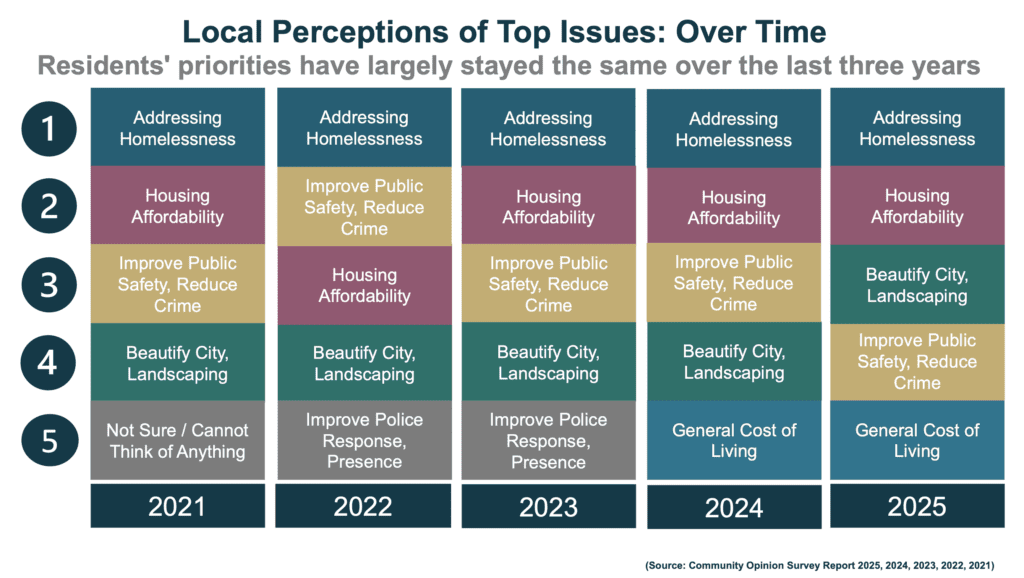
The Feb. 5 budget review session revealed a startling truth: the council knows exactly what we need, yet lacks the political will to execute. Data from the 2025 Community Opinion Survey showed that residents’ top priorities remain unchanged: address homelessness, housing affordability, beautify the city/landscaping, improve public safety and reduce crime and general cost of living.
Budgeting is about priorities, not just math. Take the fiscal year 2025-26 budget: the mayor and council approved $29 million in lost fees and tax breaks for developers. That was a deliberate policy choice to reduce revenue. To put that in perspective, collecting those funds would have reduced the deficit to $6 million — a rounding error of about 0.1%.
Beyond the numbers, we must address the civic circus of community engagement. The May public hearings are a performative exercise of inclusion. Every year, residents share lived experiences only to be ignored in final, back-room negotiations. Since budgets are finalized in June, the narrow window of a few weeks is not enough time to incorporate the feedback of a city of nearly 1 million people.
The disregard for the community’s voice flies in the face of the mandate San Jose voters sent when we passed Measure I in November 2022. Beside ethics, we voted to amend the city charter to require an equity lens in every city budget. Measure I was a promise that our values would be baked into the math. Yet, when $29 million is written off for developers while programs for the vulnerable are underfunded, that equity lens is being discarded.
Additionally, there is a lack of fiscal transparency that cannot be ignored. We are told we are broke while millions of dollars are handed out to those who need them least. It’s time for the city council to trade the scarcity mindset for a transparency mindset.
Our residents deserve a budget that protects the vulnerable and the voiceless, not one that reflects the interests of the powerful. Let’s stop the circus, honor the spirit of Measure I and demand the receipts.
Leave a Reply
You must be logged in to post a comment.