


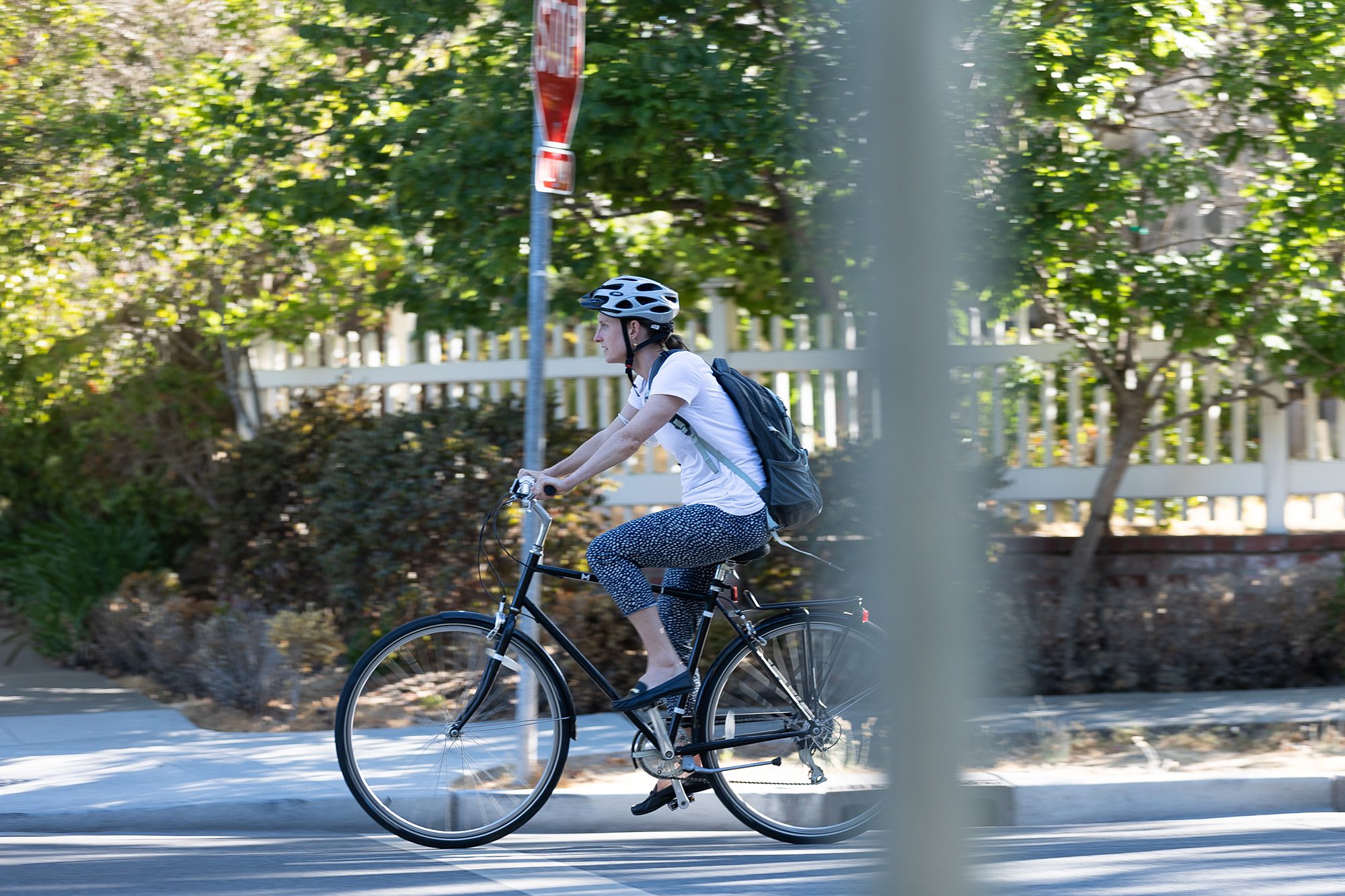
Palo Alto’s most iconic bike boulevard is slated to get a hefty upgrade next year, with city officials approving a suite of traffic circles, curb extensions and other improvements on Bryant Street.
Following nearly two years of design work, analysis and neighborhood outreach, the City Council signed off Monday on a list of road improvements in the Professorville neighborhood. Collectively, they aim to further enhance the allure of Bryant street for local cyclists. Bryant Street made history in 1982, when it became the nation’s first “bike boulevard” behind the leadership of former Vice Mayor Ellen Fletcher.
The newly approved projects include traffic circles at the Bryant Street intersections with Lincoln and Kingsley avenues and an update to the existing traffic circle at Bryant and Addison avenues.
Bryant Street will also be furnished with high-visibility crosswalks between Homer Avenue and Embarcadero Road.
“The key goal is to enhance the boulevard as it approaches downtown and discourage cut-through traffic,” said Ozzy Arce, a senior transportation planner with the city’s Office of Transportation.
The council unanimously approved the package of improvements and directed staff to proceed with the engineering design and phasing plan. The city plans to complete the design work and solicit a construction contract next year.
The Bryant Street projects target a specific area between Homer Avenue and Embarcadero Road. It also includes improvements for Lincoln Avenue, which is one of the busier Bryant Street crossings. California Highway Patrol data showed there were four collisions on Bryant and Lincoln between 2016 and 2024. The city has flirted with the idea of setting up a traffic “diverter” at Bryant and Lincoln to force cars away from Bryant. That idea fizzled under opposition from area residents who did not want to see a diminishment of road access.
Barbara Hazlett, who lives on Emerson Street, lauded the proposed improvements in Professorville. During her four decades in the area, she said she has seen a child on a bike get hit by a car and heard about a neighbor’s cat getting killed by a vehicle. Even so, she opposed the plan to close access to Bryant. She said the city should be focusing on reducing speed rather than on closing certain streets to cars, which could have the effect of driving vehicles to other residential streets.
“If the objective is traffic calming and increased safety, the No. 1 need is speed enforcement on Embarcadero,” Hazlett said. “Cars are driving 50-60 mph or more in 25-mph zones with three schools directly on this border. This clearly should be the focus of the city’s traffic-calming efforts, not street closures.”
The council agreed that reducing speed is a key objective, but there was some debate about the best way to accomplish this goal.
The approved plan employs traffic circles as the primary mechanism for slowing down cars. But as numerous councilmembers pointed out, not all traffic circles are created equals. Some, like the roundabout along Campus Drive at the Stanford University campus, are generally seen as expansive and effective. Others, like the traffic circle on Bryant and Addison have been criticized as too small to be useful.
Hugh Louch, a consultant with Fehr & Peers, assured the council that the plan would upgrade the Addison circle to make it more effective when it comes to slowing down cars. The new traffic circles, he said, would be designed to the higher standards.
Councilmember Keith Reckdahl questioned the need for the new traffic circles and suggested that the city explore speed tables or elevated crosswalks. When he bikes on Bryant and prepares to cross Lincoln, he often sees cars coasting through the stop sign. Speed tables, he said, would be much more effective in cutting speeds than traffic circles.
Councilmember Pat Burt also said he was nervous about “going all in” on traffic circles with two-way stops for traffic crossing Bryant and no stops for those moving along Bryant. He said in many cases, cars at the stop signs either treat them as “yield signs” and cruise along or wrongly assume that other cars similarly have stop signs.
Others were more cautious about reopening the design choices. Responding to Reckdahl, City Manager Ed Shikada observed that traffic calming methods can be “subject to debate forever” and said city staff were looking to proceed expeditiously with the project.
“Quite frankly, if you’re putting new things on the table, it does beg the question of how quickly it can be implemented, what additional community engagement should be undertaken so that those things can be flushed out,” Shikada said.
Burt also took issue with transportation staff eliminating a diverter on Bryant and Lincoln from consideration. That decision, he said, was made based on arguments that the diverter would drive traffic to other streets. That, however, is exactly the point, he said.
“The whole notion that we won’t consider a diverter because it does what it’s supposed to do is a little nonsensical,” Burt said. “It is a valid question of: Would it over-divert traffic, and it is therefore not what we want to do. And that’s a valid question.”
Ultimately, however, the council voted to advance the project as proposed by staff, with additional direction to explore speed tables and a reduction of the speed limit on Bryant.
Este artículo se publicó originalmente en Palo Alto Weekly . Gennady Sheyner es el editor de Palo Alto Weekly y Palo Alto Online. Como antiguo redactor, ha recibido premios por su cobertura de elecciones, uso del suelo, negocios, tecnología y noticias de última hora.

Deje un comentario
Debes iniciar sesión para publicar un comentario.