


|
Getting your Trinity Audio player ready...
|
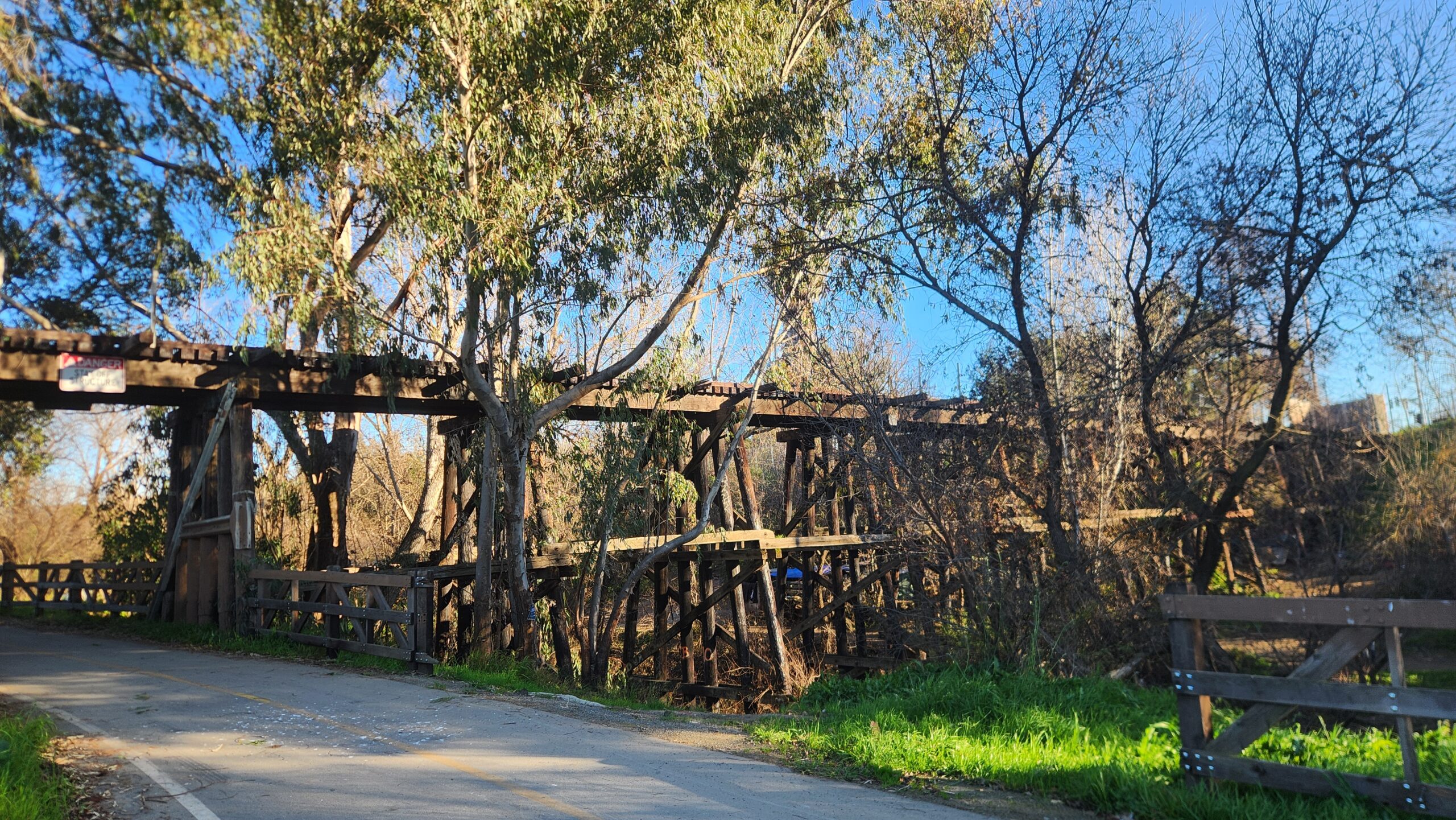
Facing potential delays stemming from a historic railroad trestle marked for preservation, San Jose parks officials have paused plans for the southernmost portion of the planned Five Wounds Trail in East San Jose.
Work on the project — originally envisioned as a 2.2-mile bicycle and pedestrian corridor linking Story Road and Highway 101 — will now focus on first completing the central portion of the trail, which runs from Highway 280 North to Santa Clara Street. The decision leaves open the thorny questions that arose as the city planned the southern end of the trail, a route that runs directly through the Coyote Creek Trestle.
Officials with San Jose’s Department of Parks, Recreation & Neighborhood Services had earlier signaled they favored a plan to demolish the decommissioned timber railroad bridge, which spans Coyote Creek, and replace it with a steel bridge. The proposal prompted fierce opposition from preservation advocates and community leaders.
While organizers behind a campaign to save the trestle are heaving a sigh of relief, residents who live near the proposed pedestrian pathway, including City Council District 7 constituents, said they are disappointed to learn they will have to wait longer for a section of trail that would have provided a faster linkage route between several other transit corridors.
“Once again, District 7 has to take it on the chin. Once again, District 7 doesn’t get anything,” Alie Victorine, president of the District 7 Leadership Group, told San José Spotlight. “That’s a feeling that a lot of times people in this area have felt because it has been neglected in the past.”
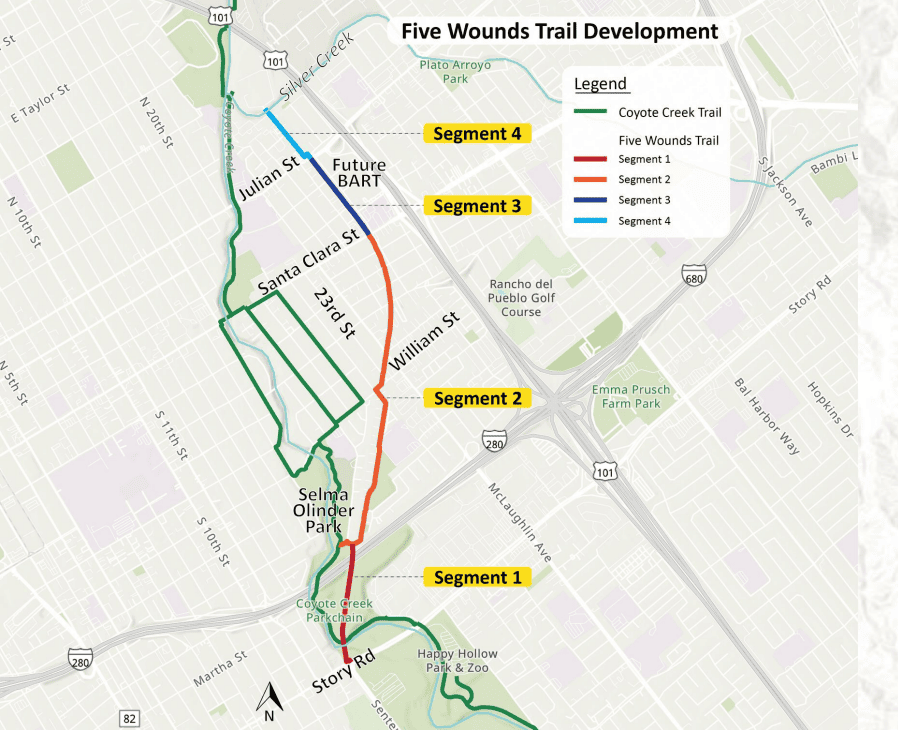
The Five Wounds Trail, which will follow the alignment of the former Western Pacific Railroad right-of-way, has been pitched as a crucial means of connecting the city’s trail network, providing easier access between the Berryessa BART station, the Lower Silver Creek Trail and Coyote Creek Trail.
Parks officials informed residents about the decision to split the project into four separate segments in a July 9 online community update. They said the portion of the trail beginning at Highway 280 will be prioritized because it faces a relatively simple path to completion.
The two northern segments, which extend the route from Santa Clara Street to Silver Creek, run through property owned by VTA. San Jose will need to coordinate work on those segments with VTA as the transit agency advances plans to create the Little Portugal BART station nearby, a project slated for completion by 2037, officials said.
Meanwhile, demolition of the Coyote Creek Trestle, built in 1922 by Western Pacific Railroad, could snarl up work on the southernmost section of the Five Wounds Trail in a sea of red tape. The railroad trestle’s historic status means that any demolition plans would trigger a lengthy review process under the California Environmental Quality Act.
Parks officials maintain the city still intends to complete the southern portion of the trail eventually. However, they said segmenting the project will allow important components of the plan to move forward, even if others hit roadblocks. They provided no timeline for restarting the southern section.
“If we had all the funding and resources to do all 40 miles of the trail network, we would,” Ed Bautista, parks department spokesperson, told San José Spotlight. “But we do have to prioritize the projects that provide the greatest regional benefit.”
Officials project planning work on the trail segment beginning at Highway 280 will be completed by December 2027. No timeline has been set for the construction phase, which will involve costly reclamation work along the former railway path.

Larry Ames, a longtime preservation advocate and member of a committee formed to protect the Coyote Creek Trestle, said that while he’s glad the historic railroad trestle won’t be demolished, he remains worried about its future.
“They have no plans at all to save it, either,” Ames told San José Spotlight. “There are trees that are growing underneath the trestle, and they need to be trimmed because otherwise, in a few years, they’ll just tear the bridge apart. So I don’t want them to do demolition by neglect, which seems to be one of the tricks the city does.”
San Jose’s Public Works Department conducts regular inspections of the trestle and performs maintenance as needed, Bautista said.
Contact Keith Menconi at [email protected] or @KeithMenconi on X.

Leave a Reply
You must be logged in to post a comment.