



|
Getting your Trinity Audio player ready...
|
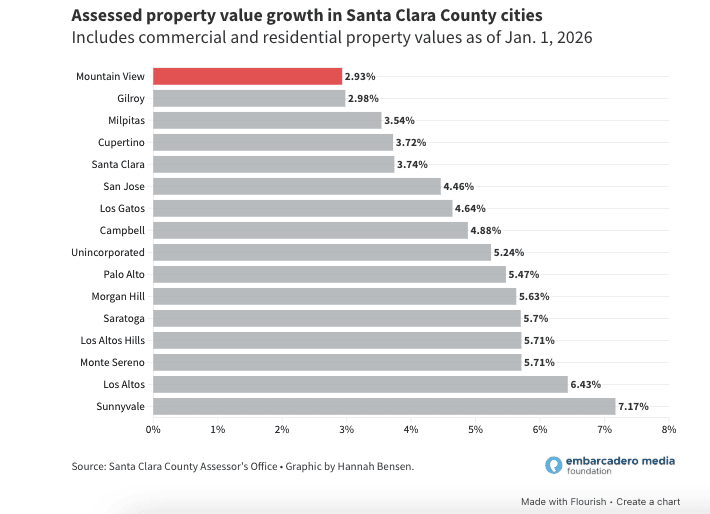
Mountain View saw the most sluggish growth in its property values out of all cities in the county last year, as the commercial office market remained under pressure.
The combined assessed value of commercial and residential properties in Mountain View grew 2.93% in 2025, according to a July 6 report by the Santa Clara County Assessor’s Office. That’s higher than the 0.51% growth that the city saw in the prior year, but both are among the lowest rates since 2012.
Overall, assessed property values in Santa Clara County increased by 4.74% in 2025, with nearby cities such as Los Altos and Palo Alto increasing by 6.43% and 5.47%, respectively.
“We call it a mixed bag,” Santa Clara County Assessor Neysa Fligor said. “There is good residential growth, it’s just offset by what’s happening on the commercial space side.”
Mountain View has the county’s highest percentage of commercial parcels, with 18% of parcels in town designated commercial and 82% residential, Fligor said.
“This greater reliance on a weakened commercial market likely contributes to Mountain View’s comparatively lower rate of assessment growth, especially in recent years,” Fligor said.
The county’s assessment roll is the basis on which local property taxes are levied, which then fund various public services, including local schools. The data reported this week reflects the assessed value of all taxable property in Santa Clara County, as of Jan. 1, 2026.
Sources of tax roll growth
Sunnyvale had the greatest roll growth in the county at 7.17%. Cities largely composed of residential properties — such as Palo Alto and Los Altos — also saw higher rates of growth.
Under Proposition 13, approved by voters in 1978, a property’s assessed value cannot increase annually by more than 2% or the rate of inflation, whichever is lower, unless the property is reassessed because of new construction or a change in ownership.
When a property is sold, the assessed value resets to the market value. Those changes in ownership added $16.9 billion to the property roll. The application of the 2% inflation factor added another $14 billion. In total, the roll grew by about $35 billion, to roughly $760.1 billion.
“With what’s happening in the AI sphere, we are seeing, especially in the high-end markets, people buying residential homes,” Fligor said. “What that tells me about the economy is there is still buying power.”
New construction was another source of growth, adding $4.9 billion to the assessment roll. Construction at major commercial properties included Google and Intuitive Surgical in Sunnyvale and Applied Materials in Santa Clara.
Additionally, data centers have increasingly contributed to roll growth. There are at least 50 data centers in the city of Santa Clara alone, with more centers being constructed in San Jose, according to the report.
“Data centers are valuable properties — the physical property itself, but also the equipment at the site,” Fligor said.
Drags on tax roll growth
These gains were offset by an increase in property value reassessments under Proposition 8. Approved by voters in 1978, a county assessor can temporarily reduce a property’s assessed value when its market value falls below its assessed value. This temporary reduction can happen automatically through the assessor’s appraisal process or from a request by the property owner. A temporary reduction in the appraised value decreases the amount of taxes a property owner is required to pay and remains in place until the market recovers.
Prop. 8 temporary reductions for the county totaled $9.4 billion in 2025, an increase of $3.3 billion from 2024, with 24,727 properties in Prop. 8 decline status, nearly triple the previous year, according to the report.
“We’re definitely seeing a drop there in the purchase price for a lot of these commercial properties,” Fligor said. “What we have happening as a result of these reductions in value is appeals being filed.”
Currently, roughly $153.6 billion of assessed value is under appeal, with 98% of that figure coming from commercial properties, according to the report.
Before pursuing the formal appeal process, property owners can file for a free, informal review of their assessment, Fligor said. Reviews must be filed by Aug. 8.

Leave a Reply
You must be logged in to post a comment.