


|
Getting your Trinity Audio player ready...
|
Santa Clara County transportation projects could be hurt if a regional tax measure to fund public transit is rejected by voters on Nov. 3, but the impact would be less than other parts of the Bay Area — and the details of service reductions are unclear.
Senate Bill 63, also known as the Regional Transit Measure, would increase the sales tax by 0.5% in Alameda, Contra Costa, Santa Clara and San Mateo counties and 1% in San Francisco for 14 years starting April 1, 2027 if approved by voters. It would raise roughly $980 million annually for public transit agencies across the region, with $245 million a year — about 25% — going to VTA.
Proponents claim the measure would prevent deep cuts at Caltrain and BART — the latter of which has warned it might close 15 stations with a 70% service reduction if the proposed tax increase fails. But despite projecting a $15 million deficit by 2027, VTA isn’t hurting as much nor planning any reductions regardless of the measure passing or failing.
“The main impact is that, while VTA is financially stable now, your transit service would not get better if the measure doesn’t pass,” Sergio Lopez, chair of VTA’s board of directors and a Campbell councilmember, told San José Spotlight. “It’s kind of a double negative. We have the opportunity to make improvements that are not the case in other counties (if the measure passes). It’s really much more than just holding still and this would really unlock a lot of possibilities.”
The other two transit agencies serving Santa Clara County are facing more immediate shortfalls, with Caltrain anticipating a $75 million deficit in the coming fiscal year starting next July, while BART expects a $370 million gap in funds.
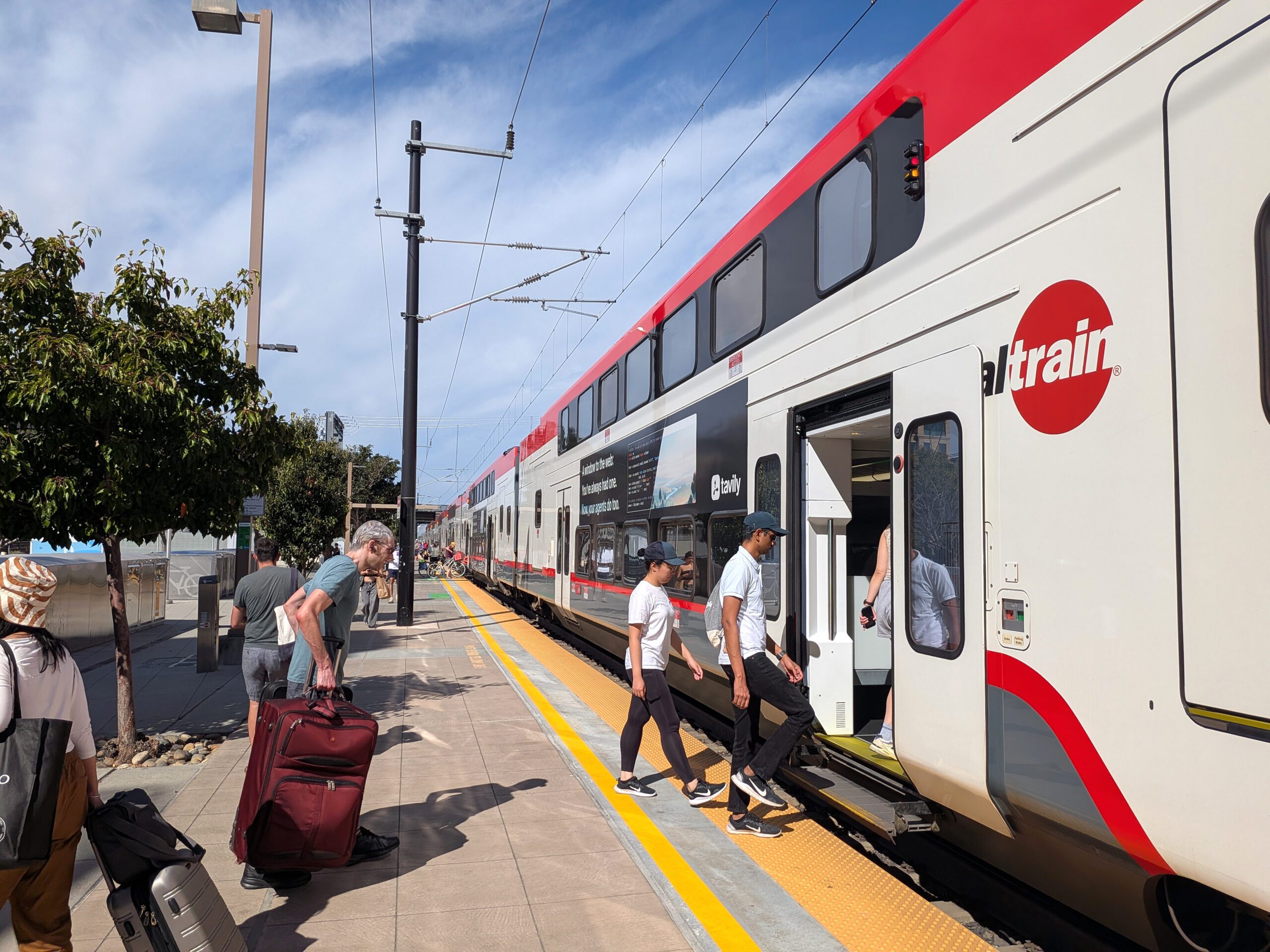
Caltrain, with commuter rail service stretching from San Francisco in the north to Gilroy in the south, has predicted extensive cutbacks starting next summer if the sales tax increase fails. This would include reducing peak weekday service from every 15 minutes to once an hour, ending service at 9 p.m. instead of 1 a.m., closing more than one-third of stations and eliminating weekend service.
“The service to South County (from San Jose through Morgan Hill to Gilroy) would very much be on the table because it has far and away the highest subsidy per passenger, due to low ridership,” Pat Burt, VTA’s representative on Caltrain’s board and a Palo Alto councilmember, told San José Spotlight.
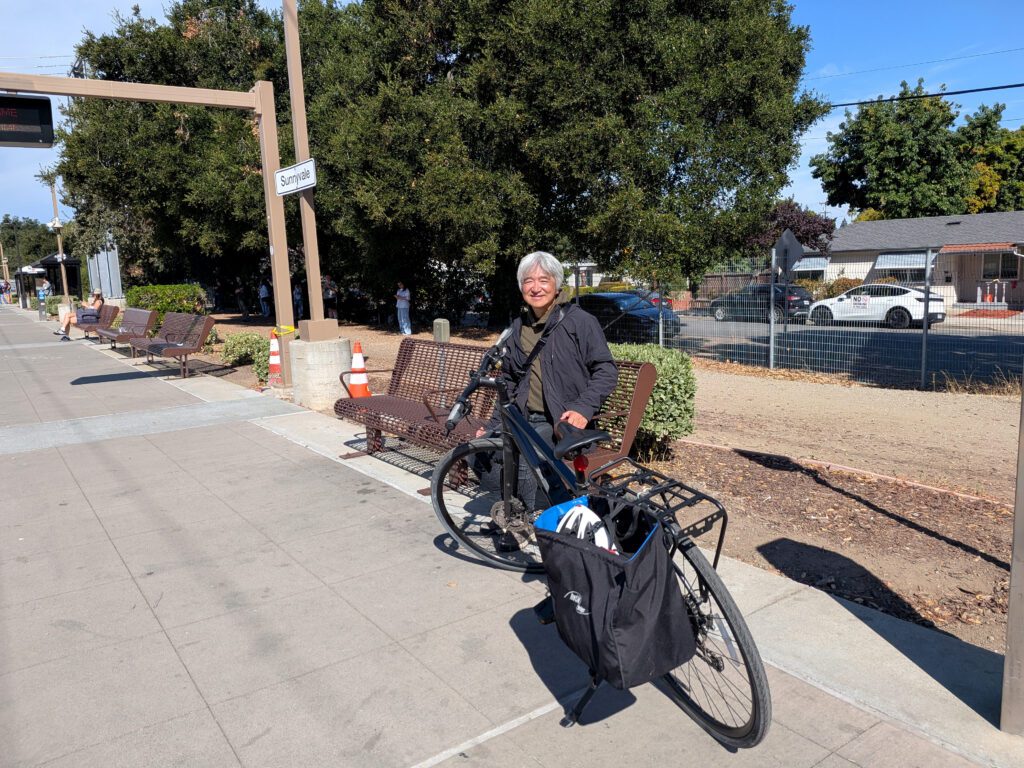
Menlo Park resident Masato Taketomi said he would miss Caltrain’s weekend service as he waited at the Sunnyvale station on Sunday for a northbound ride for himself and his bicycle to Foster City.
“I love Caltrain very much compared to Uber and other forms of transportation,” Taketomi told San José Spotlight. “Trains have character.”
BART is also forecasting big cuts if the regional transit measure fails: Reducing train operating hours by 70% starting next summer, along with a 50% fare increase, closing 15 stations and reducing the length of the system by 25%.
The two BART stations in Santa Clara County — Milpitas and Berryessa/North San Jose — are operated by VTA and are unlikely to be affected if the measure fails. The $13 billion project to extend BART to downtown San Jose and Santa Clara would not receive any money from the transit measure.
But opponents such as the Committee for Affordable Bay Area Transit accuse the transit agencies of exaggerating the impact of budget cuts instead of better managing funds.
“It’s the transit boards giving their worst case,” Thunder Parley, a committee officer and San Jose resident who said he regularly rides VTA buses, told San José Spotlight. “They’re not approaching it from (the perspective of) how to manage their chunk of the $6.2 billion that the agencies will continue to get from existing sources. They’re acting like they’ll be devastatingly broke (if the measure fails), which on that basis is kind of insane.”
Parley cites Caltrain’s South County service as an example of transit inefficiency, which he said subsidizes riders at a cost of about $40,000 each per year.
“In the first year, we could buy everybody an electric vehicle and they could drive it,” he said. “The cost is just out of balance.”

Supporters of the measure counter that transit cuts will increase the number of cars on the road, making traffic jams worse. A SPUR study released last month said the evening commute on the Bay Bridge could take 43 minutes longer than today, although all of the eight bottlenecks cited in the report are well north of Santa Clara County.
“It’s not easy,” Adam Cohen, a senior researcher at the Mineta Transportation Institute at San Jose State University, told San José Spotlight regarding the measure’s impact. “Voters are going to have to trust their gut one way or another.”
Contact Mike Langberg at [email protected].
Leave a Reply
You must be logged in to post a comment.