


|
Getting your Trinity Audio player ready...
|
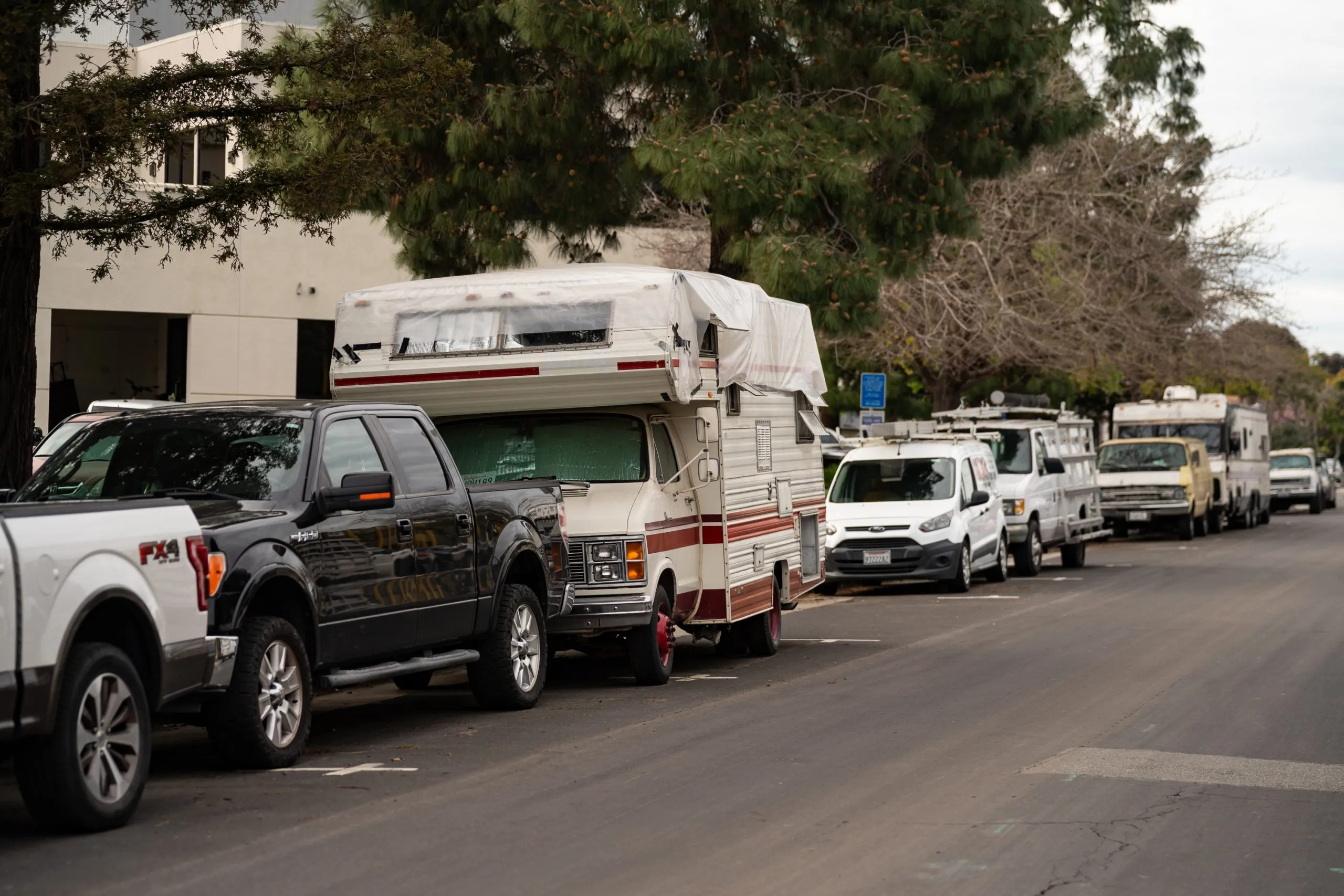
Palo Alto officials deferred a controversial pilot program on Monday that would have concentrated occupied RVs on certain streets in south Palo Alto, following significant uproar from residents.
The City Council unanimously approved the other half of the two-pronged approach and will create a pilot parking permit program for RVs on Coyote Hill Road in Stanford Research Park and Embarcadero Road by the Palo Alto Airport. This program is expected to accommodate about three dozen RVs in total and could begin as soon as March of next year, according to city staff. People living in RVs would be required to participate in case management with the goal of eventually moving into permanent housing.
The permit pilot would cost about $400,000 for the first year and a little more than $200,000 to maintain after that.
However, the vast majority of people who spoke during public comment at the Monday meeting focused on the “alternative sides” aspect of the pilot, which would have allowed hundreds of RVs to remain parked on a single side of the street at select blocks throughout the city before being required to move to the other side for the following six months.
Many residents argued this would exacerbate existing issues associated with RV parking, such as waste buildup, noise, congestion and safety. Others suggested it might make things worse by increasing the density of RVs on certain streets instead of spreading it out around the city.
“We are shocked, offended and outraged,” Barry Katz, who was representing the Ventura Neighborhood Association, said at the meeting. “It’s as if you have not heard one word we have been saying. Worse, you seem to have deliberately ignored and overruled us.”
RV parking has long been a concern for the Ventura neighborhood, and under the city’s “alternative streets” proposal, RVs would be allowed to remain in Ventura and in industrial areas near Highway 101, provided they switch to the other side of the street after six months.
Sections of Olive Avenue, Ash Street, Park Boulevard and Lambert Avenue were all proposed in the initial pilot, which was drafted by staff in coordination with the council’s oversized vehicle ad hoc committee comprised of Councilmembers Julie Lythcott-Haims, Ed Lauing and Keith Reckdahl.
Several people who live on or near the affected streets spoke out against the idea, and many suggested that neighbors in south Palo Alto were bearing the brunt of a city and regional problem.
“Our neighborhoods spend a lot of time self-reporting and self-governing,” resident Shawn Rose said. “It’s a burden on Ventura, and a permanent remedy is long overdue.”
Some people living in RVs who previously spoke to Palo Alto Weekly said the alternative streets idea is good in theory, but the reality is that it could worsen the tension between business owners, residents and RVs.
Francis, who declined to provide a last name, told the council during the meeting that the alternative sides proposal had the potential to displace people. Francis lives in an RV on East Meadow Circle, as do dozens of other people. If parking on the block were restricted to one side of that street, as the proposal suggests, it would force many RV dwellers to move somewhere else.
“I struggle with my mental health, and I’m concerned that new parking restrictions could disrupt my life and displace me from my home,” Francis said at the meeting.
Facing criticism as to how the 13 streets were selected for the pilot, Reckdahl said it was based on the streets that were most impacted by RV parking last year, when the city began rolling out its phased approach to tackle the issue. The streets were chosen for additional sweeping and enforcement at the time and seemed like a natural fit for this second phase, city staff said.
“It’s not like we chose them. The RVs chose them, and we’re trying to give them a release valve,” Reckdahl said. “It’s not appreciated, apparently.”
Hearing the feedback in the chambers, in addition to hundreds of letters sent in advance of the meeting, councilmembers were quick to table the alternative sides idea.
“You not only don’t want it on either side of the street, you don’t want it on both sides of the street, you don’t want it at all, which at this point in time I think is perfectly understandable,” Lauing said.
Councilmembers directed city staff to return later with an updated version of the alternative sides program that eliminates residential areas such as Olive Avenue and Ash Street. The council also directed staff to continue exploring other sites for RV parking locally and in the broader region, as well as to collect data on the demographics of people in Palo Alto who live in RVs.
In the meantime, the city will advance the pilot program for Coyote Hill Road and Embarcadero Road, even as staff acknowledge that it would accommodate only a small fraction of the city’s oversized vehicles.
“(The parking permit pilot) offers the opportunity to come into the regulatory environment, come in from the cold, come in from hiding and running, get a permit and get permission to park here,” Lythcott-Haims said.
This story originally appeared in Palo Alto Weekly. Riley Cooke is a reporter at Palo Alto Weekly and Palo Alto Online focusing on city government.
Leave a Reply
You must be logged in to post a comment.