

|
Getting your Trinity Audio player ready...
|
San Jose is creating development standards for future data center projects, but residents and advocates said they don’t go far enough to protect their health and the environment.
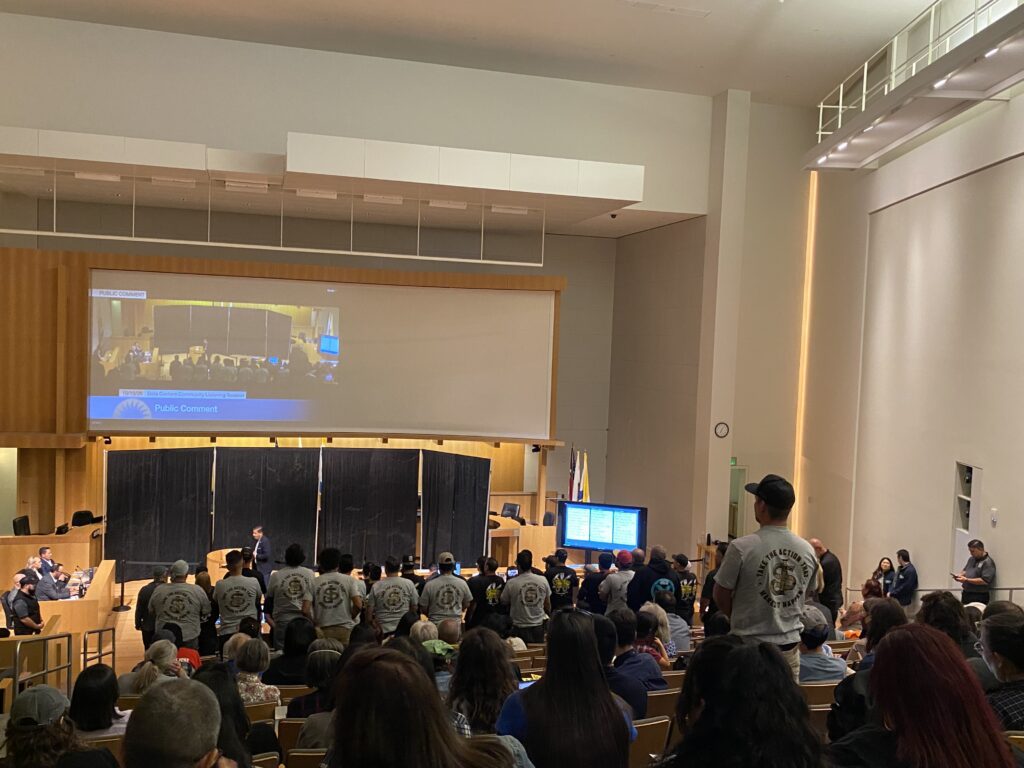
City officials presented the draft standards for the first time Thursday in front of a packed audience at City Hall. Dozens of residents spoke during the public comment portion of the meeting, which lasted nearly two hours. Cheers erupted from the audience as speakers called for a temporary moratorium on data centers until the standards are in place. The City Council is expected to finalize the standards in December.
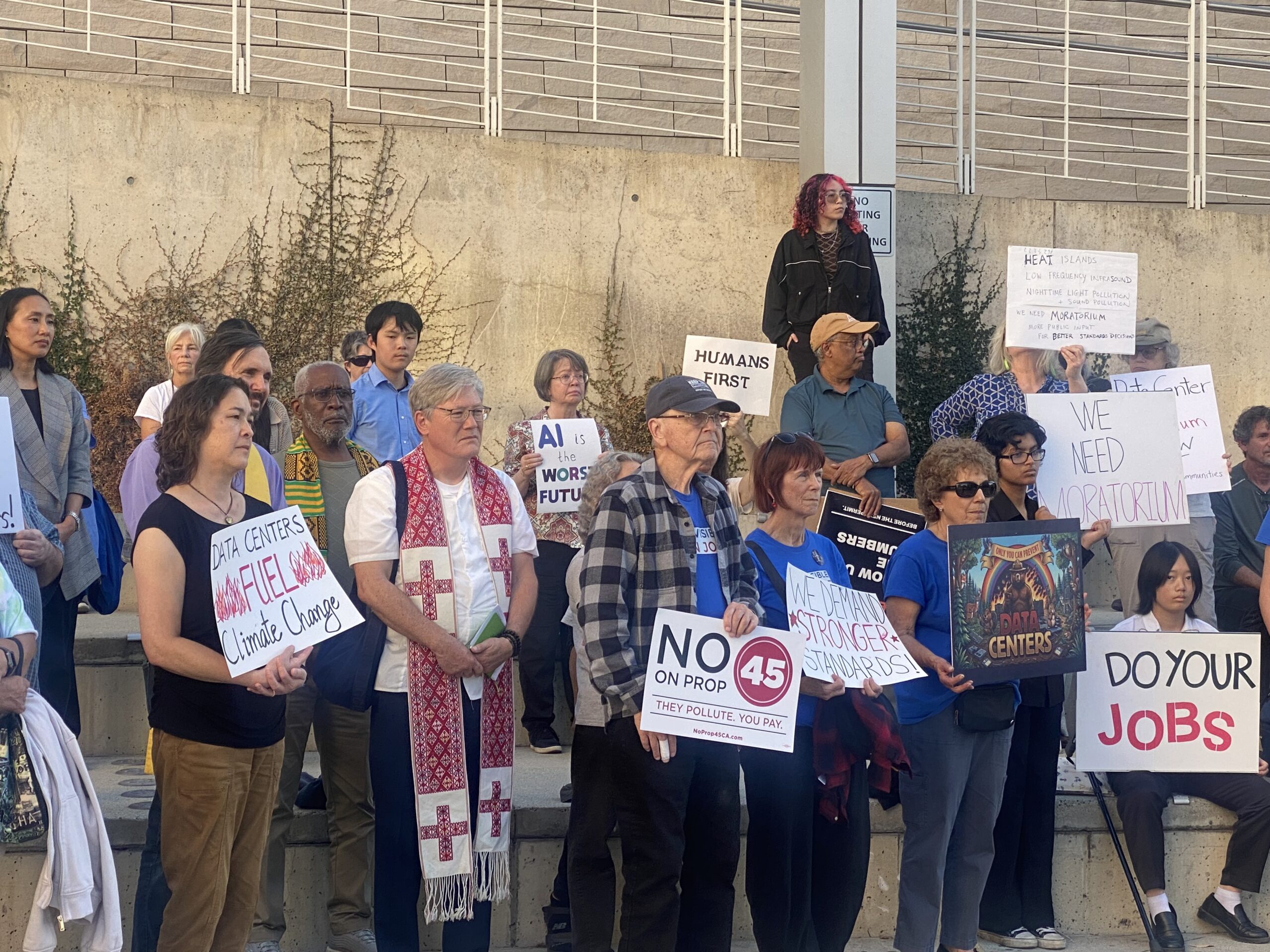
While some speakers such as union representatives supported the draft standards and called for the city to enforce fair wages for workers building out data center projects, other public commenters took issue with what they see as weak environmental protections — and wording in the rules that could let developers skirt city enforcement.
“A lot of community members have told the ways that the standards fall short,” Dashiel Leeds, conservation coordinator for the Sierra Club Loma Prieta Chapter, said at the meeting. “You’re not covering the heat island effect at all. You’re not studying low-frequency infrasound at all. Diesel backup generators can still pollute our communities with nitrous oxide. The data centers getting approved by the planning director and not the city council just is not accountability.”
In the proposed standards, data center developers will be encouraged to enroll with San Jose Clean Energy, which supplies renewable power. If the developer chooses to opt out, it will be required to submit an annual report to prove it’s operating with 100% carbon-neutral electricity, or that carbon emissions are being offset by capturing the methane.
Diesel backup generators must follow the strictest federal emission standards, and can only run when there are power outages, according to the proposed standards.
Data centers use water to cool sensitive electronic equipment. The proposal plans to prohibit open loop cooling systems that use drinkable water and can consume millions of gallons of water a year. Instead, the city will require data centers to use recycled water or a closed loop system that circulates water through pipes to absorb heat from the electronics.
Linda Hutchins-Knowles, co-founder of environmental advocacy group Mothers Out Front Silicon Valley, said the requirement for 100% carbon-neutral electricity is a step in the right direction. She wants a mandate for water to be treated on site before it gets released and more stringent enforcement of these standards.
“So much of these standards, if you look at it, are (using) words like ‘encourage’ and ‘monitor,’” she told San José Spotlight. “There isn’t any teeth. The standards are just not ready. We need the pause (on data centers) so we can get them ready.”
There are two data centers set to be approved before the new standards are finalized, Deputy City Manager Manuel Pineda said at the meeting.
Data center operators will track their own water and electricity usage and submit annual reports to the city, Pineda said. Data centers will also monitor the discharge of dissolved metals and chemicals produced from cooling the equipment, which can pollute local drinking water and rivers if not properly treated.
“You can’t have the fox monitor the henhouse,” Hutchins-Knowles said. “The city needs to be out there monitoring and enforcing it.”
The city will require an independent audit every five years to ensure water and electricity usage fall within the limits the standards will set, and the city can test water quality and usage at any time. Pineda said city officials are open to adjusting how they monitor data centers.
“The data centers standards are not done, so that’s why we’re here because we’re open to feedback,” Pineda told San José Spotlight.
Danny Mangan, a union representative with Sprinkle Fitters Local 483, said data centers provide jobs, and the proposed standards help promote safe and high-quality construction. San Jose’s standards would encourage data center developers to use skilled workers to build these facilities and pay a prevailing wage that includes benefits and overtime.
“We’ve been building data centers right here in the Bay Area for quite some time, and we want to see that continue,” Mangan said at the meeting. “But as long as they’re done correctly … that means good jobs, strong labor standards and a requirement of a skilled and trained workforce in every project of this type.”
As it stands, data centers can be built in San Jose in various zoning districts with a special-use permit, including areas zoned light industrial.
Alice Kaufman, policy director at environmental nonprofit Green Foothills, said if a project is proposed in one of those permissible areas and meets all the standards, then the city council has no legal authority to stop a data center from being built.
She wants the city to consider a change in the zoning law which would allow the council to consider each project on a case by case basis, requiring a data center to obtain a planned development permit. She points to the former IBM Almaden Research Center, which is being acquired by a data center development and investment firm, as an example of why the current policy isn’t working. But Pineda said the city isn’t considering changes in zoning at the moment.
“The IBM Almaden site, which is industrially zoned, is surrounded by hundreds of acres of open space that has rare plants on it, that is used as a wildlife corridor,” she told San José Spotlight. “Right now there is absolutely no way that the city could stop a data center from going on that site.”
Contact Joyce Chu at [email protected] or joyce_speaks on X.
Leave a Reply
You must be logged in to post a comment.