



|
Getting your Trinity Audio player ready...
|
Santa Clara County residents said the news closest to home matters most, but a new survey shows it’s also the hardest to find.
Residents ranked what’s most important in their neighborhood ahead of their city, the county, Bay Area, California, nation and world, according to a survey of 2,031 county adults — of which 52% reside in San Jose — conducted by polling firm Embold Research. Yet more than 40% of Santa Clara County residents said it’s difficult to find out what’s happening in their backyard. Only 23% said the same about national or world news. The research firm describes it as a proximity paradox.
“The things people care about getting information about the most are the hardest to get, and that’s the local stuff,” Andrea Everett, principal researcher at Embold Research, told San José Spotlight.
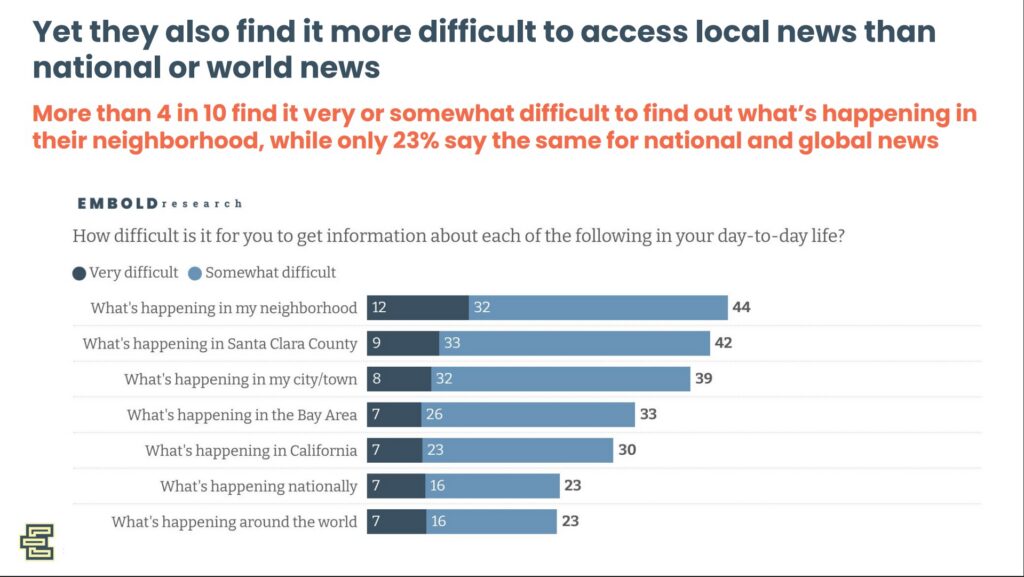
Everett said the pattern has surfaced in every market the firm has surveyed, including Marin and San Mateo counties, Chicago, Illinois and Tampa Bay, Florida. Comparison figures provided by Embold showed Santa Clara County residents rank among the least satisfied with the local information they found on topics ranging from public safety and local politics to housing and education.
“All of us feel as though we’re being inundated with national and international news through the internet,” Gary Hector, vice president of the Almaden Valley Community Association and a longtime Oak Canyon resident, told San José Spotlight. “Trying to find local news requires effort.”
Janine Zacharia, the Carlos Kelly McClatchy advanced lecturer in the Stanford University Department of Communication, said Santa Clara County’s media landscape is thinner than it looks.
“We need many more reporters,” Zacharia told San José Spotlight. “The Mercury News is a shadow of its former self. They have a fraction of the reporters they used to have out in the field.”
The widest gaps between how residents rated local topics and how satisfied they were with available information pertained to civic issues. Local political information was rated important by 84% of residents, public safety was rated at 91% and emergency preparedness at 89%. But the satisfaction levels were much lower at 42%, 52% and 51%, respectively.
A separate question shifted from news topics to 10 everyday situations respondents may face, such as when a crime occurs near them or when local and state policies or laws change. The survey asked residents how satisfied they were with their ability to get this information as needed. Satisfaction barely outpaced dissatisfaction on both — 39% to 34% on crime and 37% to 34% on policy changes.
The most common obstacle for residents was not knowing what information to trust, at 40%, ahead of information that was incomplete or lacked detail at 35% and paywalls at 32%.
“When news moved to the internet, people got used to clicking on stories for free and didn’t want to pay to get through the paywall,” Zacharia said. “You know what’s free? Pink slime media and advertising and posts by your great uncle on Facebook.”
Pink slime refers to sites built to look like local news outlets while pushing political or even corporate agendas.
Where residents obtain their news varies by age. While online search was the most useful source overall at 44%, residents 65 and older leaned on local television, while people ages 18 to 34 turned to friends, family and content creators on social media.
Hector said residents have told the association they don’t feel equipped to speak up on projects that deal with zoning and density proposals in their own neighborhood. He said they blame it on less local news.
He added news outlets that once wrote about a single city now cover a much wider area.
“You don’t feel that connection that you once had,” Hector said. “Many of the smaller newspapers have succumbed to the economic pressure that you get from the internet.”
Contact Gabriel Symkowick at [email protected] or @SymkowickGabe on X.
Leave a Reply
You must be logged in to post a comment.