


|
Getting your Trinity Audio player ready...
|
There is no shortage of challenges — and solutions — facing Silicon Valley, according to community leaders and elected officials who spoke at San Jose Spotlight’s fourth annual political festival known as PolitiBeat.
The day-long series of panel discussions on Aug. 7 at the Hammer Theatre in downtown San Jose explored knotty topics ranging from housing and homelessness to public education, data centers and artificial intelligence in the workforce to immigration policy and preserving open space in South County.
“Events like PolitiBeat remind us that democracy is not a spectator sport,” Michael Fox Jr., Goodwill of Silicon Valley CEO and chair of San José Spotlight’s board of directors, said in his opening remarks. “It does not just happen at City Hall. It works best when we show up, when we ask the tough questions, challenge ideas and policies, listen, disagree and, in the tradition of former President Ronald Reagan and Speaker of the House Tip O’Neill, enjoy a glass of Irish whiskey afterward.”
An Aug. 18 San José Spotlight podcast episode highlights two of the panels on data centers and the planned ICE facility near Gilroy.
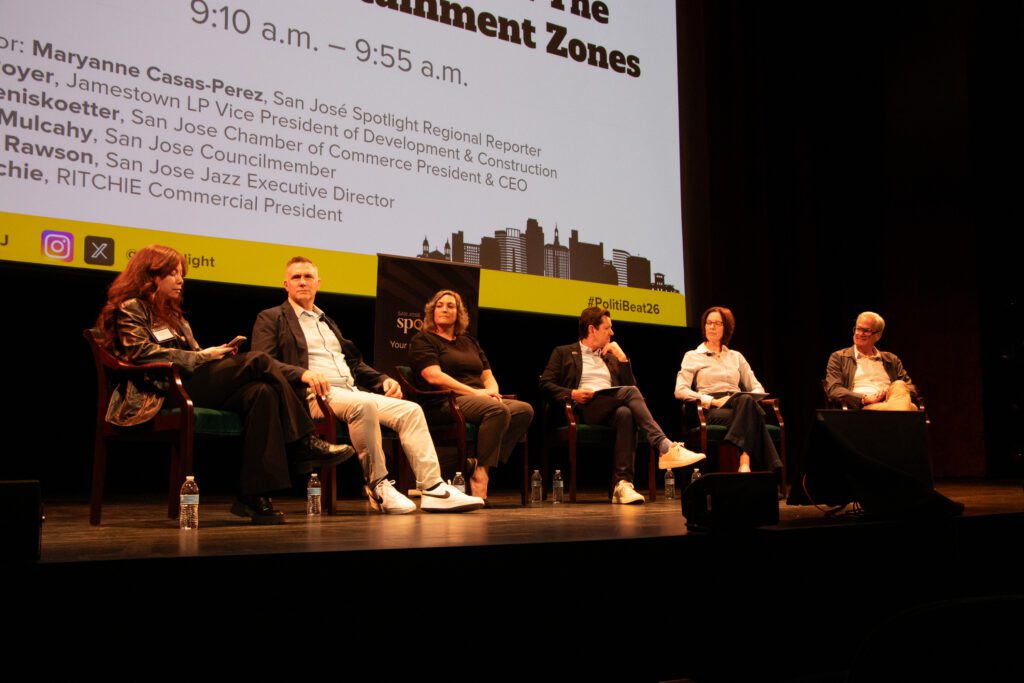
PolitiBeat 2026 kicked off with a discussion on San Jose’s entertainment zones — six parts of the city’s downtown core where alcohol is allowed to be sold and consumed in public plazas and streets during special events. The City Council approved the zones to help San Jose capture revenue from visitors during the Super Bowl and World Cup.
Panelists said entertainment zones can be more than just a few streets where alcohol can be legally consumed in public — they can be an opportunity to recreate cities.
“I don’t see this as booze for everyone,” District 6 Councilmember Michael Mulcahy said. “This is not about how much booze we can sell. This has to be organized in a way where it really is about branding the city, (showing) that we’re open to this kind of activity. It’s about engaging the businesses that are storefronted right in these zones, and it’s about creating community.”
The huge turnout this summer for World Cup watch parties in downtown San Jose shows the demand for “the experience economy,” Rachel Royer, vice president of development and construction at Jamestown LP, said.
“Those kinds of experiences can’t be replicated online,” Royer said. “Those are things you have to come and experience with other people in a place that has been created, with all of these other elements that we’re talking about, music, art, parks and the live community around you. It doesn’t need to revolve around alcohol.”

The next panel focused on data centers and how Silicon Valley is planning for projects in the pipeline. Some panelists said data centers are an unavoidable necessity for the future of AI, but there are no quick solutions to the huge demand they create for electricity and water.
“These solutions will take time,” Will Chueh, director of Stanford University’s Precourt Institute of Energy, said. “They will be expensive before they are not. … It’s very important to make sure that investments are being made on the innovation aspect, so when the time comes to scale them, then we’re ready to do so. And I think this is where California can really lead in a strong way.”
Masheika Allgood, an AI ethicist and founder of AllAI Consulting, countered that optimism.
“While there are innovations, there are always trade-offs,” she said. “The fact of the matter is none of this stuff is free. … You have to recognize these solutions are not quick and easy and that it will take effort from a rulemaking process to make those solutions the day-to-day reality.”
One example Allgood cited is backup power for data centers. Diesel generators create air pollution and noise, but replacing them with high-tech batteries introduces the risk of fires that are hard to extinguish.

A talk on the region’s information needs followed the data center discussion. Santa Clara County residents value local news about their neighborhood and city above the nation or world, according to a survey by San José Spotlight and partner organizations — yet they have a hard time finding it.
“The further away (news is), the less important it is, the easier it is to get,” Andrea Everett, principal researcher at Embold Research, which conducted the survey of 2,000 residents in July, said. “We have taken to calling this the proximity paradox. It’s something we’ve observed in surveys we fielded in other places recently as well.”
The problem, panelists said, is a decline in mainstream local media and the distractions of “clickbait” news in social media feeds.
“The long game here is that we’ve got to fix the distribution channels,” Chandran Sankaran, founder and CEO of Gigafact, said. “In the meantime, anyone who is a good journalist has got to be wildly effective in reaching audiences where they live on social media, and not to think of that as someone else’s problem.”
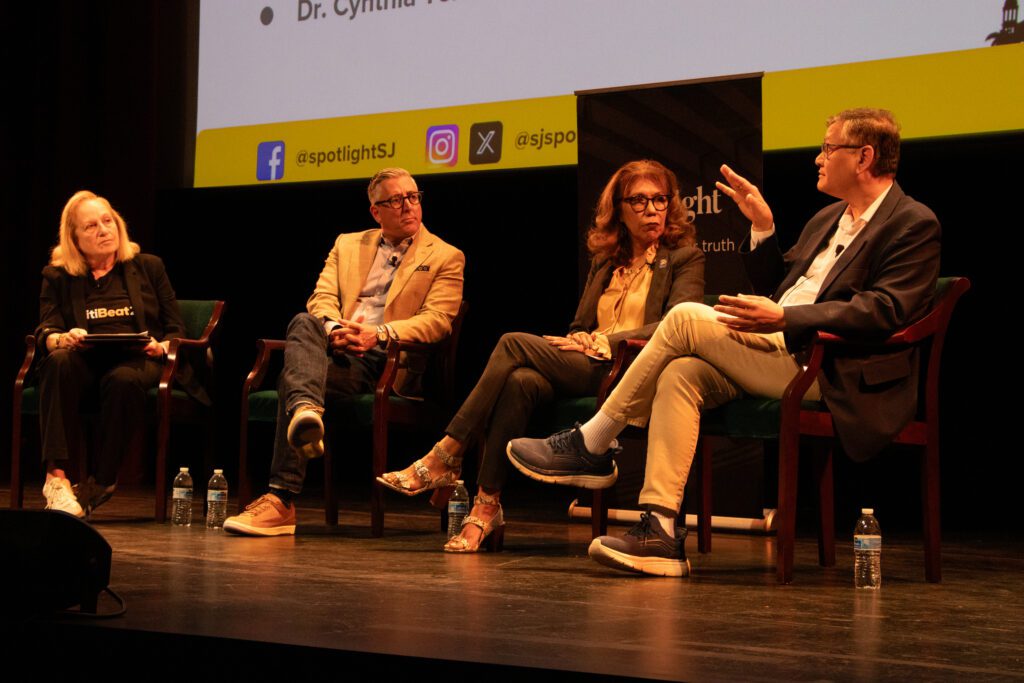
Artificial intelligence is drastically remaking the world of work, according to panelists speaking on the topic of AI in the workforce, with special challenges for newly minted college graduates looking for their first job.
“Career ladders are getting broken,” Anshul Sonak, Intel Corporation global director of digital readiness, said. “I think we need to foster and create new opportunities. … Instead of just talking about this issue as extreme hype or extreme horror, you have to find a middle path of hope.”
Colleges and universities are responding by incorporating AI in their curriculum and by training students to be their own advocates.
“It’s important that students or recent graduates understand how to market and position themselves,” San Jose State University President Cynthia Teniente-Matson said. “The other piece is ensuring our graduates and all of our students have current internship opportunities and project-based learning opportunities in their classes that they’re transmitting into the interview process. Our students are getting jobs across the board because they’re ready for the workforce that’s occurring here.”

Local political and community leaders have been nearly unanimous in condemning a proposed U.S. Immigration and Customs Enforcement (ICE) facility near Gilroy, most recently through a lawsuit seeking to stop the project. County leaders discussed their strategy during a panel on the proposal.
“This is the wrong place and the wrong process,” County Counsel Toni LoPresti said. “(The federal government is) running roughshod over the law and pretending that they don’t have to comply with it. We were lucky to have the mandate from a board of supervisors that’s willing to engage and fight back and to be able to hold them accountable in the courts. And we’re confident in our chances of success.”
Immediate concerns include an inadequate septic system at the site, which could cause water pollution, and toxic waste left over from the site’s former use for agricultural research. The bigger concern is whether the facility signals a move toward broader immigration enforcement in the region.
“As news of this (facility) spread back in April, it felt like a wave of shock, a wave of grief and then panic,” Working Partnerships USA Movement Building Director Rebecca Armendariz said, noting Gilroy’s population is 59% Latino. “Folks are staying home (and) uprooting their families out of our schools. … Some of them are moving, trying to figure out which community will keep them safest at this time.”

The region’s longstanding housing crisis took center stage in a panel with housing officials and policy experts.
Silicon Valley’s stratospheric housing prices are choking the local economy and contributing to homelessness, but housing advocates said they face entrenched resistance to new ideas.
“The concept of self-interest keeping the price (of housing) up because of scarcity is very real,” DignityMoves founder and CEO Elizabeth Funk said. “Even realtors have an incentive to make sure that not enough housing is produced because then it stays expensive and they get the higher commissions. The answer is to disempower the opposition, and we can only do that if we have zoning rules and so forth that are carefully and correctly written. The special interests have got to be silenced.”
Panelists called for more public spending on housing, and pointed out that only 20% of Silicon Valley residents who qualify for housing vouchers receive them. But changes are underway, such as the new California Housing and Homelessness Agency that is looking to accelerate construction of affordable housing.
“We’re really excited about this,” SV@Home Director of Policy Alison Cingolani said. “The pots of money that help to fund affordable housing are (now) sitting in all kinds of different state agencies, (which) adds time and adds cost for developers. Bringing everything together in one agency has a lot of promise (and) we could conceivably see a streamlined single application for all of these funding programs.”
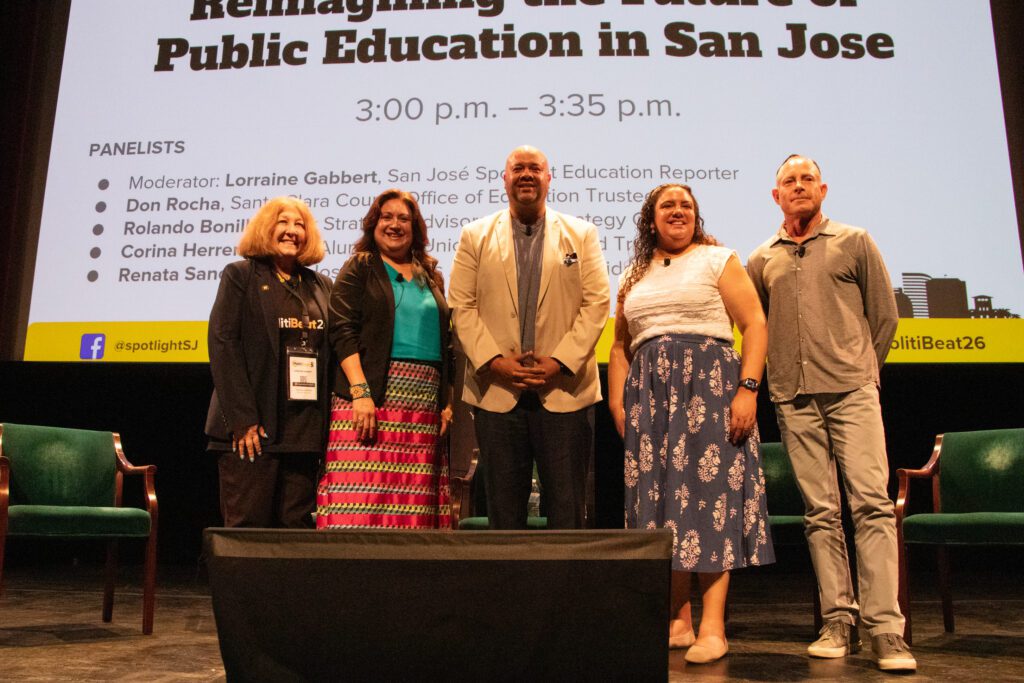
School districts in Santa Clara County are in turmoil because of inadequate funding, declining enrollment and tug-of-war disputes for resources between parents and teachers. A panel of education experts dissected the issue.
“(State leaders) claim that we’re fully funding education and we aren’t,” said Don Rocha, a trustee with the Santa Clara County Board of Education. “There’s a reason why you see school districts having to go out for parcel taxes and bond measures. That’s to fund the shortfalls that the state has continued to do year after year, decade after decade.”
Declining enrollment, in part due to the high cost of housing in Silicon Valley pushing out young families, is causing school closures that further fuel fights between parents, teachers and school boards.
“When your board meetings feel like a WWE WrestleMania pay-per-view you aren’t focused on the bigger issue,” Rolando Bonilla, chief strategy officer for Voler Strategic Advisors, said. “The (fights) are the symptom of the disease. The disease is simply California is not funding its public schools. … We have to unify and have a collective conversation saying, ‘Sacramento, pay us dollars.'”

Open space in Santa Clara County, especially Coyote Valley in South San Jose, require constant vigilance to be maintained. That’s according to two panelists who spoke about the work to preserve green areas in the region.
“Once you make land use decisions, you can’t take them back,” Kathy Sutherland, chair of the Santa Clara Valley Open Space Authority, said. “It’s very important that we preserve our natural lands now, because once they’re gone for development, nobody else has that opportunity.”
The authority’s reach expanded significantly in June with passage of Measure D, which boosts the agency’s annual spending from $10 million to $29 million. Community organizations are also helping, with public pressure recently contributing to the cancelation of a 40-acre battery storage facility in Coyote Valley and ongoing support for agriculture.
“Here in Santa Clara County we have a whole lot of small farmers who are trying to grow crops sustainably in ways that benefit the earth as well as feed all of us and give us produce isn’t covered in pesticides,” Alice Kaufman, policy and advocacy director for Green Foothills, said. “I wish more environmentalists thought of farming as a good thing and not (always) as big agriculture, as something that’s the enemy.”
Contact Mike Langberg at [email protected].

Leave a Reply
You must be logged in to post a comment.