

|
Getting your Trinity Audio player ready...
|
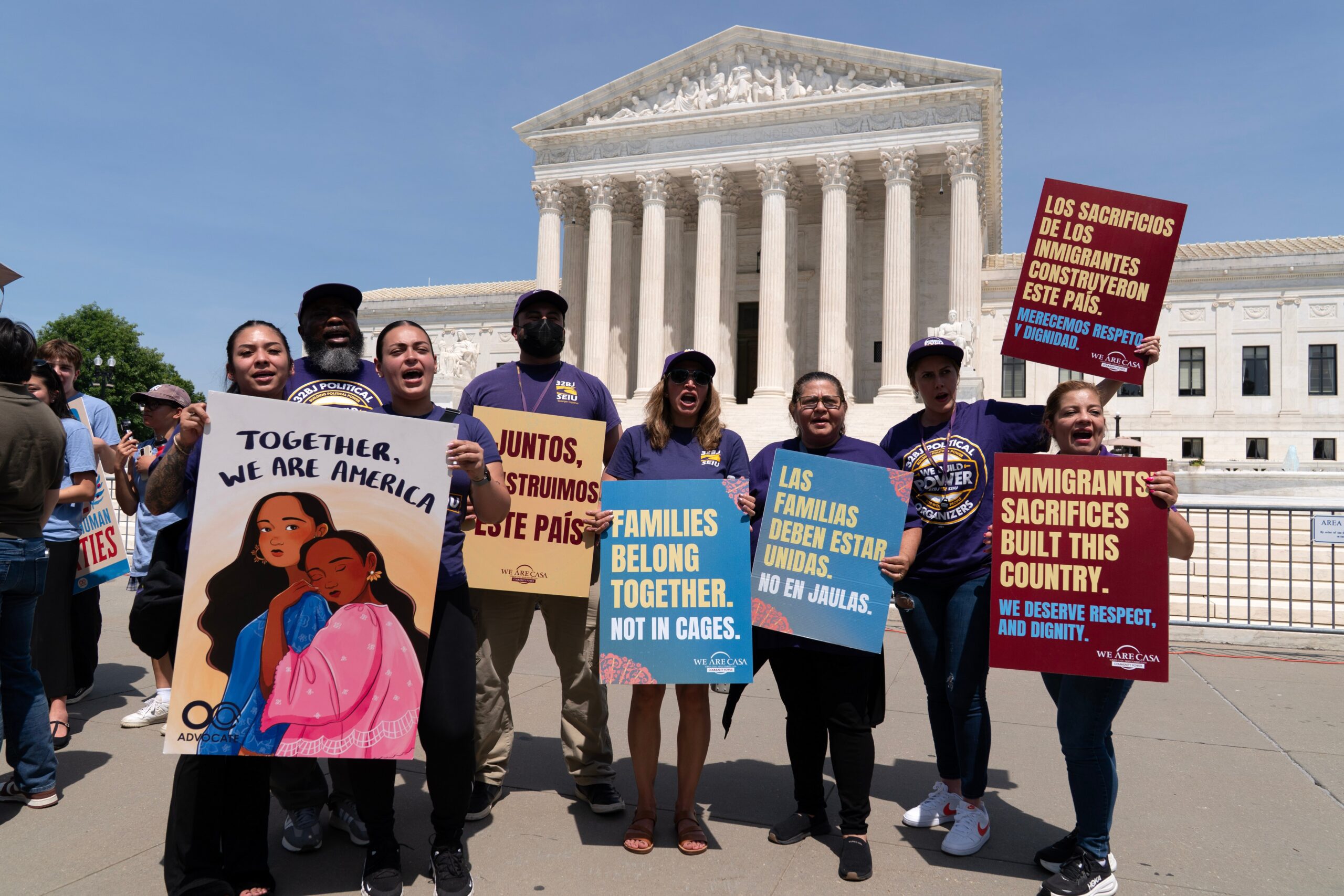
For more than a year, immigrant families across Santa Clara County have wondered whether a constitutional right that’s existed for generations would disappear after a Supreme Court ruling. Tuesday’s decision brought relief to many, but advocates said the fight over birthright citizenship is far from over.
The U.S. Supreme Court in a 6-3 ruling rejected President Donald Trump’s executive order seeking to end automatic citizenship for some children born in the United States. The decision reaffirmed the longstanding interpretation of the 14th Amendment’s Citizenship Clause. Justices Clarence Thomas, Samuel Alito and Neil Gorsuch voted in favor of Trump’s executive order.
Trump signed the executive order Jan. 20, 2025, the first day of his second term, prompting Santa Clara County to file a federal lawsuit 10 days later arguing the order violated the 14th Amendment. The Supreme Court agreed to hear the case months later, and advocates said the months leading up to Tuesday’s decision created uncertainty for many immigrant families.
“We can breathe a sigh of relief that birthright citizenship was upheld. But this decision isn’t made in a vacuum,” Huy Tran, executive director of the Services, Immigrant Rights and Education Network (SIREN), told San José Spotlight. ”The fact that this right is being attacked means that we can’t take anything for granted.”
Birthright citizenship, established under the 14th Amendment, grants automatic U.S. citizenship to nearly everyone born in the country regardless of their parents’ immigration status, with limited exceptions.
“People who come to the U.S. for work or school or are asylum seekers — our process can take a while,” Tran said. “Throughout the process, people fall in love, they have families and those kids become citizens through birthright. The families can establish themselves and find some stability.”
For Victor Vázquez, executive director of SOMOS Mayfair, the debate over birthright citizenship revived memories of California’s Proposition 187, the 1994 ballot measure that sought to deny public services to undocumented immigrants.
“I grew up during the Proposition 187 era,” Vázquez told San José Spotlight. “This brings memories of people trying to vilify and take away our rights as U.S. citizens, especially the children of immigrants.”
Vázquez said the months leading up to the ruling created anxiety among people who questioned whether they truly belonged in the country despite being born here.
Jessica Paz-Cedillos, CEO of the Mexican Heritage Plaza and a San José Spotlight columnist, said the decision reaffirmed a principle that extends beyond immigration policy.
“Birthright citizenship reflects one of our nation’s most enduring promises: that every child born here belongs here,” Paz-Cedillos told San José Spotlight. “At the Mexican Heritage Plaza, we see everyday that our diversity is our greatest strength.”

Santa Clara County Supervisor Sylvia Arenas also welcomed the ruling, noting the county was among the first local governments to challenge Trump’s executive order in federal court.
“I am incredibly proud that Santa Clara County was among the very first to fight back by filing our own federal lawsuit to halt this unconstitutional overreach in its tracks,” Arenas said in a statement.
While advocates celebrated the ruling, Tran and Vázquez said they remain concerned the issue could face future legal and political challenges.
“To me, this is a direct attempt to disempower immigrants, particularly the Latino community,” Vázquez said. “A lot of our young people who are born here will be the next lawyers, the next presidents, the next future leaders of this country.”
Contact Maryanne Casas-Perez at [email protected] or @CasasPerezRed on X.

Leave a Reply
You must be logged in to post a comment.